Note, transcription performed by AI and may contain minor mistakes.
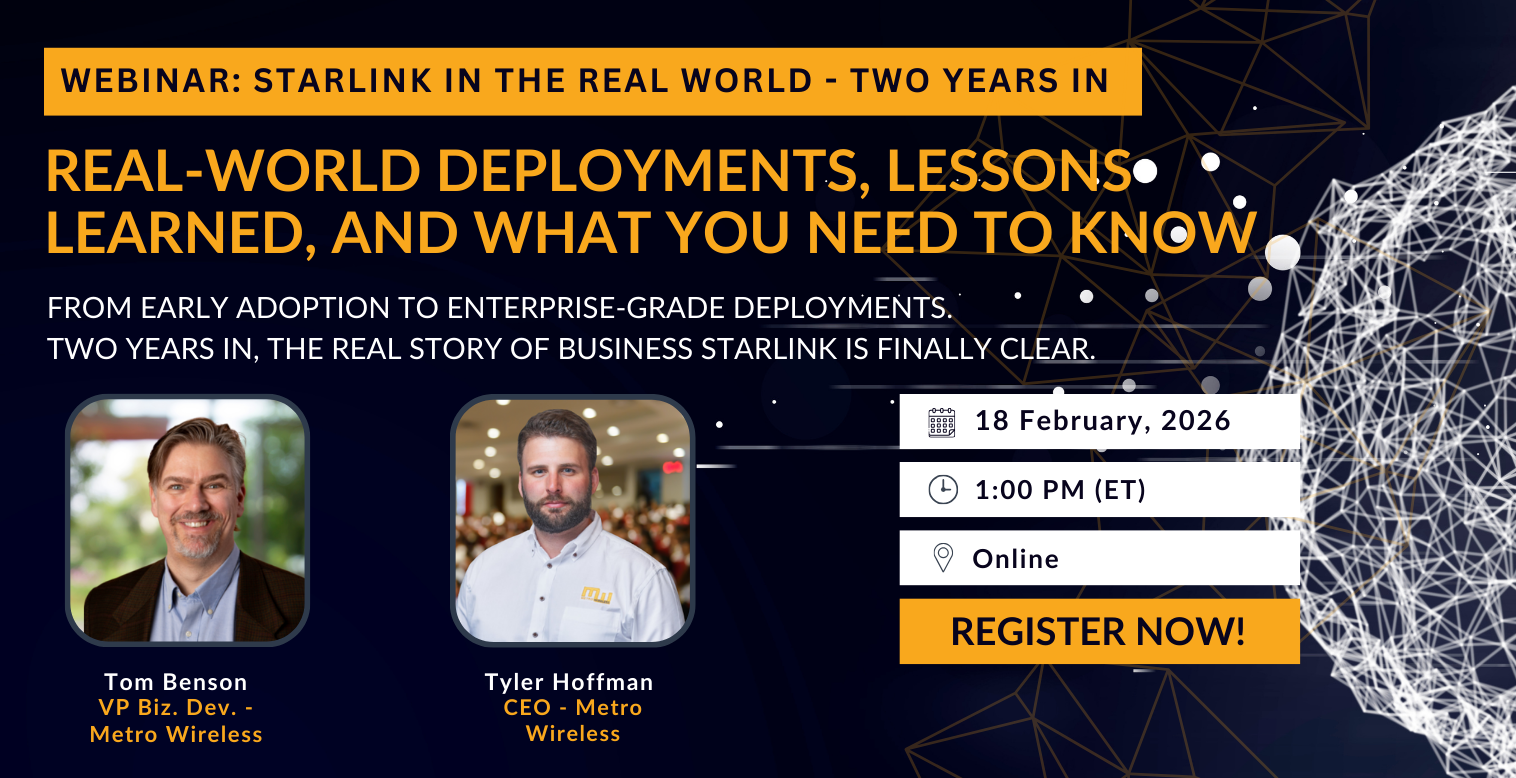
Tyler Hoffman: Awesome. All right, so we’ll go ahead and get started, folks. So, today we’re here to talk about Starlink. I’m joined by Tom Benson, who is our VP of Business Development. Tom’s been with us two years now, but he’s been in the channel working in wireless for—is it almost 13 years, Tom, if I got it correctly?
Tom Benson: Yeah, 2013 or 14, something like that.
Tyler Hoffman: Wonderful. Yeah, so Tom is what I call the "Wireless Wizard." And so the topic of our first webinar for this year is Starlink in the Real World, two years in. You know, Starlink in the commercial space has really now been around for two years. Obviously, it’s been around in the residential space a little bit longer on the consumer side, but really from a true penetration perspective, Starlink’s been with us about two years. And so today we want to discuss kind of what we’re seeing happening now two years in: what are best practices and deployments, and what the pricing models and the changes that Starlink has are. We’ll be teasing some things at the end. And so Tom, with his crystal ball, is going to be sharing a lot of knowledge today for our partners.
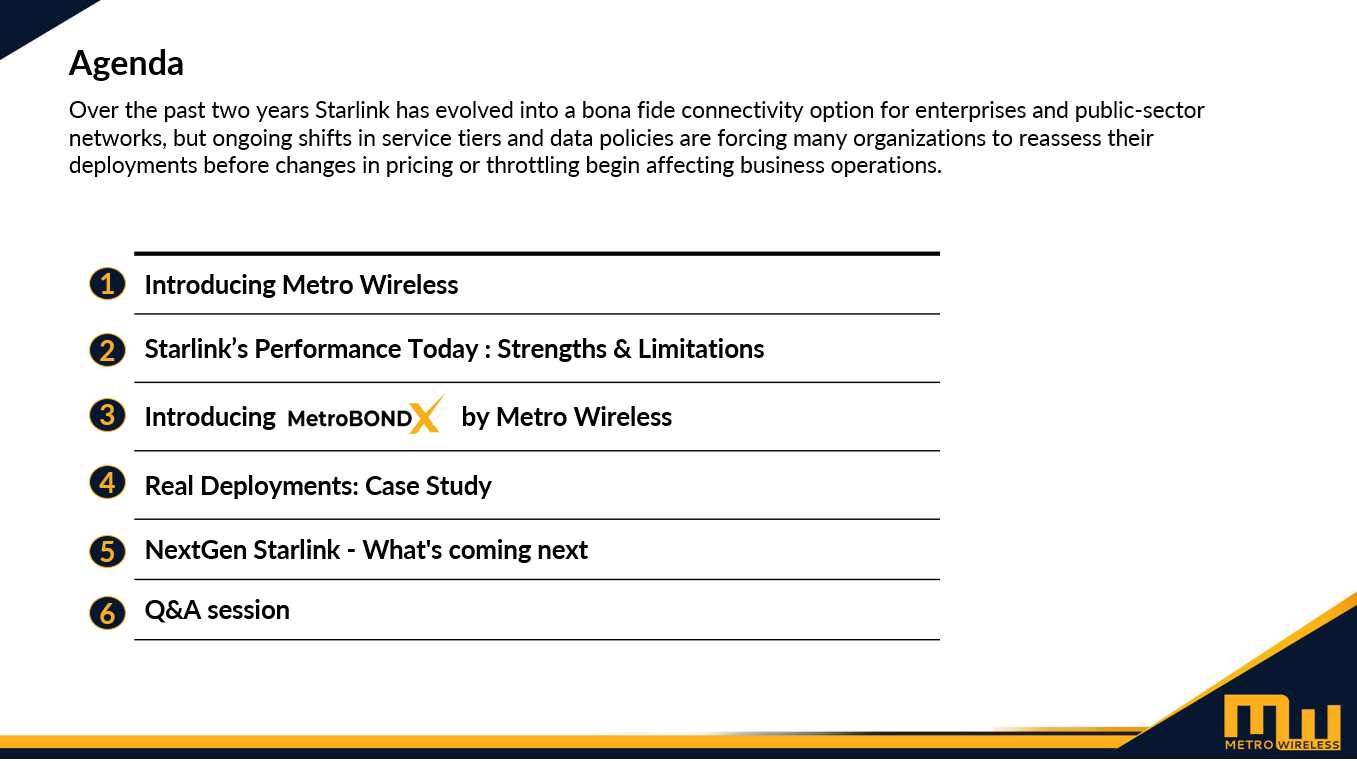
Tyler Hoffman: So, just to give you a sense of our agenda today: For those who don’t know us at Metro Wireless—I recognize most of the faces—but we will reintroduce Metro Wireless to a lot of you just briefly and tell you about who we are and why we have credibility and authority in the space. We’ll talk about Starlink’s performance today. Tom will talk about strengths and limitations. Again, he works every single day with partners talking about when Starlink is a good fit, and he’s very honest when it is not a good fit. So, we’ll talk about the limitations as well.
We’ll also talk about our premium option in the space, that’s our MetroBOND offering—just to tease that, that’s our Peplink-bonded Starlink and 5G offering that’s been a huge success for us in the last two years. That’s a Tom Benson creation, and we’ve been grateful to have that product with us. We’ll also walk through a case study. So, Tom worked with an oil and gas client that is now a client that has 13 or 14 sites with us; they just came on board last year using the MetroBOND offering. Really good MRC (Monthly Recurring Charge), obviously a great commission in the channel there, and so we’ll talk about that for a really nice wireless deal. And then at the end of the conversation, before the Q&A, I’ll talk about what we’re hearing about what’s coming next down the pike for Starlink regarding speeds and things of that nature. There are some conversations that I’m privy to there. So, that’s the agenda for today.
Tyler Hoffman: Some quick housekeeping matters: Just like all the webinars we’ve done so far, your microphones are muted by default. However, we want this to be a collaborative conversation. So, please use that chat window, and please submit questions via the Q&A. If someone could submit a test question to the Q&A just to make sure that’s working—we believe it is, but it would be appreciated to make sure that we do have the Q&A bar going.
All the questions for the Q&A, please feel free to submit them during the webinar and during when we’re discussing; however, we will save answering those questions for the end just to be respectful of the team there. And then, this session is recorded. So John Lynch, to answer your question, we are going to record this session today like we typically do. It will be posted on our website with the full transcription. We’ll also be sending out the slides, some additional marketing collateral, and of course, our sales team will reach out to you one-on-one to see if there’s an interest in discussing with you or your clients after this call as well. So, that’s the run of house for us here today for housekeeping. If you have any technical issues, Ibrahim is our marketing director; feel free to send him a note and he can help you with the AV needs there. All right.
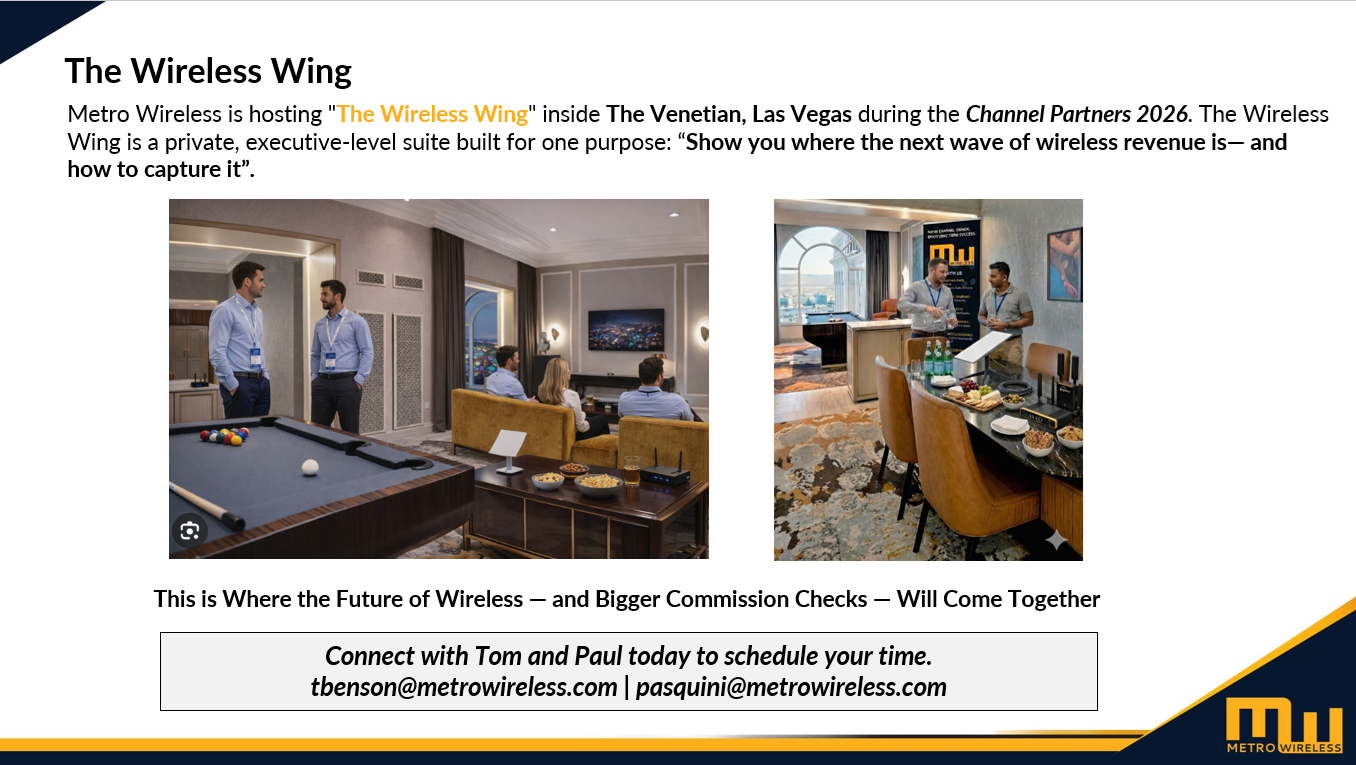
Tyler Hoffman: So, to also tease something else—this is a little bit of a surprise for any of our channel partners that are attending Channel Partners this year. In lieu of a booth, we decided to do something a little bit different. We’re going to call it "The Wireless Wing." We’re renting out a big suite in The Venetian during the Channel Partners Conference this year. The idea is that we want to take care of our partners in a more intimate setting that’s a little bit more fun than a traditional table or a booth that you might see on the expo floor hall.
And so we’re bringing in a lot of products, a lot of our Peplink devices, Starlink products, our DAS (Distributed Antenna System) offering, and I believe we’re going to have some private cellular network hardware there as well from our team. We’re going to be doing, of course, drinks and snacks and things like that, and coffee and what have you. And then we’re going to be doing two formats. We’re going to be having open office hours—say for happy hour on Monday, and during the day on Tuesday and Wednesday—but if you want to schedule a private conversation, there’s a calendar link where you can schedule a 30-minute private demo with your channel manager, either Tom Benson or Paul Pasquini, who will be there to kind of schedule a private conversation to do kind of a business review if you’re an existing partner with us or just to learn more about our offering if you’re a new partner for us. Tom, did I miss anything on the Wireless Wing?
Tom Benson: No, Wireless Wing is going to be cool.
Tyler Hoffman: Yeah, I’m excited. It’s our first year doing it. I’ve seen a couple other smaller providers do it in the past and it was a big success, and so I’m really excited. You’ll start to see LinkedIn and email communications going out in the next few weeks here, and don’t be surprised if you guys get personalized one-on-one emails about it too. So, we’re excited.
Tom Benson: All right. We know we’re competing against Vegas, guys, but step away from the insanity. Stop by and say hello.
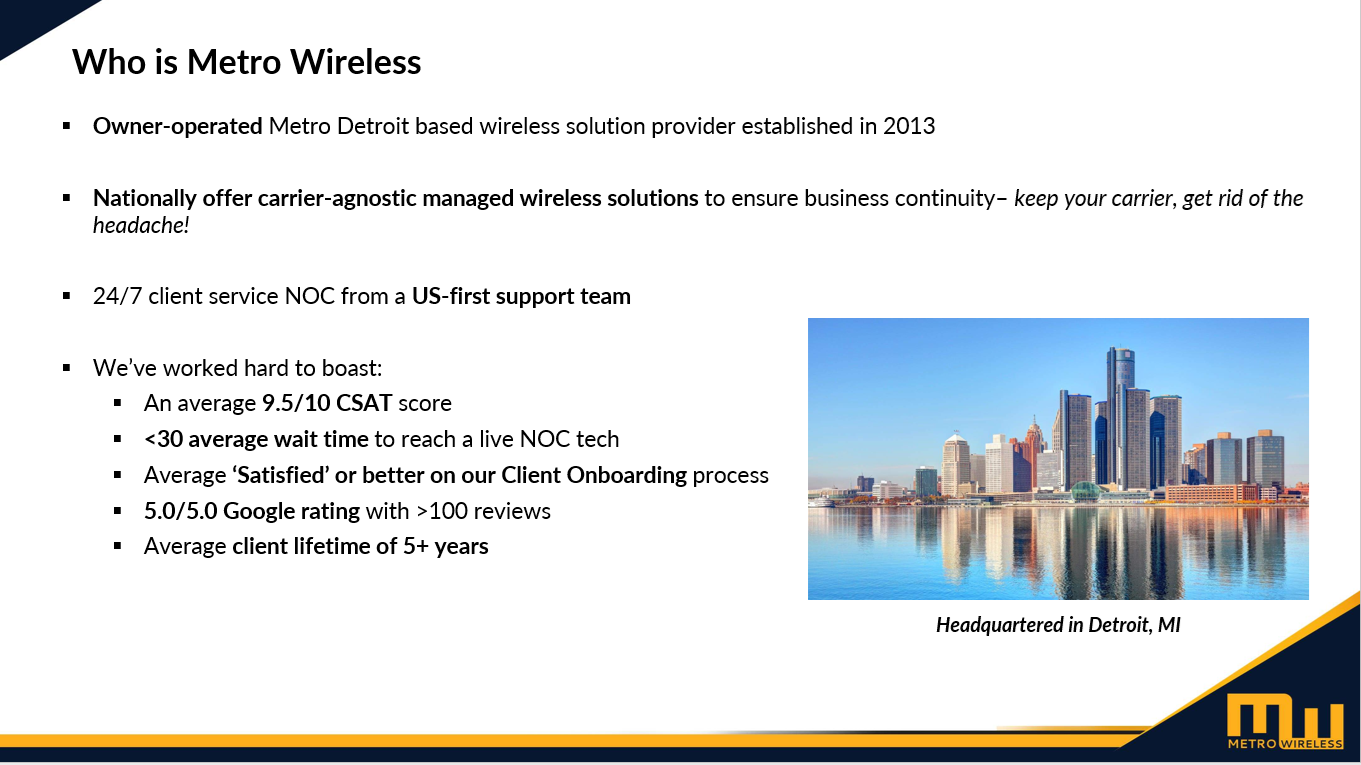
Tyler Hoffman: Yeah, it’s going to be a more relaxed environment than the show floor and all of that. So, we’re excited to kind of mix it up a bit. So, we are Metro Wireless. You know, just to kind of re-establish who we are: I’m Tyler Hoffman, the CEO and owner here at Metro Wireless. We’ve been around since 2013, so about 13 years at this point. And what we pride ourselves on is being the premium wireless provider in the U.S.
We offer carrier-agnostic solutions, and what we mean by that is whether it’s a Verizon SIM, a T-Mobile SIM, an AT&T SIM, a Starlink, or whatever—whatever that carrier is for the last mile is less important to us; we offer whatever is best for the client and the partner. And so we offer managed wireless solutions to make sure that you have nearly perfect uptime and continuity. A little casual slogan that we like to say is, "Keep your carrier, but get rid of the headache." And so we offer a managed, value-added approach to wireless, and that’s what we’re good for.
We offer a 24/7 NOC (Network Operations Center) from our U.S. team here, and we work hard to boast—and when we say we, it’s really the team; I can’t take credit for this. We track customer satisfaction scores on every ticket; we average 9.5 out of 10 on those. We also take a look at our NOC call wait times; we average less than 30 seconds to reach a live technician from our team. Take a look at our Google reviews; we have an average of 5 out of 5 with over 100 reviews, and we’re lucky to say that clients average over five years of tenure with us. Onboarding is another thing that we track with our survey, so we’re very lucky that clients like to work with us and our partners do too. We rely on that repeat business. So, we’re proudly headquartered in Detroit. If you guys are ever in town, please give us a call. The first slice of Detroit-style pizza and your first beer is on us, so please give us a ring if you’re ever in town.
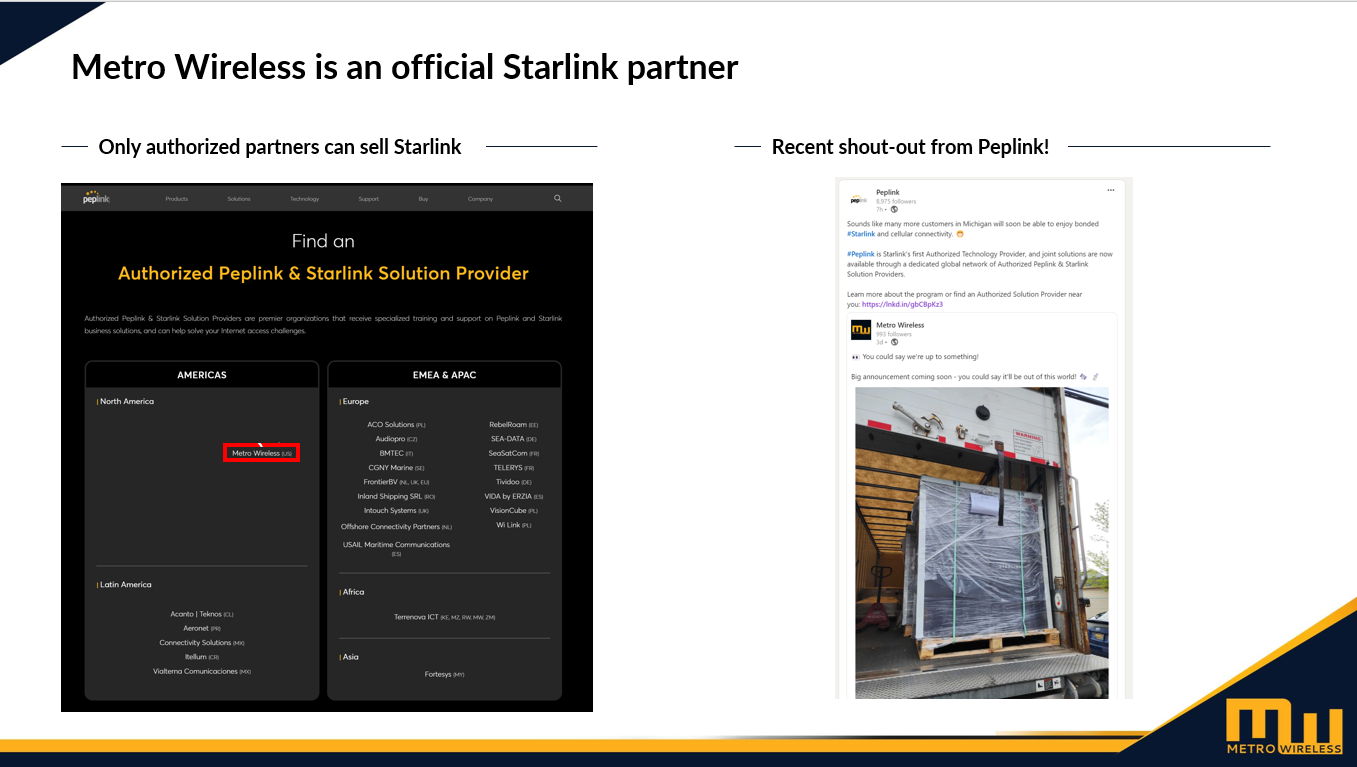
Tyler Hoffman: The big piece today—and again, given that we’re talking about Starlink here today—it’s important to know that Metro Wireless is an official Starlink partner via the Peplink consortium, as we say. So, we’re a big partner with Peplink; we have been for a number of years. If you’re not familiar with Peplink, Peplink is very similar to a Cradlepoint. We like Peplink for a few reasons: they’re very rugged and durable, they have a really high-quality offering, and they’re also very affordable compared to Cradlepoint, so we can pass those savings onto partners and to our clients, which is really great.
Two years ago now—I can’t believe it’s been two years, Tom—we joined the Starlink solution provider offering. And so, there’s only so many companies that are allowed to do so in the U.S., and even fewer that are part of the channel, but we’re one of the few authorized partners that can sell Starlink. That’s something you want to be mindful of if you’re a partner vetting your vendors and suppliers: you really want to make sure... there are some fly-by-night companies out there that are not official Starlink partners that are not allowed to resell. We’ve heard of some shutoffs and some issues from partners working with certain vendors. I won’t name any, but just make sure you’re working with an authorized Starlink partner.
But we’ve been really successful with them. So, Peplink—we like the cut of their jib, as I had mentioned—and Starlink’s been really successful for us, and we’ve been doing it two years. And to talk to you more about that is Tom, who is really the boots on the ground and sees all the deal flow and all that fun stuff. So, Tom, I’m going to turn it over to you to talk about what Starlink does well and then we can talk about its limitations as well.
Tom Benson: Yeah, I just ran into one two days ago. A company... your first clue that they’re not authorized is they’re not willing to put Starlink on the bill and they don’t want to talk about Starlink. I just ran into one yesterday at a campground. They claimed to have put four Starlink satellites out and they said, "It doesn't work well during the weather." Well, Starlink works just fine during the weather. So, I have no idea if that was Starlink or not, but the campground thought they were getting Starlink and the agent brought it to us.
We went back and said, "Okay, we can give you a true Starlink solution," and now we’re working through that because the customer, understandably, is very leery. They’re of the mind, "Well, Starlink doesn't work." And I can’t tell you how many times I’ve seen this in wireless. 5G doesn't work, 4G doesn't work, Starlink doesn't work. It works great if you work with a good partner. If you work with someone who’s not, and they think... I can’t tell you how many times I’ve seen this. So, you can tell when it’s quality, and so we’d like to present a quality approach and we’ll go from there.
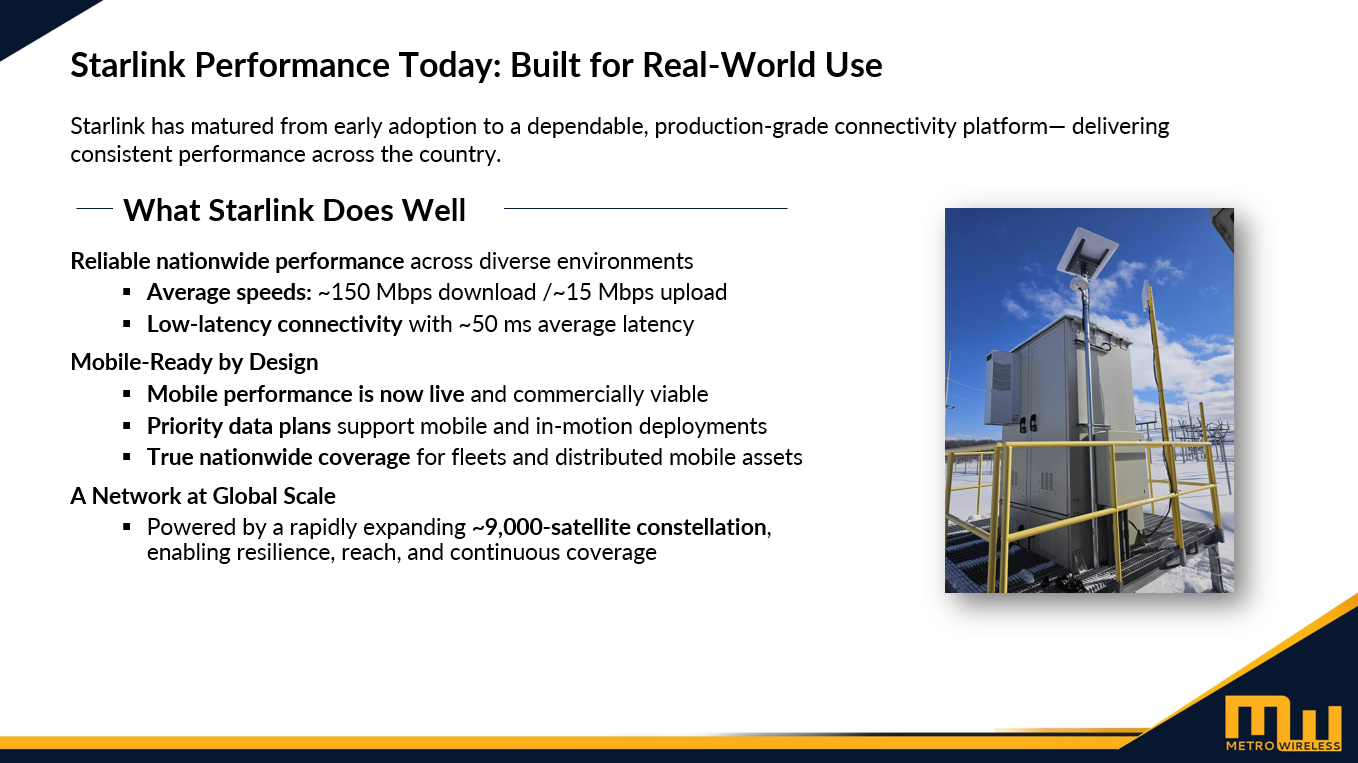
Tom Benson: So, talking about Starlink and performance today and being built for real-world use: Starlink has matured and it’s sort of a good news/bad news situation. We know what happens with Starlink. This is not really open for debate. We know what happens with Starlink. And so here’s what does happen with Starlink that’s positive: We’re seeing about 150 megabit download on average. Starlink maxes at 220 as we sit today. There are some changes coming, but as we sit on the spec sheet, it’s 220 with the dishes that are commonly available. 220 is pretty aspirational at this point. I just don’t see a lot of 220 on deployments. I see a lot of 150. I see a lot of 170. I see a lot of 135. Call it 150, but you can count on it. 150 is pretty much going to be there. If you can see the sky, you’re going to get 150. And you don’t really have to worry about regionality anymore. It works in Florida—you know, it used to be a northern-based thing—but it works in Florida, it works in Arizona. It works.
Tom Benson: And then the upload on this is about 15. And so they’ve tuned it for 90% download and 10% upload. Max is 22, but 15 is about what you’re going to see, and latency is in the 50-millisecond round trip. So, that is a reasonable performance business network that you can use for your customers. And it can be used in a number of different ways. The satellite config is up to 9,000 now; it was 5,000, I think, when we started this two years ago, so they keep putting them up in the sky. So, this is a reliable business network that many, many people are moving over to. It’s just one more tool in the toolkit. So, that’s all the upside for Starlink.
Uptime, I should mention as well, is good, but not perfect. Starlink’s had four outages in the last two years that are measurable, as well as micro-outages, but four system-wide, nationwide, worldwide I guess—well, I don’t know if they were worldwide, that’s not important—U.S.-wide outages. So, that’s been established too. Bottom line, they’re just another network and they’re not perfect, but they’re good. Okay, next slide, please.
Tom Benson: Here’s the downside. Starlink does what it does, and then—and I think this is almost reflective of Elon, if you follow Elon at all. Elon is stubborn and he’s mercurial and he’s opinionated, and that’s just who Elon is. And so this Starlink is classic. Like, they do what they do and they don’t even pretend to do what they don’t do, and they just don’t do it. And I really feel like that sort of reflects the mind of Elon.
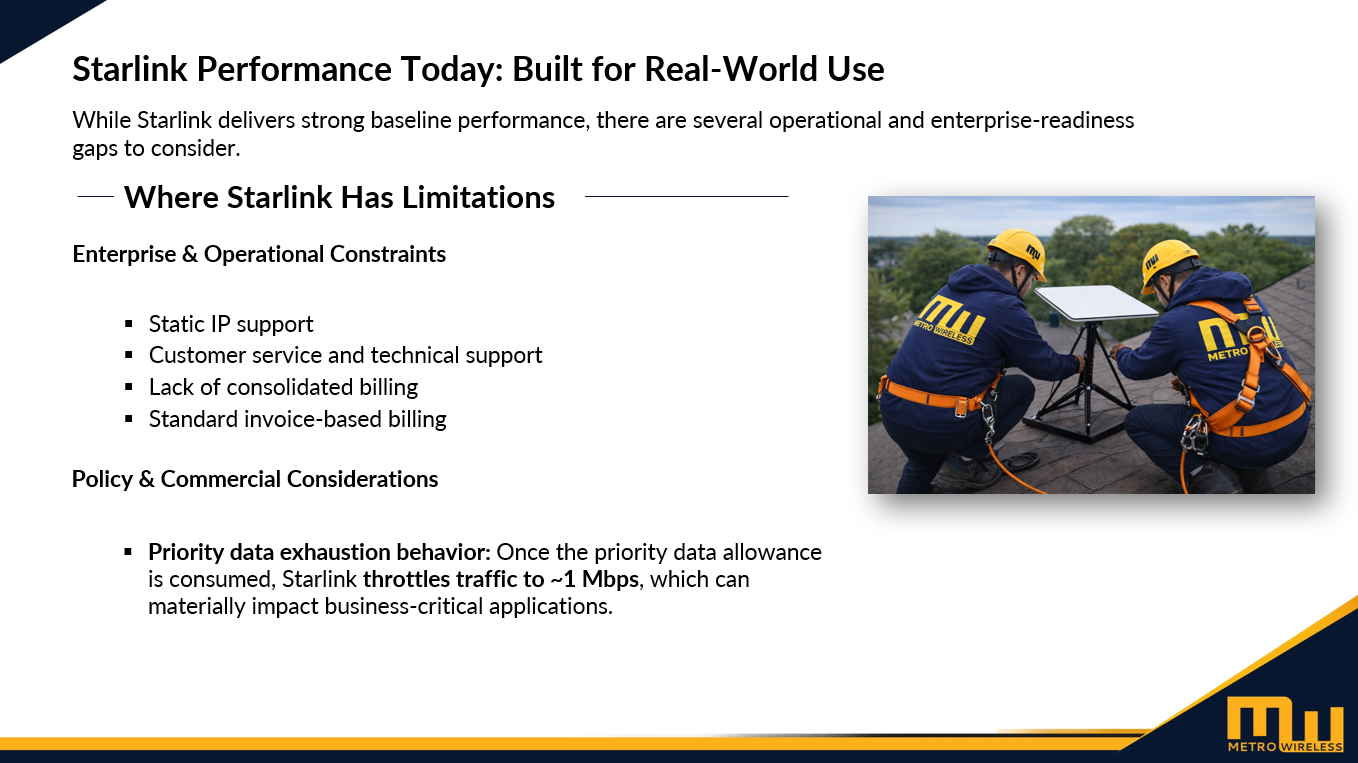
So, number one: you cannot get a static IP on Starlink. And this is also not open for debate. It just doesn't exist. There’s a "persistent IP," and a persistent IP is not a static IP. If your Chief Information Security Officer wants a static IP, you cannot get it. There’s no subnet, there’s no mask, there’s no gateway. It should stay the same, but it can change. And so it’s just not a static IP. We can provide this at Metro because we’re an ISP in Detroit operating a fixed wireless network; we have our own ASN (Autonomous System Number) and so we can provide static IP quantities of 1, 5, or 13. That sets us apart from most people. And so I’m just going to say it again—yes, we can deliver a static IP. I don’t know if we’re the only person in the channel who can do this, but we’re close. We’re close. So, it’s just true.
Tom Benson: Then customer service. If you go to Starlink direct, it just doesn't exist. You can’t call Starlink. They won’t talk to you. And we’ve talked to people who have 150 stores across the country, 200 stores across the country, and Starlink won’t call you back. Starlink has essentially outsourced business services to the reseller channel. That’s my opinion, but that’s what I’m seeing. It is that "we do what we do, we operate a network, and the things we don’t want to do, you just do those for us."
So, consolidated billing, value-added services like static IP, pooling services if you’d like to do that, 24/7 support, getting ahold of somebody, doing troubleshooting—these are all the things that they’ve outsourced. And if I add up those things, to me, that’s what makes a business-grade circuit. Performance is great, and without performance, you have nothing, of course. But on top of performance, you have to have billing, and you have to have support, and you have to have consolidation, and cost-center billing, and all the other things that people need in order to make it fit inside their business. And so that’s where the authorized resellers step in and fill that gap. We’re not the only authorized reseller, but we’re very good at it, and we do this every day.
Tom Benson: One other thing that I’ve held to for the 13 years I've done this is: if you work with a wireless company, you should work with a wireless company that does it full-time. It’s not an add-on, it’s not auxiliary, it’s not a me-too. It is their full-time profession because wireless is hard. And it just is. And so you want to do this all the time and get used to troubleshooting things and not give up when it gets hard.
Tyler Hoffman: Well said. And yes, Steve, you did hear pooling. Pooling is available if it financially makes sense. I would like to have direct conversations with people because we want to get into the math, but yes, pooling is a possibility for multiple things on Starlink, but it’s just money, and I want to make sure that we’re actually saving people money by going to pooling. And that requires getting out the spreadsheets.
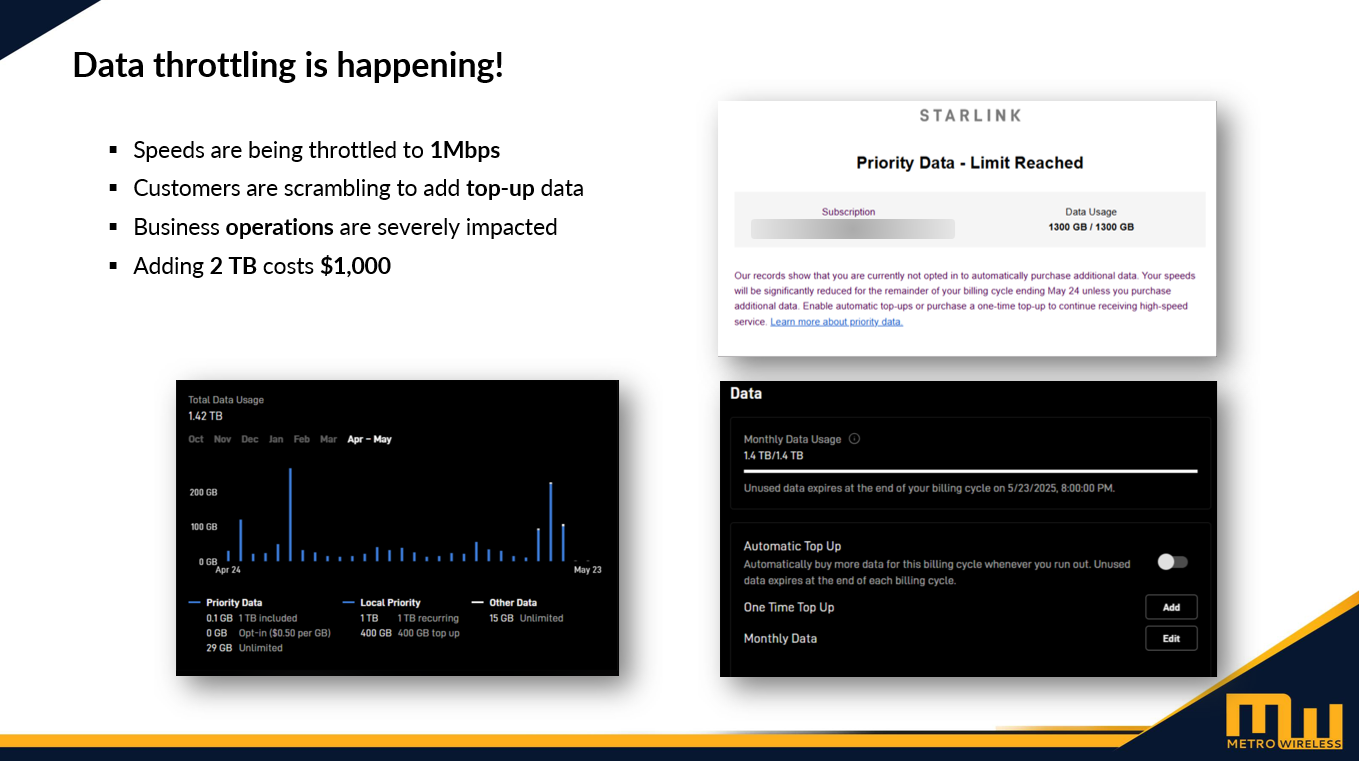
Tyler Hoffman: So, the downside of Starlink is what we step in to fill, and when we add that all together, Starlink is fantastic. It works. But here’s the other downside to Starlink: they went to throttling in April. It came out as an unlimited—essentially unlimited service—and like most wireless networks, you’ll see them getting introduced and then you’ll see load on the network and then you’ll start to see network slicing. And so the same thing has happened to Starlink. So, when you hit your priority data limit, you are throttled to 1 megabit, and 1 megabit, of course, is unusable.
Now you have to manage your Starlink circuit, and this was not the premise when it was introduced, but it’s the reality now. So, as you keep adding, it’s going to cost you more money and you have to manage it. If you add 2 terabytes of data in an auto top-up situation, that’ll cost you a thousand bucks. So, this circuit that went in at 220 might cost 1,220 or 2,220 or 3,220, and now we have unhappy customers. So Starlink is just one more network that does what it does and doesn't do what it doesn't do, and we recommend having an expert advisor to hold your hand and guide you through it and deliver to the customer a no-surprises solution that can be supported, is going to be predictable in costs, and has someone to talk to and fits into their billing consolidation and the security consolidation the way they need it to fit.
Tyler Hoffman: Yeah, Tom, to your point, I run into—you know, or I’ve seen the invoices come in where a client is surprised by an invoice due to overages, and it’s something that we—and you’ll get into this of course—but we really like to avoid and help our clients proactively manage to your point.
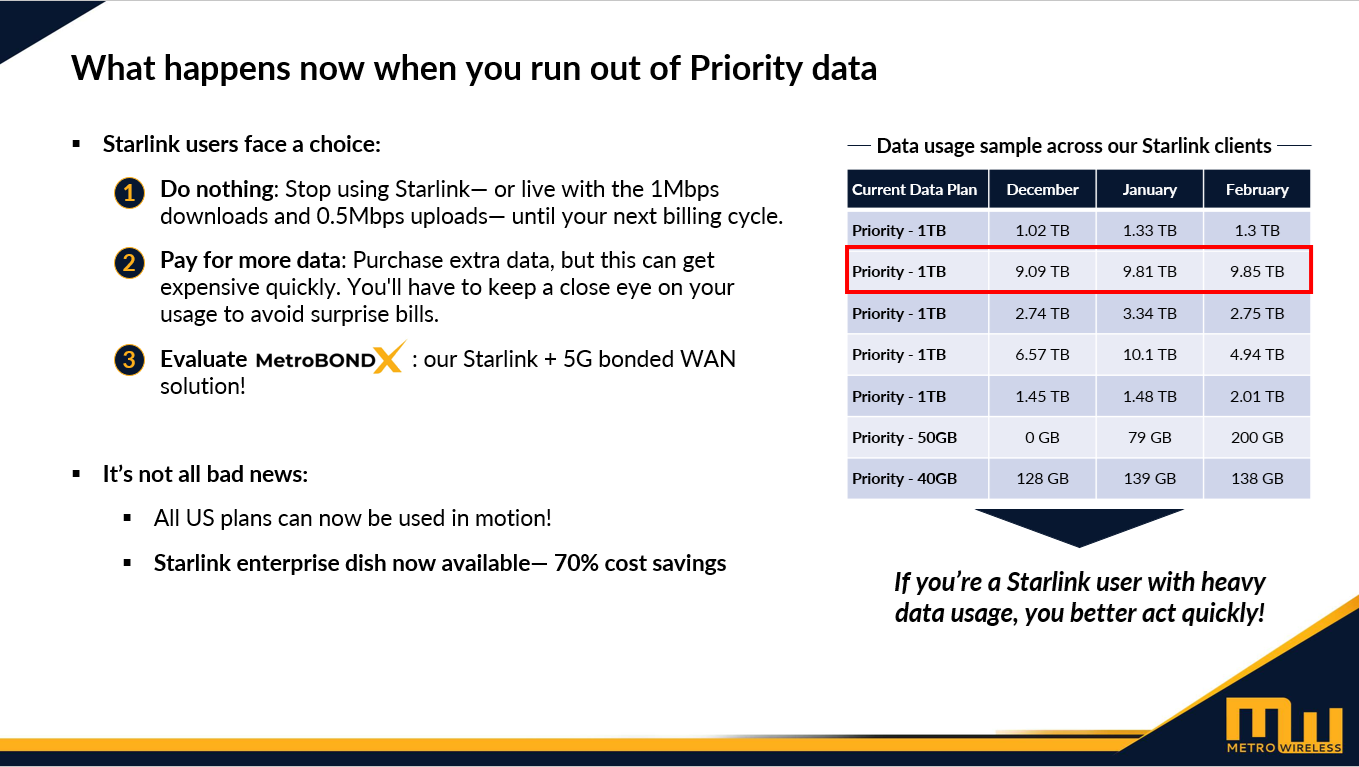
Tom Benson: So with Starlink, if you run out of priority data, you go down to 1 megabit. Well, that’s unacceptable of course. So, your next option is to upgrade, and these are our customers. We have 9-terabyte users and 10-terabyte users on Starlink. Now, this goes back into the past a little bit. So, 9 terabytes with an upgrade is two grand. That’s $250 per terabyte. So Starlink from a channel perspective can become this thing where we put it in because we thought it was easy, and then your customer is on the phone two months later with a $2,000 overage bill or they’ve been throttled and they’re very unhappy.
And if you think about your premier customers, you don’t want that headache, of course. As a channel manager, I’m not telling you your business, but we all know this. The hassle factor, the uncertainty factor, and the surprise factor is the thing that we guard against most in the channel, and I’m trying to protect everyone from that on this—if they introduce Starlink and your premier customer calls you two months later and says, "What have you done to me?" That not only hurts your circuit, it hurts your next sale. And so we’re trying to keep people out of that game.
Tom Benson: The one other thing that Starlink has added is that you can now move with a Starlink dish. And so, a year ago, they had different plans for dishes in motion, and that’s no longer true. So, the next great forefront in Starlink is going to be mobility solutions. Putting Starlink on an RV—and we’re starting to install these right now—putting them on doctors' cars that go to appointments, putting them on vans, putting them on construction equipment, putting them on something and bringing enterprise-grade internet anywhere.
And then if you pair that with some of our high-range Wi-Fi broadcasters, you could bring Starlink and a mobile hotspot and cover a half square mile anywhere you go. So, that’s a teaser for an upcoming webinar, but these are the things that we’re working on here at Metro Wireless to add value. Next slide, please.
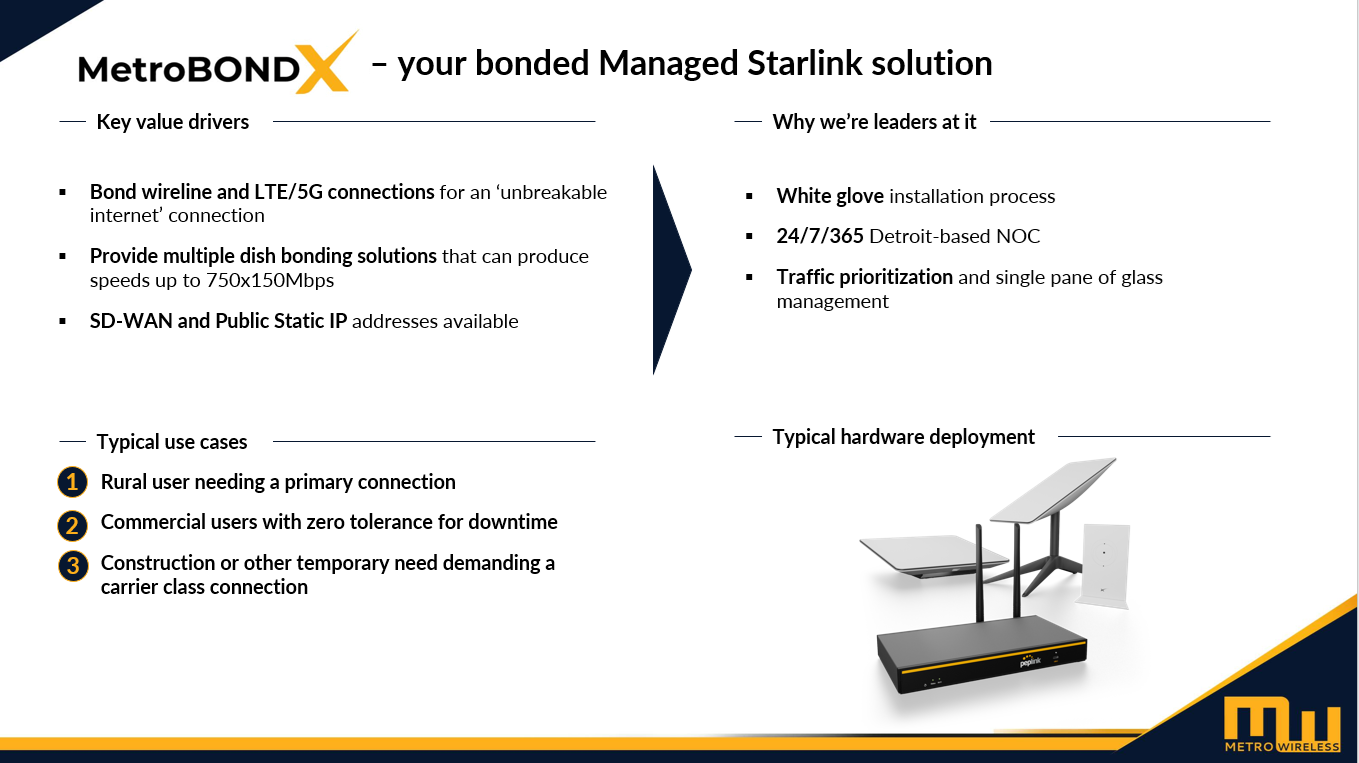
Tom Benson: So, MetroBOND is what we came up with to avoid this problem, and it does two things: We’re bonding Starlink using Peplink SpeedFusion with a 5G unlimited circuit. And then we’re dynamically allocating the Starlink data plan so that you end up with the same cost and the same performance throughout the month. And so now you can confidently say, "This is going to cost you 600 a month or 700 a month," and you’ll have faster speeds, and you’ll have carrier diversity, and you’ll have static IP, and you’ll have faster upload speeds—because Starlink, remember, is only 15 megabit up. So, we can add that upload speed from the 5G circuit and get you into the 50s.
Now this is a circuit that you can use for cloud protection, you can use it to protect your data center, you can use it to protect your high-value assets that have to be connected to the cloud at all times. This is something that—you never want to say exclusive, but I don’t know that there’s someone else in the channel doing this. You have to be a Peplink shop to do this and then you have to be committed to learning the software and how to actually do it. So, MetroBOND has been an outstanding solution for us. It differentiates us from everyone else in the marketplace. It protects you against what Starlink doesn't do well and it makes it go faster. So, there’s a lot of value here, but it’s value for your premium customers. This is not an economic play. It can protect you against Starlink overages, sure, but this is a premium service, and we’re looking for you to bring it to your premium customers who have to be connected to the cloud at all times, so they have zero tolerance for downtime.
Tyler Hoffman: Well said. Yeah. Next slide, please.
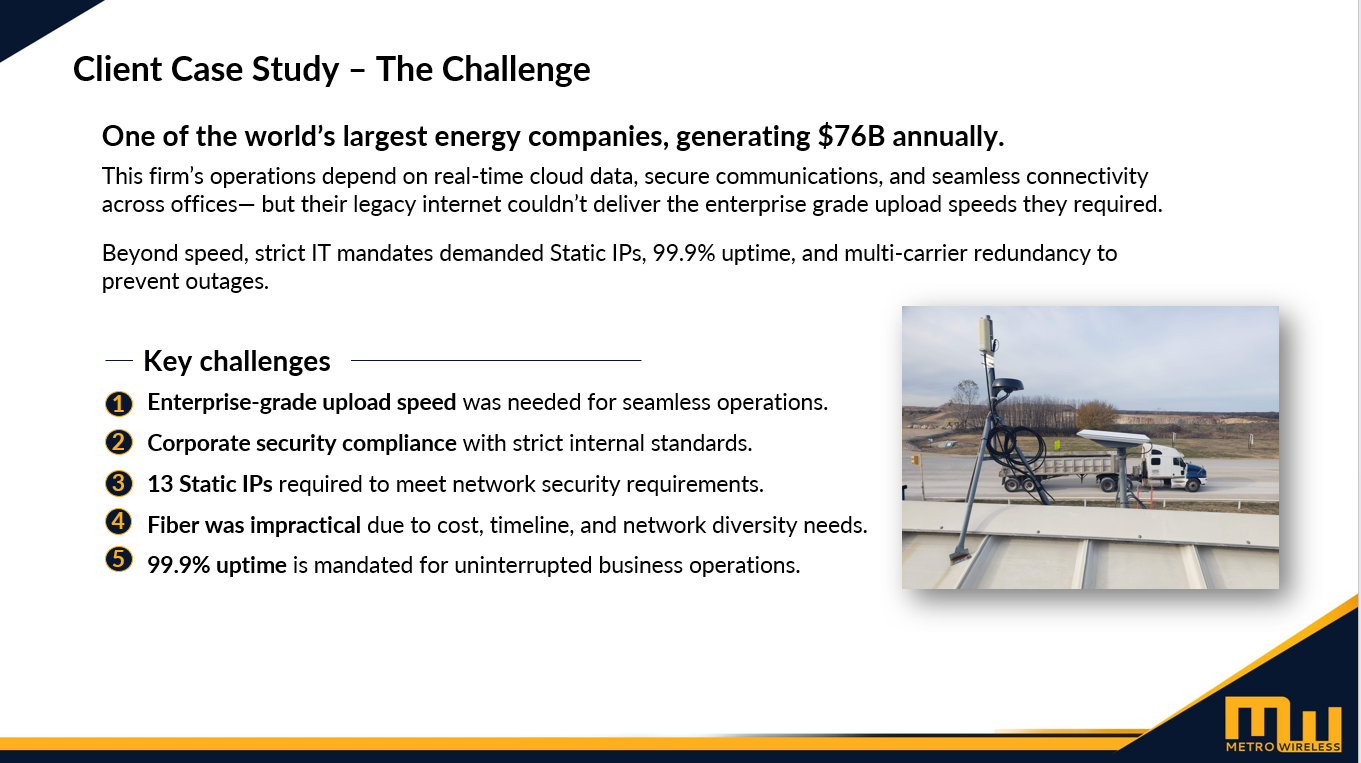
Tom Benson: So, case study of that exact client: We had never heard of these people, and we have to—they have to remain nameless—but this is a Fortune 500—actually it’s a Global 500 business. It’s a power company, and they have very high standards, and they normally probably wouldn't have taken a look at us based on their size, but they had a unique situation where they needed to get to 50 or 100 megabit upload in rural locations.
A channel partner found us after going through numerous other providers who could not deliver. And they came to us and they said, "If it works in location one, you got a shot here, but frankly, we don’t think it’s going to work." Fast forward a year later and we’ve installed 13 now. So, we delivered MetroBOND X4 is what we call it here. This is a four-circuit solution for this customer. And we bonded generally speaking three 5G plus one Starlink, although there’s some different flavors of that. But what we’ve done at every location is bond four circuits together.
We’ve also delivered 13 static IPs, so slash 28. And their CISO signed off on it with the static IP, so we passed, you know, internal audit as far as security concerns go. And they’re in the 99.9% range for uptime. So, this has been a really nice rollout for us. This is something that we’re going to build upon, and we would like to bring more of this, and we’d like to bring this example to you so you can find it. The economics on this, I think, are on the next page.
Tyler Hoffman: Getting there, I think. We’ll get there.
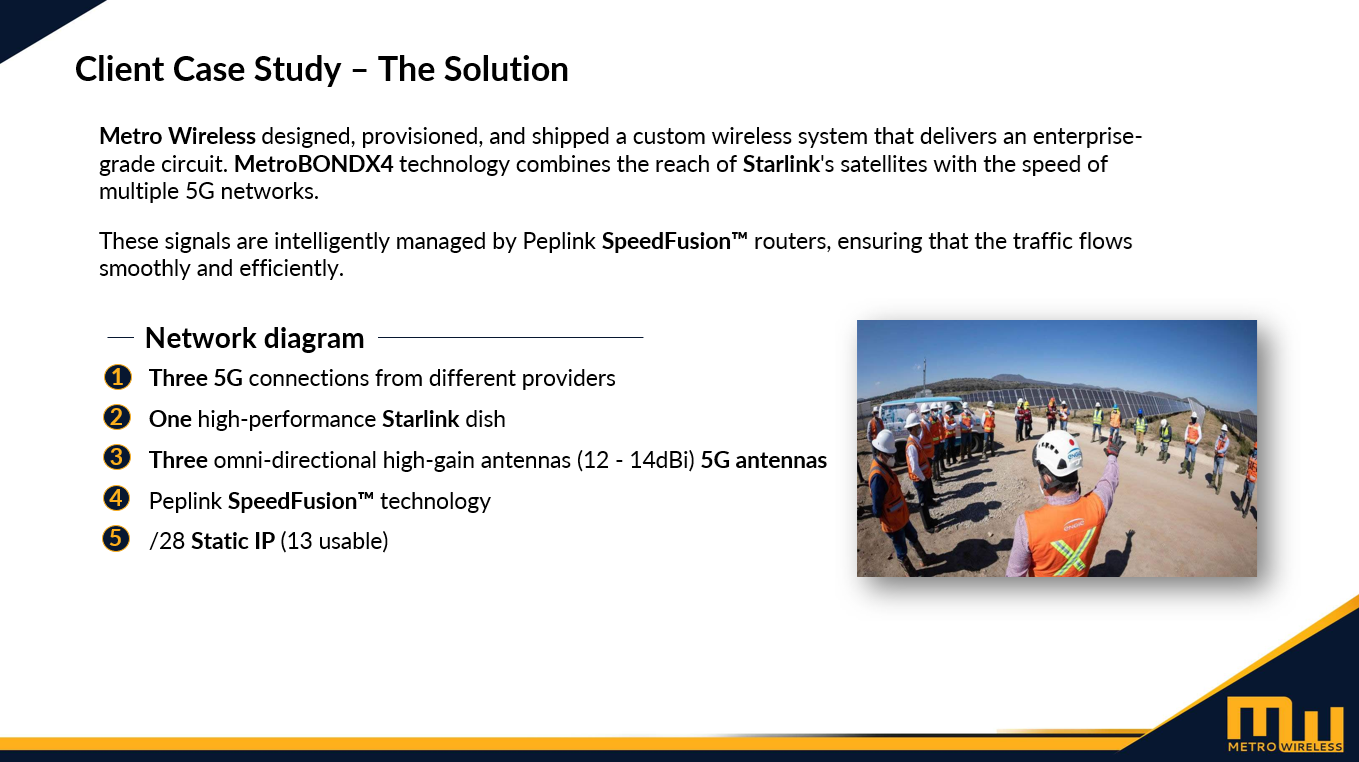
Tom Benson: So yeah, I sort of jumped ahead a bit. So, it’s three 5G plus one high-performance Starlink dish. We also put high-gain antennas on each one because they really wanted upload speed, and speed comes from antennas on a 5G circuit.
This gets a little nerdy, but the 5G frequencies don’t penetrate buildings as well, and so if you want maximum performance on your router—your 5G circuit—you want an antenna outside the building. We call it "building penetration loss." It’s just physics. The higher the frequency, the less building penetration you get. And once you put a router inside, you might lose those 5G frequencies that are higher, and that’s where your speed is. You put an antenna outside and you pick them all up. Is it a pain to put up an antenna? Yes, it’s a pain, but you pay for it once and it’s faster for the rest of your life. So, you don’t have to, but if you want to go fast, that’s where the speed comes from and we will coordinate all installs. So this particular customer installed all of their stuff. That was nice; they had the chops to do that. So they installed three antennas plus one Starlink dish, Peplink SpeedFusion, and then a slash 28 static IP block—13 usable. And they rolled it out to 13 different sites. Next slide, please.
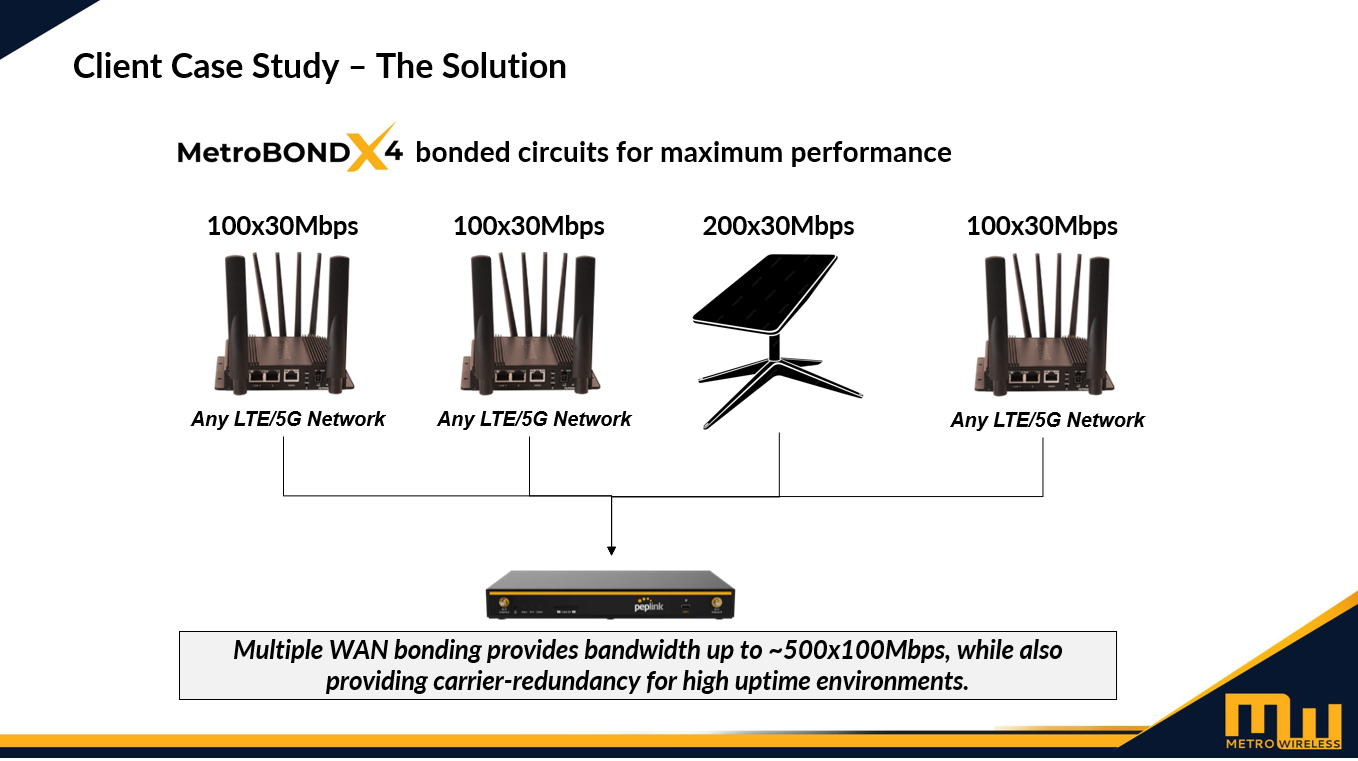
Tom Benson: For the visual learners, this is what it looks like: This is just a simple network diagram. This shows three 5G plus one Starlink and then to a bonding solution with a handoff. And there’s our cool MetroBOND X4 logo, which I’m a big fan of. And then finally, next slide. And then the economics: the customer’s billing $18,000 a month in MRC, and this will grow. This could be a $50,000 MRC biller, we’ll see. But as we all know in the channel, this is where success comes from. You prove it one site and then you roll it out and then it becomes cookie cutter and you keep rolling it out.
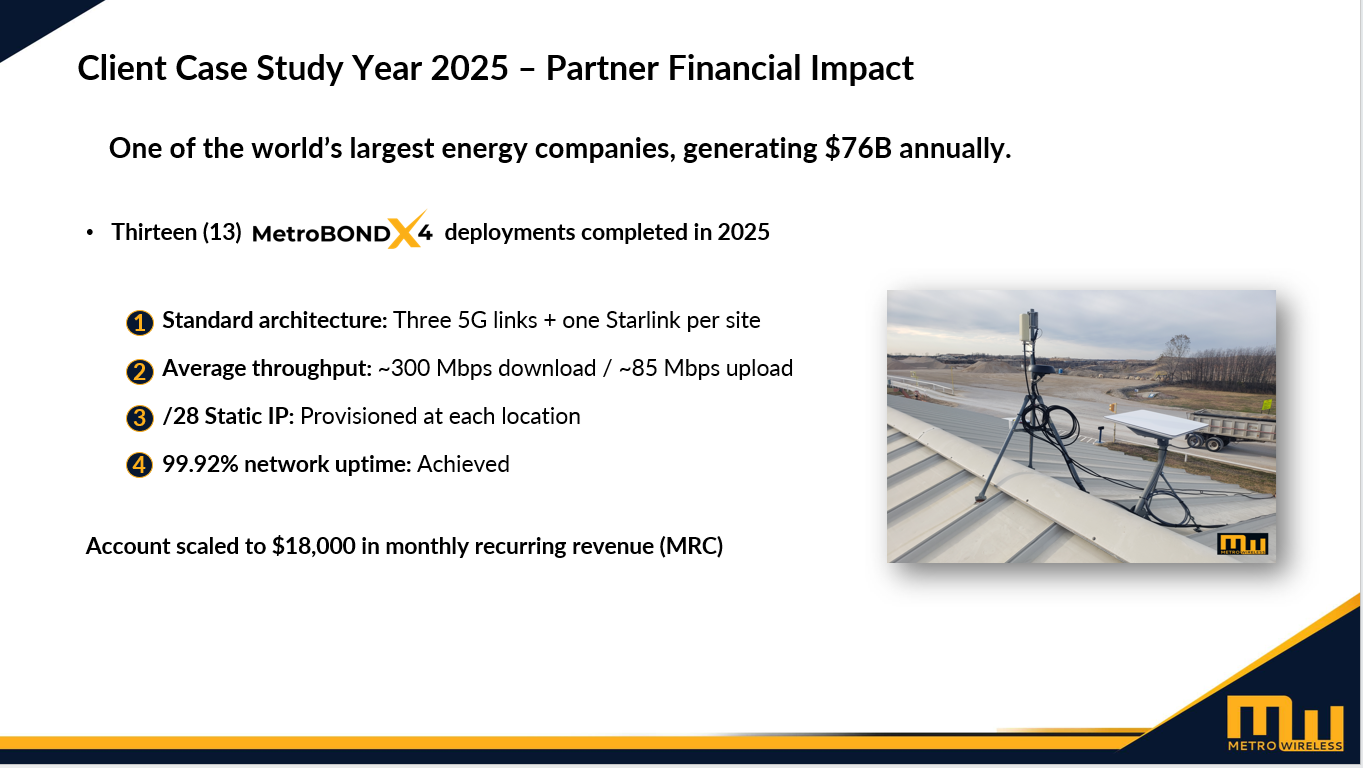
And so we’re very proud of this and this is why we presented it, but it’s just an example and I’d like to hear people’s minds turning over the airwaves saying, "Wow, I have customers who look just like this, I wonder if I could roll this out too." So hopefully that’s what we’re suggesting in this is that there are good solutions out there either for when you can’t get good speed or for protecting the cloud. Your premium customers that you brought in two 1-gig circuits for—they got two 1-gig circuits for a reason, guys, and if they get their fiber cut, which happens, they can’t get to the cloud. If they can’t get to the cloud, they’re in big trouble. This is the circuit that protects that. So that’s sort of my final thought on MetroBOND.
Tyler Hoffman: And so Tom, I’ll talk about what’s coming down the pike. So you know, one of the big things that exists to Tom’s point about why MetroBOND’s been so popular for us over the last year and a half is that bonding multiple wireless circuits together—whether it’s Starlink and Starlink, or 5G and 5G (Verizon, T-Mobile)—is the fact that we can get higher aggregate download as well as upload speeds without having to increase latency too much.
But you know, given that we’re an official Starlink partner, there’s a lot of dialogue happening in the background right now about how we get to faster speeds. Some of you might be aware of Amazon’s lower earth orbit satellite offering called—I think it’s pronounced Kuiper.
Tom Benson: Kuiper.
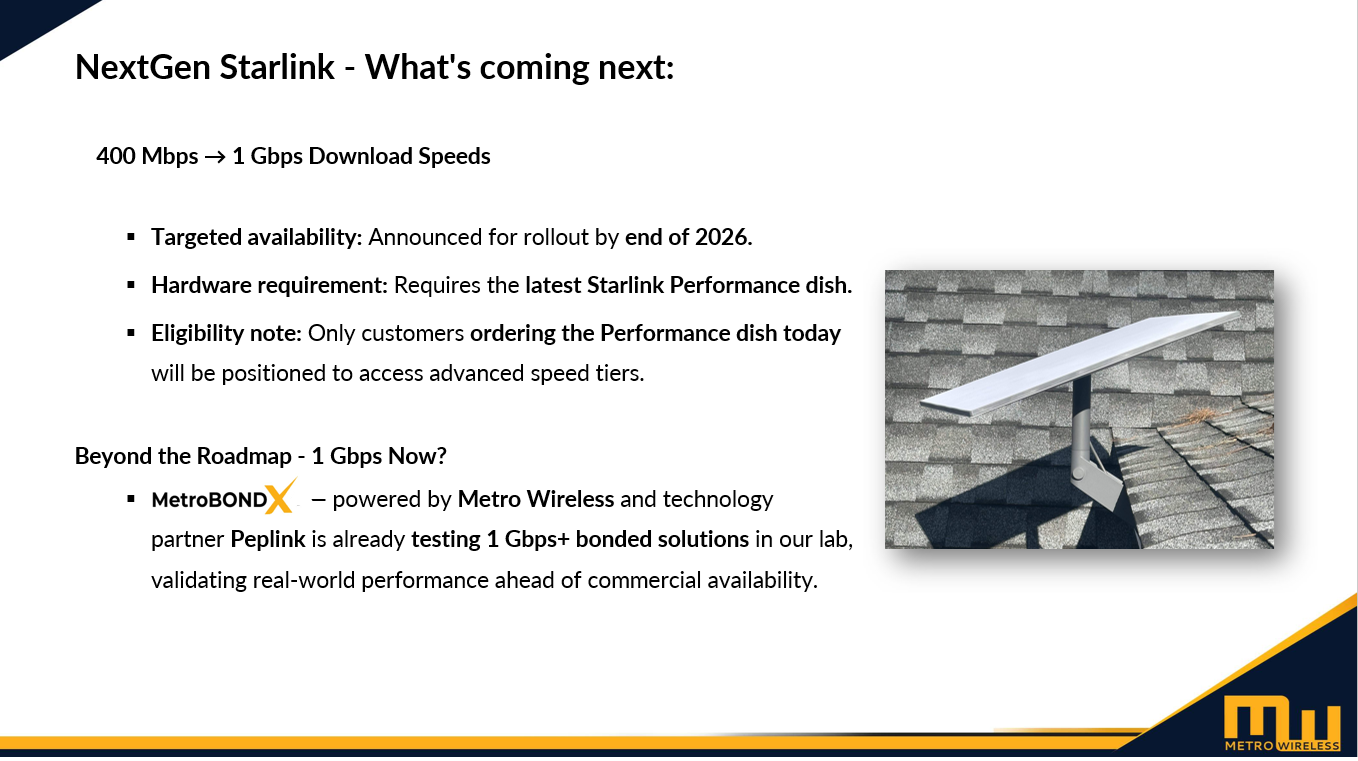
Tyler Hoffman: Yeah, Kuiper, exactly, that’s what I thought it was. Coming out in the next year or so. They just won a bunch of grant money from the residential space, but they’re going to offer really fast speeds, and so Starlink’s going to have to compete with that, which is a good thing for everyone—ourselves, our partners, and our clients. And so right now Starlink is beta testing with some select partners the 400 megabit speed plans. And so we expect those to be rolled out by the end of 2026. There hasn't really been too formal an announcement with regard to when those plans are coming or whether there will be price impacts to the plans, but we do expect that those plans or speed offerings should be available by the end of the year.
Now, I want to note: the faster plans are going to require the latest Starlink performance dish. It’s either the Gen 3 or the Gen 4 dish. So, those of you...
Tom Benson: I think it’s four.
Tyler Hoffman: It’s the four. I agree with you too; I think it’s four. Yeah, I agree. The latest Starlink performance dish will have to be used. You can’t use an older generation high-performance dish, you can’t use a residential dish, you can’t use the Mini or even the enterprise dish. It’ll have to be this new performance dish. I think it retails for $2,000 to my knowledge, and we’re starting to deploy those more and more. It’s a very high-quality dish—metal frame—the build quality is really strong on it.
But so again, you want to make sure that if you want to be future-proof when you’re reaching out to us for quotes, make sure we’re quoting that performance dish for you today to get those fastest speed tiers when they become available. And then after the 400 megabit plans roll out, we do believe that we’re going to see 1-gigabit download plans coming out. Again, my sense of the matter is it won’t be in calendar year 2026; I think those will be in 2027.
But if you want a gig now—and we’ve done this as a proof of concept actually for a large cellular carrier, the one that has red in their branding—they actually brought us in to do some proof of concept testing for their cellular COWs, which are "Cellular On Wheels" for emergencies and events and things like that. We bonded 12 Starlink connections together to get them a test of 1-gigabit download speeds in our lab, kind of validating the real-world performance of what Starlink and Peplink can do today. So, if you or your client do not want to wait for the faster speed plans to come out, we can offer you a gig today. And in fact, Tom, I was looking at Salesforce and CRM the last couple days. Remind me—there are some quotes out there recently for I believe it was an oil and gas client for a bonded solution. Can you tell us about that?
Tom Benson: It’s power and data center. I used to say "oil and gas" all the time and now I’m saying "power." And I’ll tell you: if you want to make money in wireless, talk to your power clients. And power is wind, solar, electrical distribution, and oil and gas. They are the number one business consumer of business wireless services and they have been for 30 years. You talk to any wireless company and they will have any number of power companies—our three biggest customers are also power companies. That’s just the nature of the business because the power is where the internet isn't.
And then data centers are starting to fall into that same spot where they’re putting data centers in places where the land and power are cheap but the internet isn't necessarily there. So, the suburbs are not a great place for data centers because it’s so expensive. North Dakota’s great! South Dakota’s great! Land’s cheap, lots of wind, lots of sun, no fiber. Or they might be next to a dam. And so you have to bring the internet to it while the fiber’s coming in. We’re getting quotes for data centers who want to commission the data center but they need a gig to do it, and then when they’re done and the fiber finally shows up, they’re going to leave it in as a backup circuit. So data centers are almost following the same megatrend as power and gas; they’re looking for the right site and then they bring the electronics to it. So, power and data center is an excellent application for this service.
Tyler Hoffman: Excellent. And Tom, are those clients the same quotes I’m thinking of that we just sent out in the past week or so?
Tom Benson: Yep. One was the data center and one was actually a construction company who’s building a wind farm in North Dakota.
Tyler Hoffman: Wow, okay. And do you recall how many bonded Starlinks or circuits they’re putting together on the MetroBOND platform?
Tom Benson: It’s depending on Starlink and where the cell towers are and how much we can get off the cell tower, but generally speaking, you’re looking at bonding eight to ten.
Tyler Hoffman: Wow, eight to ten. Yeah, that’d be a good win. So, okay. Thank you. So yeah, it’s all to say we can get you the faster speeds today, and then of course Starlink—keep an eye out for the announcements later this year; we’ll of course be amongst the first to let our partners know that that’s become available soon.
But Tom, I think you know we’re starting to get a good number of questions. Let’s go ahead and open up the Q&A here. Please feel free to submit more questions via the chat or the Q&A. Tom, I think you addressed pooling—yes, Steve, of course, we can do pooling both on Starlink and our 5G. To Tom’s point, it’s an analytical conversation where you've got to get the Excel out and the spreadsheet, so yeah, that’s a part of it. Tyler Andrews...
Tom Benson: The only thing I’m going to editorialize on that is that pooling does not automatically make it cost less. I don’t want to say I invented pooling, but I was there when it was invented back when I was at BroadSky Networks in 2014. So I know pooling. And pooling does not mean lower cost. What it means is you’re spreading out the pool on a more efficient basis, which means your usage has to make sense for a pool. And then you also have to compare it to the underlying buyer rate—say, "What could I just buy it for at each site?" So, if you’re not doing a financial analysis, you have no idea if pooling is helping you. Pooling does not automatically equal lower costs, but my shortcut competitors like to sort of imply that it does. It just doesn't. We’ve got to get into it.
Tyler Hoffman: Um, Tom, we have a question from Tyler Andrews. Can you confirm what the priority data limit is before overages occur?
Tom Benson: Yeah, there are three buckets: 50 gig, 500 gig, and 1 terabyte, and each one costs separate. After that, you go into upgrade mode. You can buy infinite amounts of data and you don’t have to do upgrade mode, but you pre-buy it. Pre-buying can hurt you. So, if you want to buy 7 terabytes, go ahead, but now you’ve bought the 7 terabytes, and if you only used 4, you still paid for 7.
On the flip side, if you want to buy 1 terabyte and then just go to auto top-up, the auto top-up is going to cost you twice as much as if you pre-bought it. And so that’s going to cost you 50 cents a gig, which doesn't sound like much until you use 5,000 of them and that’s a $2,500 bill. So, I’m not a financial analysis guy, except I’ve been in networking and I started off selling long-distance—and that dates me a little bit—so I’ve been looking at spreadsheets and rate cards for 35 years, and it’s just "consumption times unit cost equals cost." And now Starlink is in that same place. And so that’s when we sit down to figure out how we actually tune this so that we have the lowest cost experience and the best performance.
Tyler Hoffman: Well said. Well said. John Lynch had a question, and this was a few minutes back: was cost an issue? Oh, he’s asking about the case study, I believe, about whether the client was budget-sensitive and roughly what was the cost per site per month, Tom, for that energy client?
Tom Benson: Yeah, they need performance, and bonding four circuits together is somewhere between 1,100 and 1,400 a month. Yep. If it’s all 5G, it costs a little less; if it’s all Starlink, it costs a little more.
Tyler Hoffman: Well said. And that was on a 36-month or 12-month? I recall...
Tom Benson: Yeah, they went three years on that.
Tyler Hoffman: Three years on that. Okay, lovely. John Griffin had a question: Does Metro offer any automated notification to a customer when they’re close to hitting their data cap? Tom, can you speak to that?
Tom Benson: Yes. And so on the 5G side, since we offer 5G unlimited: no. So, getting more granular into your question: on the 5G circuits, we don’t offer warnings because we don’t need warnings. And I remember well when I used to sell data plans with 100 gig or 50 gig and warnings were a huge deal, and we’re sort of evolving out of that. On Starlink, yes, we will give you notifications.
And I guess I’m going to deep-dive on this a little bit: Because we’re using Peplink and we’re handing off to a Peplink router and we’re using that to manage the router—and we didn't mention this before—that Peplink router also provides 5G failover to our Starlink, because I mentioned the four outages that we’ve had. So, based on the Peplink data, we can track every gig going through in real-time, and we can tell you how much consumption you have, and yes, we will warn you.
Tyler Hoffman: Yes. And two additional comments there: When you say "four outages we had," you mean Starlink, correct?
Tom Benson: Yes, Starlink had four outages in the last two years.
Tyler Hoffman: Right, okay. Just making sure you weren't...
Tom Benson: So 5G failover is a real value-add. Starlink’s not perfect.
Tyler Hoffman: Absolutely. And then so John, to your point: yes, we absolutely do, whether it’s via the Peplink router that we install... and we do offer metered plans for 5G, so in case for clients who are very budget-sensitive and they don’t want to pay for an unlimited plan, we can do that and then offer them a notification when they exhaust their data, and we can continue to offer them additional data there. Similarly, John’s question goes to: Do customers have access to a portal that shows the bandwidth health for the active sites and devices?
Tom Benson: Yeah, Peplink InControl does that for you.
Tyler Hoffman: Exactly. Go ahead. Oh yeah, so I think what we’re both trying to say here is that via the Peplink routers that we deploy, you have access to their cloud portal that we provision for you or your clients. Again, we’re happy to give partners access or clients access or the client’s IT team, the MSP—whoever needs access, we can give it to.
And so yes, they do have access to those things where they can see not just for one site, but they have a single sign-on across all sites—a multi-tenant kind of setup there—and so they can see uptime, they can see latency, speed tests, data usage—all of those, any type of statistics they want. That’s something we have the ability to do via the Peplink InControl platform. Again, we will always manage it on behalf of the client, but if clients want to co-manage it with us, we’re happy to do so.
Tyler Hoffman: Paul: "Will the Cubs win the World Series this year?" I’m hoping so! I’m from Detroit, but I spent nine years in Chicago, as I mentioned earlier, so I’m hoping that’s the outcome we have there. So, anyhow. But Irv also asked: "Will we send the deck out from today?" Yes, Irv, we absolutely will. Please give us a few days to aggregate the materials and the recording and the transcription, but yes, we will send out the deck from today’s conversation as well.
Tyler Hoffman: Jack asks a question: "Is there a reason you don’t use a multi-carrier eSIM rather than three separate routers?" I will answer this and, Tom, I’m going to want you to answer this as well. So Jack, on our more standard, basic deployments that are more simple needs: yes, we do have an electronic SIM that is multi-carrier in that sense. It’s not available on an unlimited data plan; it’s only available on a metered data plan.
And so we can do that, and our technicians with each deployment are doing what we call "hardware optimization." So, for every single installation, we don’t just ship a router and hope for the best, but we’re testing each individual carrier to see which one’s performing the best. Not just from a download perspective, but if a client is using the wireless circuit for VoIP (Voice over IP), we obviously want to make sure that latency is within expectations; same thing for upload speed. Some clients really are uploading video and they need to make sure they have good upload speed. So, we’ll optimize for whatever the client wants. Tom, I think the question about three separate routers—why are we doing three separate routers in a bonded scenario? I think you can speak to that.
Tom Benson: Well, yeah. Jack sort of touched a bit of a nerve I have in this industry, I think unwittingly. Jack’s question was: "Is there a reason you don’t use a multi-carrier eSIM rather than three separate routers?" And that sort of implies that these eSIMs that have access codes to three separate carriers are connected to all three carriers at the same time. I think that’s what Jack’s sort of getting at—why not just use an eSIM that’s connected to all three carriers at the same time?
Because it’s not. And my eSIM brethren in this industry continually suggest that you’re connected to all three carriers at the same time. You’re not. You’re just not. And the reason you’re not is because you only have one modem in your router. And so just think through this logically: If you’re connected to AT&T and you’re passing traffic on AT&T, you have no idea what’s happening on the Verizon or the T-Mobile tower because you’re not connected to them because you only have one modem.
The only way you could connect to Verizon is if you disconnected from AT&T and then connected to Verizon. And now you’ve connected to Verizon and we’re happy for you, but now you’re not connected to AT&T. This continuous suggestion by eSIM providers that you’re connected to all three carriers at the same time—I’ve been hearing it for five years—it’s just a straight lie. I’m just at the point where I have to say it that way: it’s just a straight lie. You’re connected to one carrier at a time.
So, to answer the question, if you want the performance, we used three modems and three SIM cards because we want three separate sessions, each session getting about 120 megabit download so we can combine all three of those into one faster pipe. One modem delivers one circuit. So, that’s the answer to the question, and I apologize for soapboxing a little bit here, but I just get so tired of the lies in this business.
Tyler Hoffman: Well said. And there’s a lot going on there. Noah has a question: "Do you see Amazon’s LEO Kuiper service being directly competitive with Starlink? I’ve heard that Kuiper satellites are more tailored for data centers than medium-sized customers."
Noah, I’m not saying that that’s incorrect, but I can’t say I’ve heard that myself. I am aware that Amazon has, again, won some large grant money in the BEAD program, which is the federal broadband access program for residential clients. I do see it being competitive with Starlink. I do see a world where—and to my knowledge, the conversations I’m having with Peplink management is that Peplink wants to have a relationship with Kuiper.
And I think what’s going to be cool is in a future world we’re going to be able to offer a client a really cool multi-carrier bonded solution. You’ll have a Verizon SIM card perhaps on the 5G side, you’ll have a Starlink lower earth orbit satellite option, and then you’ll have an Amazon Kuiper service, and you can bond all of those together to have really great carrier redundancy. Our hospital clients, I think, will be a good use case for that, as well as some of our logistics clients. So, that’s where I see it.
I do think that their speed plans are going to be faster on average, at least in the onset, than Starlink just because their satellite infrastructure and constellation is going to be newer. So, I think that could be a good use case for data centers. Tom, I have not heard many other rumors or gossip about Amazon Kuiper. Have you heard much yet?
Tom Benson: Well, because of Amazon Web Services and their built-in customer base, there’s going to be... I’m sure there’s a segment where they’ll put it up there because when you put a satellite up, you want revenues immediately. In fact, if the customer will sign a contract before you put the satellite up, that’s even better. So, I’m guessing that this will be part and parcel to AWS and that’ll be a strong component so they can get revenues going right away and start to test it out and burn it in, right? Because inevitably there’s going to be some mistakes. And then step two is they’ll start to spread it out so that they can pick up more and more and more. Every network starts with a certain coverage zone and then it expands. Starlink did the same thing.
I had one of the first Starlinks five years ago because I live north, and Starlink covered the north. You could, back then, see the satellite come over the horizon. You'd do a continuous speed test and it would go 20, 30, 40, 70, 50, 40, 20 like that, and then the next satellite would come over. And now Starlink’s pretty steady state. So, I think everyone’s right here. I bet they do concentrate on their data center AWS clients first and they keep expanding the network as they chase Starlink down. Yeah.
Tyler Hoffman: Absolutely. Irv, you have a good question here: "What do you see is the average size of your clients?" You know, today obviously we’re talking about a large enterprise deal, right? Tommy’s pizza shop here in Detroit is probably not buying $18,000 a month worth of Starlink bonded services. They’d be a better fit for our $60 metered options. So, not every client needs an unlimited multi-bonded circuit for their wireless failover.
There're a good chunk of our clients, Irv, and I know you’ve been a partner for a while so you’ve probably sold more of this or been part of more of that market of... we get down to $60, maybe even $50 per site, and that typically includes the Peplink router and a 1-gigabit metered failover. That client is really just trying to make sure that their pizza orders—the phones don’t go down on a Friday night or the DoorDash orders keep coming in through their system.
So, yes, we do offer a more affordable option for those clients, but more of where we’re going in the space is the more premium middle-market, middle-price, enterprise-type circuits—clients who can afford to pay $1,400 a month for their backup connection and they’ll do it for 13 or 20 sites, etc. So, that is kind of the trend of where we’re headed, but I always try to make sure that we don’t forget about some of the smaller needs as well.
Tyler Hoffman: Ian has the last question, so please feel free to submit any more questions guys. Ian asks: "Are the unlimited 5G data plans unthrottled?" Yes, that is true, Ian. I think the fastest speed test, Tom—I’m curious if you’ve seen one faster than this—the fastest speed test I’ve seen was a T-Mobile 5G connection. It was on Band 71, which is their high-performance 5G band on their 2.5 spectrum. It was 550 megabits per second downloads. It was for a construction trailer in Detroit. Yes, that’s not a mis-speak: 550 megabits per second download speeds. I think the upload was like 100 megabits per second. So, yes, Ian, if that gives you a sense, our unlimited data plans are unthrottled. Our metered plans are as well. So, you know, you’re not speed-capped per se on the metered. If you obviously keep running speed tests, you’ll run through a lot of data and get a pretty big invoice quickly. But the unlimited plans are unthrottled, as are the metered data plans as well.
Tyler Hoffman: Awesome. Tom, I think that exhausts the Q&A questions. I’ll give the chat a few more seconds here to see if anyone has any final questions. But you know, Tom, given the conversation we’ve had today and thinking about kind of some of the questions and the dialogue we’re having, is there anything that we’re forgetting to discuss with the group here today?
Tom Benson: No. Ian noted: we will make sure that someone speaks with you to talk about unthrottled unlimited 5G. And the market’s bifurcating in wireless. If you come out to the Wireless Wing in Vegas—and we’d love to see you out there—we’re going to be demoing some things with the next generation of wireless services. The wireless service market is bifurcating; there’s the commodity market—and it’s like every other market ever—there’s the commodity market where you pay a little bit and you get a little bit. And then there’s the engineered market where you deliver high value, high performance.
We’re migrating into the engineered side and the high-value side. And we’re hoping to find people who want to walk on that journey with us. Wireless delivers unique value that no other service can. You can’t cut it, you can’t cut it, and you can’t cut it. And no other service can say that. Every fiber circuit can be cut and every dual SIM string can be cut, and wireless can’t.
So, the megatrend of cloud and high-speed wireless absolutely go hand-in-hand. We support all of your cloud initiatives. I would argue that without a wireless circuit you don’t have a cloud initiative because you’re generating so much risk in putting all that data into the cloud; you have to be able to get to it. So bring us along on that journey to make sure your cloud customers feel safe about being able to access their programs. We’ll deliver the speed they need and—I never want to say never—but there are just very, very few companies in the wireless space who can do what we do. And so that’s the message we’re trying to get across. But you know, we’re not that big a company, we don’t have a big budget, so this is how we do it: we talk to the people. But that’s what we’ve got.
Tyler Hoffman: Yeah, well said. And it’s worked out. I think we grew 23% last year, which is hard to do without a big marketing budget, but we did it. So, Brad, thank you for the nice comment about a great webinar. Yes, email us at sales@metrowireless.com. That’s where all quote requests and inquiries should go. That gets picked up by our team, and we try to respond very quickly. I have a KPI (Key Performance Indicator) to track our response rate.
And then Tom, Charles Bridgman has a question. I know you run into this one fairly often so I’ll turn it to you, but his question is: "Are you open to a new market to providing a lower cost option for families and homes who just want great service inside the home—basically home internet on a lower-cost model?"
Tom Benson: I don’t see us serving that, Charles. We’ve never been able to compete in the residential internet market against the Comcasts and the Spectrums of the world. That’s their market.
Tyler Hoffman: Yeah, we get that question a lot just because there’s a huge market there, right, as far as a TAM (Total Addressable Market) goes. But to Tom’s point, it’s hard to be cost-competitive when T-Mobile and Verizon are doing $30 to $50 a month to the home. We just can’t get to that price point offering all the value-add that we do. But I appreciate the question because there is a large market there. Anyway.
But yes, as I mentioned, we will go ahead and send this out—both the slides, the recording, and the transcription; all of that content’s going to come out. Brad will, of course, reach out to you and make sure we get everything taken care of there. Folks, please keep an eye out for additional email communications. As I mentioned, we’re going to be doing the Wireless Wing here at Channel Partners. So if you or your colleagues are in attendance, please come by, grab a beer, grab a coffee, come chat, and play with the hardware in your hands.
And then keep an eye out—we do a monthly newsletter series that always comes out. Keep an eye out for our posts on LinkedIn: Metro Wireless on LinkedIn. And if there’s anything else we can do for you, let’s make sure that we get you guys taken care of. Dan asked one final question. Thank you, Calvin, for the good feedback. "Are we in the Bridgepointe portfolio?" Tom, I’ll turn that one to you.
Tom Benson: Yes. We should talk about that. It’s a two-step orbit, but yes. Let’s start with yes and then let’s have a direct conversation.
Tyler Hoffman: Yeah, Bridgepointe’s a big focus for us this year and we’re having a lot of good conversations, so Dan, this could be a good opportunity for us to kind of roll up our sleeves together on that. But all right, well, with that said, we’ll give back seven minutes to the hour to everyone. Thank you so much for participating today; we really appreciate it. Keep an eye out, we’ll probably announce our next webinar within the next four weeks, and we will talk soon. Awesome, thank you everyone.
Tom Benson: Thanks everyone.
Tyler Hoffman: Thanks everyone. Bye.