We have all been there. You walk into a modern office building, a sprawling hospital, or a sports stadium, and the signal bars on your phone drop to zero. The data stream stops. The call fails. In an era where business relies on constant connectivity, these dead zones are more than just an annoyance. They are a liability.
Thick concrete walls, energy-efficient glass, and steel structures are great for building integrity but terrible for RF signals. For facility owners and IT managers, the solution is not hoping the carriers boost their towers outside. The solution lies inside the building.
This is where a strategic distributed antenna system design comes into play. By bringing the signal source indoors and distributing it evenly, you ensure that every corner of your facility supports high-speed voice and data.
Before moving forward, use this DAS discovery checklist to ensure your deployment is properly planned from the start.
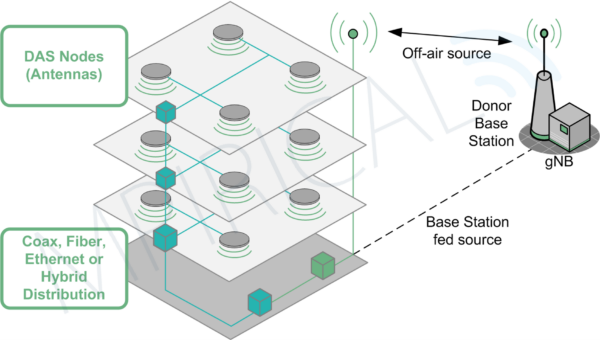
At its core, a DAS system is a network of spatially separated antenna nodes connected to a common source. Ideally, a DAS provides wireless service within a geographic area or structure.
Unlike a single router or a massive outdoor cell tower trying to blast a signal through layers of concrete, a distributed antenna system takes a more surgical approach. It splits the signal power among several antennas spaced out in specific locations. This provides coverage over the same area as a single antenna but with reduced total power and improved reliability.
When planning a design, there are generally two main categories to understand:
Passive DAS
This architecture uses coaxial cabling and splitters to distribute signals. It is often cheaper but signal loss occurs over long cable runs. This makes it better suited for smaller spaces or specific dead zones rather than large campuses.
Active DAS
This utilizes fiber optic cables to convert and transport signals to remote units. These units then turn the light signals back into RF signals. This is the gold standard for large campuses, hospitals, and stadiums because it maintains signal strength over long distances.
With the rollout of new standards, the demand for 5G distributed antenna systems is skyrocketing. High-frequency 5G signals struggle to penetrate buildings even more than 4G. This makes an in-building solution mandatory for modern wireless infrastructure.
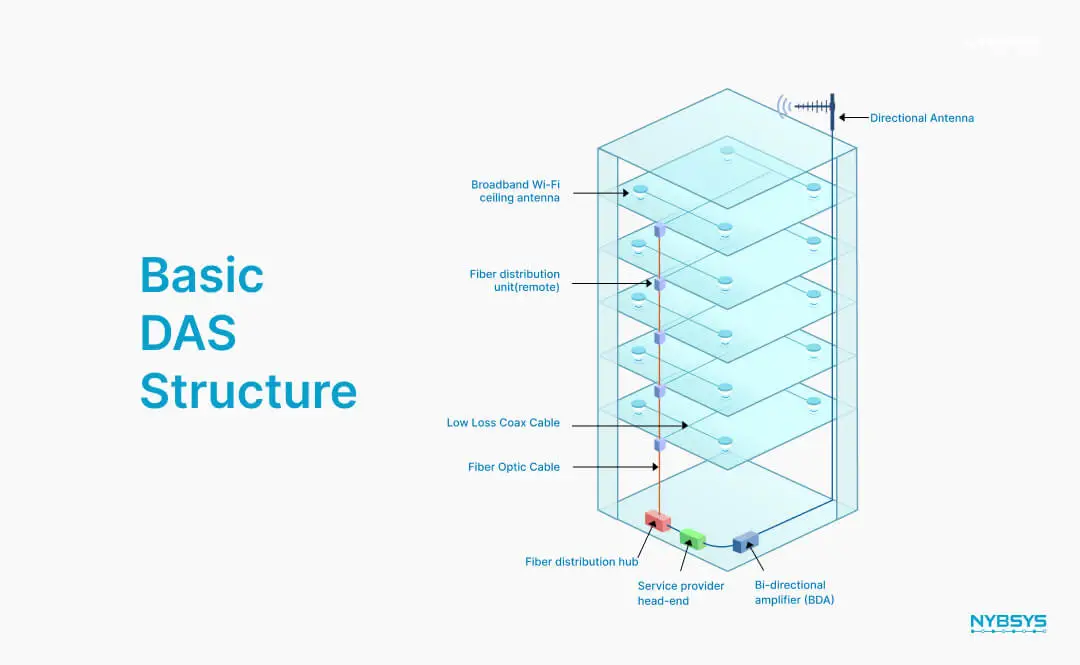
Understanding distributed antenna system design requires a look at the hardware that makes it happen. A robust system relies on several main components working in harmony to deliver seamless in building wireless coverage.
The Head-End Unit is the brain of the operation. It typically sits in the main server room or MDF (Main Distribution Frame). It interfaces directly with the signal source. This source could be a carrier feed, a small cell, or an onsite Base Transceiver Station (BTS). The HU takes these signals, modulates them, and prepares them for distribution throughout the facility. In a carrier neutral DAS, this unit manages signals from multiple providers like AT&T, Verizon, and T-Mobile simultaneously.
In an active system, the signal travels from the head-end to Remote Units located throughout the building. These are typically placed in IDF closets on various floors. These units are responsible for converting optical signals back into Radio Frequency (RF) signals that mobile devices can understand. Strategic placement of RUs is critical. It ensures that the signal is strong enough to reach devices but not so strong that it causes interference.
Connecting the brain to the remote units requires a high-performance backbone. This is usually a fiber optic network. Fiber is essential here because it allows the signal to travel long distances across a campus or up a high-rise without degrading quality. For a facility manager, ensuring your fiber internet and internal fiber cabling are up to spec is vital for DAS performance. This mimics the reliability we see in dedicated internet access circuits where fiber provides the cleanest transmission path.
Finally, the antennas broadcast the signal to the users. These can be omnidirectional, which send signals everywhere, or directional, which focus signals down a hallway or into an auditorium. The choice of antenna impacts the aesthetics and the performance of the cellular DAS system. Ceiling-mounted antennas are the most common and are designed to blend into the environment.
Modern designs must account for 5G. A 5G distributed antenna system often requires more antennas placed closer together due to the nature of millimeter-wave frequencies. When planning your infrastructure, designing for 5G now saves the cost of a major upgrade later. This component selection ensures your building can handle the massive bandwidth required by future telecom solutions.
Implementing a DAS system is a multi-step engineering process. It is not as simple as plugging in a repeater. It requires precise planning to align with your enterprise connectivity goals.
You might wonder if simple Wi-Fi calling or smaller signal boosters are enough. For a small shop, maybe. For an enterprise, no.
Distributed antenna systems offer digital transmission advantages that other solutions cannot match. Because active DAS uses fiber, there is almost no signal loss between the main equipment room and the antenna. This results in crystal clear voice calls and fast data throughput.
Furthermore, a DAS is scalable. If you build a new wing or need to add 5G business internet capabilities to a specific floor, the system can be expanded without reinventing the entire network. Centralized control allows IT teams to monitor the health of the wireless spectrum alongside their other business internet tools. This separation of cellular traffic from Wi-Fi traffic also frees up bandwidth on your local network for internal applications.
Investing in a professional distributed antenna system design delivers ROI through operational efficiency and user satisfaction.
The initial cost of a cellular DAS system varies based on square footage and the density of coverage required. Expenses include hardware like remotes and antennas, cabling such as fiber runs, and engineering labor.
However, the Return on Investment is visible in property value and tenant retention. Commercial tenants today view cellular connectivity as a utility. It is just like electricity and water. If a building has poor reception, tenants leave. Additionally, a robust DAS reduces battery drain on devices since they do not have to search for a signal. This improves the overall user experience.
The future of wireless infrastructure is converging. We’re moving toward digital DAS platforms where the separation between cellular systems and the IT network becomes minimal. These newer systems integrate more tightly with existing network equipment, making cellular coverage feel like an extension of the core enterprise network.
At the same time, cloud-managed DAS is becoming standard. This fits naturally with modern SD-WAN solutions, allowing IT teams to monitor cellular performance, signal quality, and traffic levels from the same dashboard they use for their dedicated internet access.
As 5G continues to mature, DAS will be central to enabling private 5G environments. This will support large-scale smart building applications and IoT deployments, creating more automated, responsive, and data-driven facilities.
1. What’s the difference between a DAS and a signal booster?
A signal booster repeats outdoor signals indoors and works only for small spaces. A Distributed Antenna System (DAS) uses fiber and remote units to deliver a dedicated, high-quality signal across large facilities like hospitals, stadiums, and towers.
2. Can one DAS support AT&T, Verizon, and T-Mobile?
Yes. A neutral host system carries multiple carriers on one infrastructure, giving all employees and visitors seamless enhanced cellular coverage regardless of their mobile provider.
3. Is a DAS ready for 5G?
Modern DAS platforms support 5G, but higher-frequency bands require precise design, denser antennas, and stronger fiber backbones. A 5G DAS is built to handle the increased bandwidth and low latency of next-gen networks.
4. Is a DAS legally required for public safety?
Often. Fire codes like NFPA and IFC mandate Public Safety DAS to ensure first-responder radios work in areas like stairwells and basements. Compliance is frequently required for a Certificate of Occupancy.
5. Does installing a DAS affect my Wi-Fi?
No. DAS uses licensed cellular frequencies, separate from Wi-Fi. Offloading calls and mobile data to a cellular DAS system actually improves Wi-Fi by freeing bandwidth for business applications and internal traffic.
A poor signal is no longer acceptable in professional environments. Distributed antenna system design is the engineering answer to the physics problem of blocking materials and distance. By turning dead zones into areas of full-bar coverage, you ensure your hospital, campus, or office building is ready for the future of work.
Whether you need to support 5G, ensure public safety compliance, or simply keep your tenants happy, the right infrastructure makes all the difference.
Is your facility suffering from poor wireless coverage?
Metro Wireless provides industry-leading telecom solutions and enterprise grade network solutions.Contact Metro Wireless today to discuss your distributed antenna system design and deployment needs.

Tyler Hoffman
CEO


%20(1).jpg)


