September 25, 2026
.png)
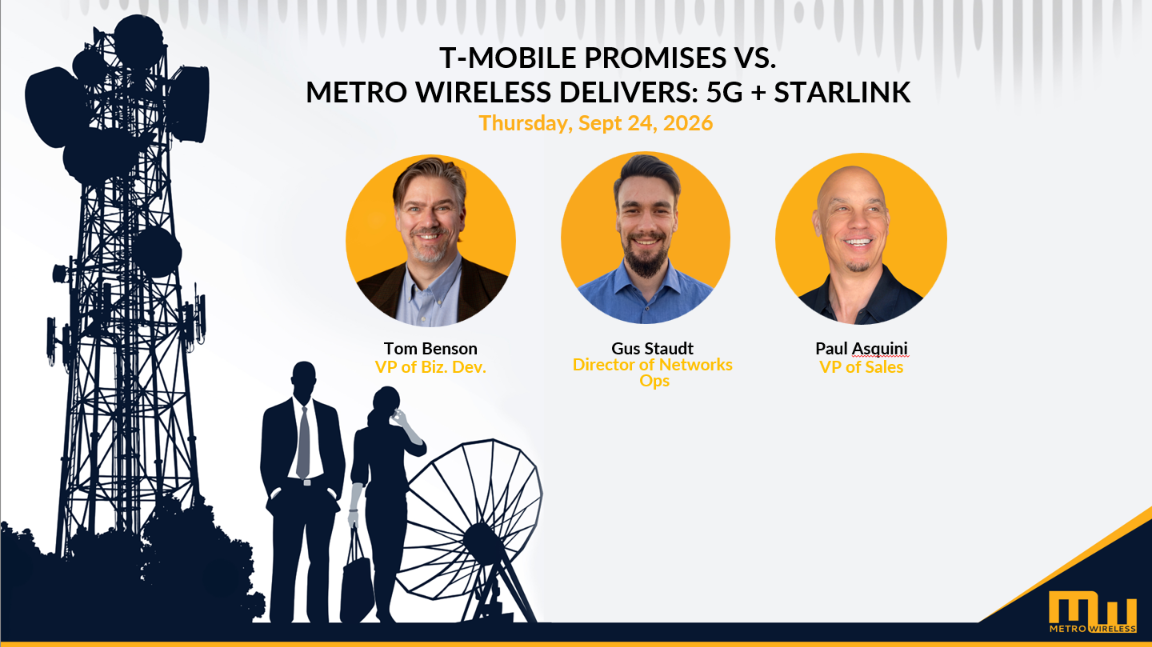
WEBINAR TRANSCRIPT · THURSDAY, SEPTEMBER 24, 2026
Paul Asquini — Host, VP of Sales
Tom Benson — VP of Business Development
Gus Staudt — Director of Network Operations and Support,
Paul Asquini 00:02:39
All right, every body, woohoo. Hey, good afternoon for you Midwest and East Coasters. Good morning to the left side of the country. So welcome, welcome to Metro Wireless and our. Quarterly webinar series. This is where, guys and gals, where we review our engineered wireless solutions with our clients, as well as with our technology advisors. You know, this series continues to grow, every quarter, and again, we've reached another record level of registered attendees, so really, truly, thank you very, very much for carving out some time in your busy day. We all know how busy you guys are bringing us opportunities, so thank you very much. I am Paul Asquini, and I'm joined by two dudes that are much smarter than I am. One, Tom Benson, many of you certainly know who he is. He's a longtime telecom.
Paul Asquini 00:03:40
guy, let's call it 30 years, just to make a nice round number, Tom. There you go. And then you know I got stumped last time, Tom, right? We talked about this, the this community tends to not only just ask excellent questions, but sometimes highly technical ones. And I'm not an engineer by any stretch. So Tom and I thought it would be important if we had some added firepower with us. So please welcome our Director of IT, Gus Staudt. Hey, Gus, thank you for joining, buddy. I know you're out there being busy, but. Thanks for being our technical conscience today. All right.
Gus Staudt 00:04:19
All right. Yeah, glad to be here with you guys and help you guys to get through some questions
Paul Asquini 00:04:23
You got it. You got it. You bet, man. You got, oh, I think we're going to get you. Thank you, sir. There we go. All right. Yes, intentionally you are muted. If you have any technical issues, there's the email to to hit up there and we'll get we'll get you right on board. We love your great questions. So please, we'll answer them at the end of the session. Drop them in the chat, get them off to us, and we'll do your best. And again, we've got some, like I said, some added firepower today because we might get a little nerdy, you might get a little techy, a little nerdy. So. And then, of course, yes, this will be recorded and sent an email to all of you who have registered, and it'll be posted on our website. Solet's go on to the next
Paul Asquini 00:05:13
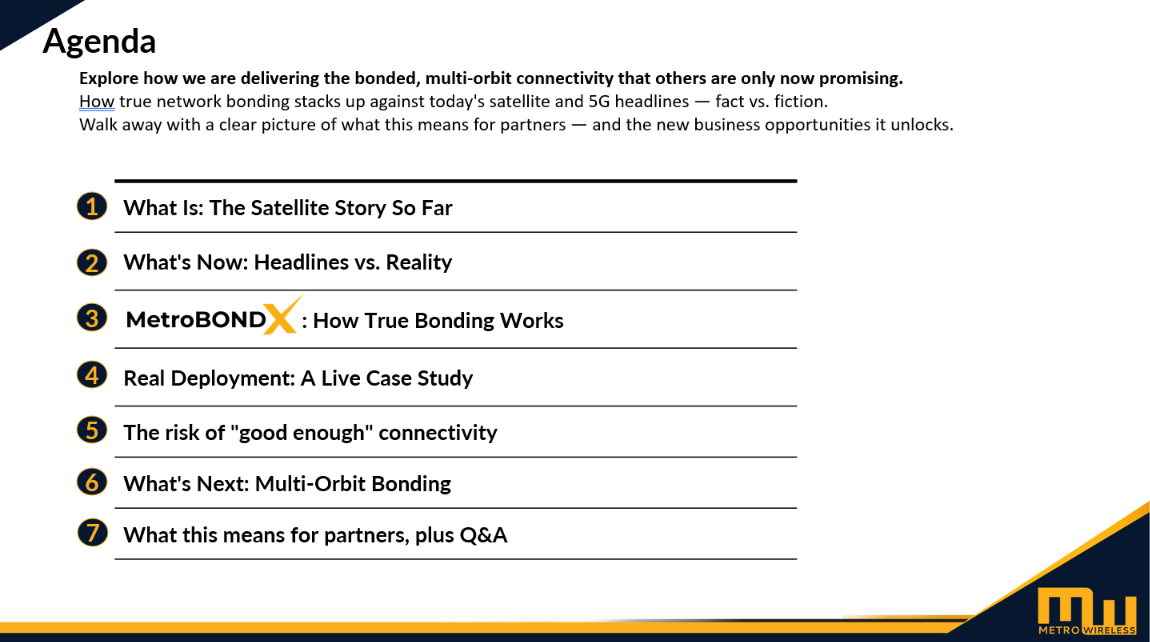
So, hey, what are we talking about today? Yeah, that's a good question, right? Lately, there's been a surge in, well, I guess I'll call it advertising or propaganda of companies bonding of wireless circuits and. Well, let's say some of it small amount of it is fact, and unfortunately, a large portion of it is fiction. So we are here hopefully to clear the air. I will say this. I'm going to shout out to my friends over at T-Mobile. For being the inspiration for this webinar, not necessarily just picking on them, but they were They were the impetus for this. So thank you very much, guys. At any rate, man, here we go. So, I think when you first. To start out today. What is bonding, right? And maybe that's where this fiction and fact and all that kind of comes into play, but if we agree on this definition, right, that bonding combines two or more independent wireless. Internet connections into one single logical connection, right? That aggregates their bandwidth to deliver greater speeds than what one circuit can provide. If we all agree on that. You're gonna have fun time talking with us today and learn about what we're doing. Our folks at T-Mobile and others are touting this capability, but it's misleading. And Metro, quite frankly, has been delivering an engineering bonded solutions since 2018, so knocking on 10 years there. Tom is going to spend a little time later on a really, really super cool case study. We like showing you guys case studies, real life case studies, installed case study. And also we'll talk to you a little bit more about what the future is going to look like here when it comes to bonding and bonding multiple orbits and those sorts of fun things. So and Gus, be prepared. All right. All right, let's go on to the next.
Paul Asquini 00:07:25
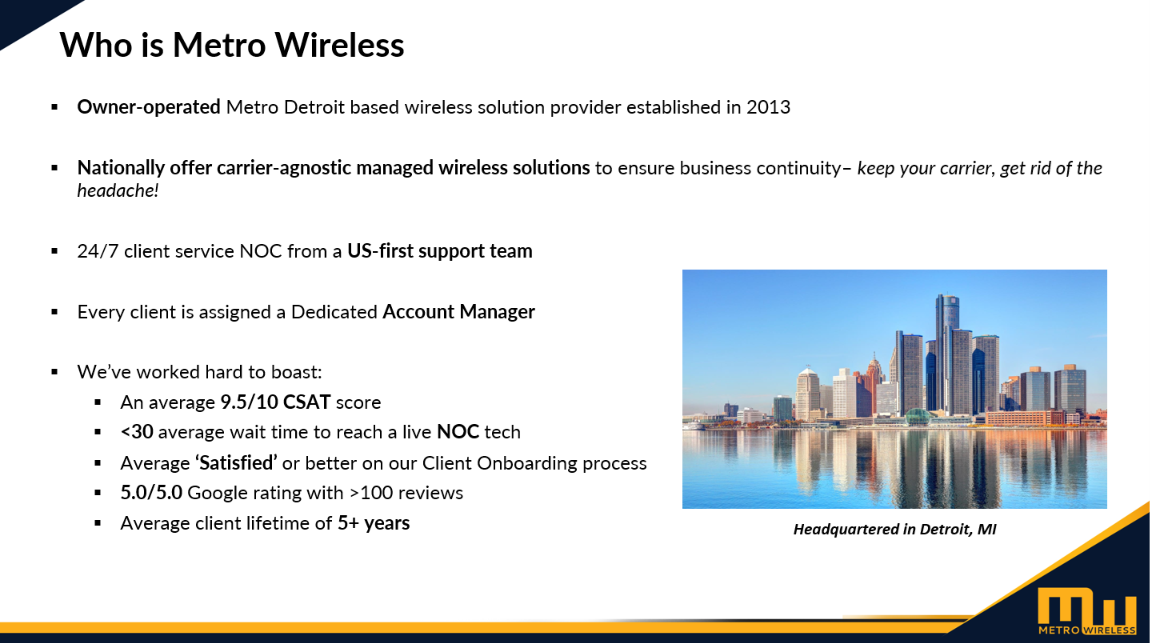
All right, so here we are. So this slide is very familiar to our strategic partners, right? But to our newer friends out there, we did begin our wireless journey well over a decade ago. As a wireless ISP in the mean streets of Detroit, Michigan. We are a wireless engineering firm. And we deliver the most complicated wireless solutions that really the big guys just can't do it. They just say they can't do it. And if you hear that from any of them, that's one to bring to us. But to keep it simple, I want you to think of Metro Wireless really as. All things wireless, with one exception, right? We're not selling mobility, cell phone plans, tablets, cell phones. But anything else that comes wireless, we can get into DAS, that's a huge Wi-Fi, private cellular networking, if you've been on some of our past webinars. So bring it to us. But in addition to delivering complex, right, we also stand above others. And really our back office support, it starts with, frankly, live human touch, right? We all know about artificial intelligence, AI, chatbots, those sorts of things. And there's a time and place for it. And even this old guy here uses a little bit of AI from time to time, right? But when it comes to doing the common things uncommonly well, having a live tech support when your customers call in, again, they're in a panic when their internet's not working, right? We brag about a 30 second hold time. Frankly, it's a lot less than that I guess we got to stick with 30 seconds. When your customers call in. You know, and I'll tell you, just yesterday, actually, it was kind of timely. I live in the New York market, and I get my sports fix from WFAN radio here in New York. And I heard Boomer Esiason yesterday morning was doing one of those commercial ad spots. And I didn't write down the name of the company because it wasn't something I heard, but it said that they offer. This company offers real tech support in two minutes. And I found that interesting. I wasn't quite sure what real tech support meant. If any of you know, certainly drop that in the box there for us. So. And then in addition to tech support and live tech support and fast answering, and we have this year tripled our customer success team now. That means that every customer you bring to us, regardless of their size, regardless of their spend. single location, 150 bucks, 50 locations, whatever it is, doesn't matter. They're going to get an assigned dedicated account manager. Again, those things cost us money. But we feel like a huge touch is important. And the big companies are putting their customers in a queue, especially smaller, smaller customers. These are some of the reasons why we have very loyal customers, high satisfaction scores, as you guys can all read right there. So thank you very much. If some of our clients are on today, so we appreciate it. Let's go to the next.
Paul Asquini 00:10:52
Starlink and Peplink. Wow. Well, listen, first, wireless is in our DNA. It's not only in our name, but it's in our DNA. I mean, it is our business. It is not a hobby, it is not an after thought. And for those reasons, right, it is 99% of our business, right? We stock Starlink dishes. I'm sure some of you have come across others. Our aggregator friends that this is a hobby. This is 1% of their business, you know, and they have to order from Starlink, and what do you see? 4 to 6 week lead times. We keep Starlink dishes, Peplink modems, routers, mounts, cables, kits, everything that we need. If you have a customer that needs something quickly, we can ship same day, next day. And the others, again, you're waiting on timelines that are out there. So if you've got urgent needs, certainly we don't want that to be the standard, but we can, we can support you and do. We're an authorized solution provider. I don't know, Tom, you may know better the exact, but it's more than two and a half years and we're starting to knock on three years with becoming a certified authorized solution provider there. Make sure whoever you're talking to about Starlink has been certified and is authorized solution provider. We learned a few months ago of a supplier with another TSD was not certified. They had a few hundred installed. They all got shut down by the Starlink cops. We've got well over 700 installed. Starlink instances globally, yep, as far away as Australia. Perth, Australia. So not only do we know how to deliver it, we know how to manage it as well.
Tom Benson 00:12:42
And that's not the first time there's been a Starlink shutdown. I heard about one - two years ago. We don't get into naming names.
Paul Asquini 00:12:45
No.
Tom Benson 00:12:46
Because we're polite, but. Bottom line, just let's make this clear. Somebody sold a deal from Starlink in the channel. The customer at Starlink, they're rocking along and one day Starlink turned it off. If that's your client, it got turned off. And then like, oh geez, sorry, dude, we were cowboying it up. So.
Tom Benson 00:13:20
That I cannot imagine that any sales partner was happy when all of their clients got turned off on Starlink, and it was discovered that they were not in the right place. There is no way you can't look bad if that happens to you. So authorized provider is a big. Deal.
Paul Asquini 00:13:22
Yeah, it is a big deal. By the way, just without getting into numbers too, it's a big financial commitment on the front end. And I think that's why a lot of companies don't do it. We do want to shout out a little bit more to Peplink here because as we're talking about today, about this bonding, right, this whole definition of bonding and whatnot I mean, that's where all the magic is within the Peplink environment and their technology. So we'll get, you know, that's that's why it's really important for us to bring that out. But hey, Tom, thanks for jumping in. Please welcome Tom Benson, who's going to take us out of the next round here.
Tom Benson 00:14:02
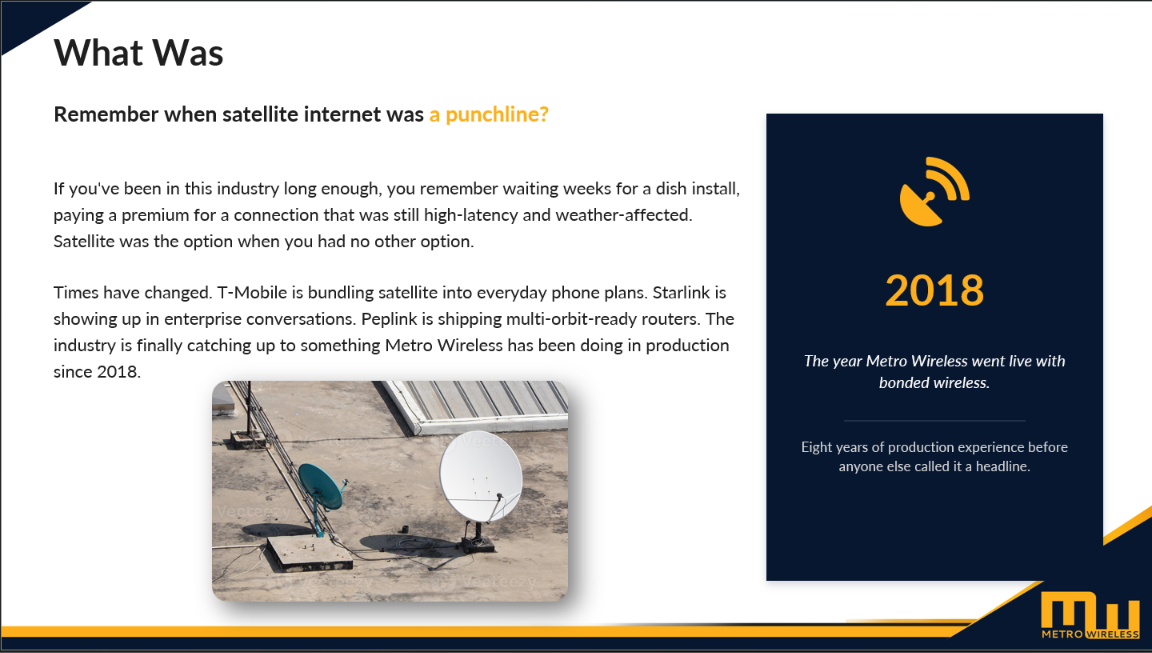
I just had a weird pop up there. All right, so I've been in wireless internet since 2012. I used to work for Broad sky Networks. Broad sky Networks actually was its foundation was satellite. It was a satellite aggregator before 4G came along. So I've actually quoted, I've been quoting Starlink, pardon me, I've been quoting satellites since 2014. Old-school satellite, and so, old school satellite was 3 meg down, one mega up, 600… latency about 500 milliseconds. it was a last resort. And then a HughesNet was a part of that, and most people don't have a favorable memory of HughesNet. Then my friends at Viasat came along. Faster download, but still high latency. And they're still around. But satellite was not. That was the last thing you went to, and the dishes were enormous, and the speeds were bad, and for many different reasons. Satellite never really became a big thing, except for in the power industry, because the power industry is the biggest wireless consumer in the world. So that's kind of satellite was. And then. Times have changed. Starlink… everybody knew about low Earth orbit. Low Earth orbit is not a secret. The technology and the concepts existed since 1987, you know, in the mid 80s. If we just put satellites a couple hundred miles up, we could really have something here. That's not an issue. What at issue was, is how do we boost it into the sky at a reasonable cost? That's what Starlink solved with SpaceX is we can… but with the reusable rockets, and it's an amazing engineering achievement. And so now there's 10,000dishes up there and that's or pardon me, satellites up there. That's constellation one. Then Amazon wants to get in Blue Origin. There's a lot of companies with money. There's a space race going on right now. And as a sales partner and as someone in the channel, this is like when SD-WAN kicked off. Satellite is here and it's going to be here and we're going to keep doing it more and more. So right now, Starlink is the most viable in-orbit network. Itis the first, it will not be the last. Okay, so it's coming. Next slide, please.
Tom Benson 00:16:18
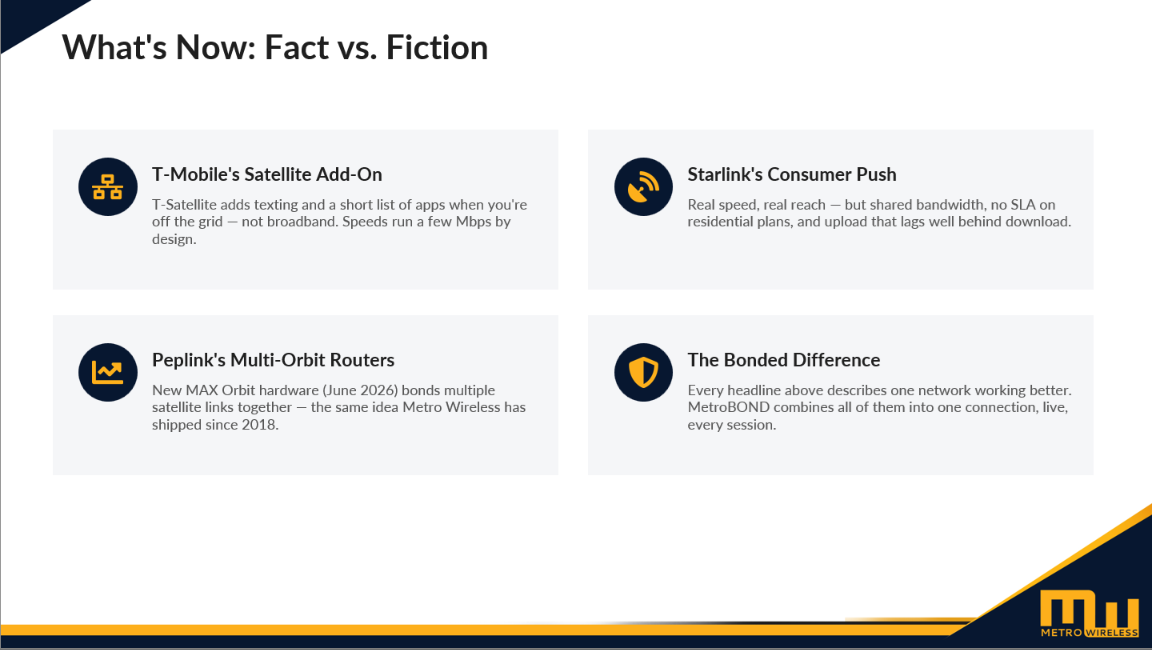
So we've been doing this for two and a half years. My friends at T-Mobile kind of got onto the game. And so here's what's going on. T-Mobile has a thing with Starlink, and right now, if you have a T-Mobile handset, you can maybe get texting and a short list of apps when you're off the grid. That's great. That's hand set, that's not business internet. Then Starlink has a consumer push. It's real speed, but there's no SLA on it, and it's mostly download. The upload is not great. And then you can't get a static IP. Also, just as long as I was talking about rules before. Please don't put a Starlink consumer plan on top of a business customer. They will find it and they will turn it off. That hack got exposed two years ago. There's still people getting trying it. Don't do that. Because the consumer plans are cheaper, we get it. And then Peplink recently came out what they're calling a multi-orbit router. And the concept of this is no more than multi-orbit is referring to Starlink is sitting about 200 miles up. Amazon is going to go a little higher. They're going to go about 1,000miles up. This isn't that important, except to know that there are going to be multiple layers of satellite up there delivering different bandwidth and different performances. And also different diversity. So now we could connect to Peplink and Amazon and Blue Origin and whatever the next one that rolls up there is. To deliver more and more bandwidth from space. The bonded difference: MetroBOND is combining all of these networks that currently exist, which is 5G and Starlink are the mature wireless networks at this time. And the networks to be. Which will bond those two. So as the technology progresses, we're already in a position, we'll just plug it in and we'll add it on. And we'll just keep going faster. Okay. Next slide, please.
Tom Benson 00:18:11
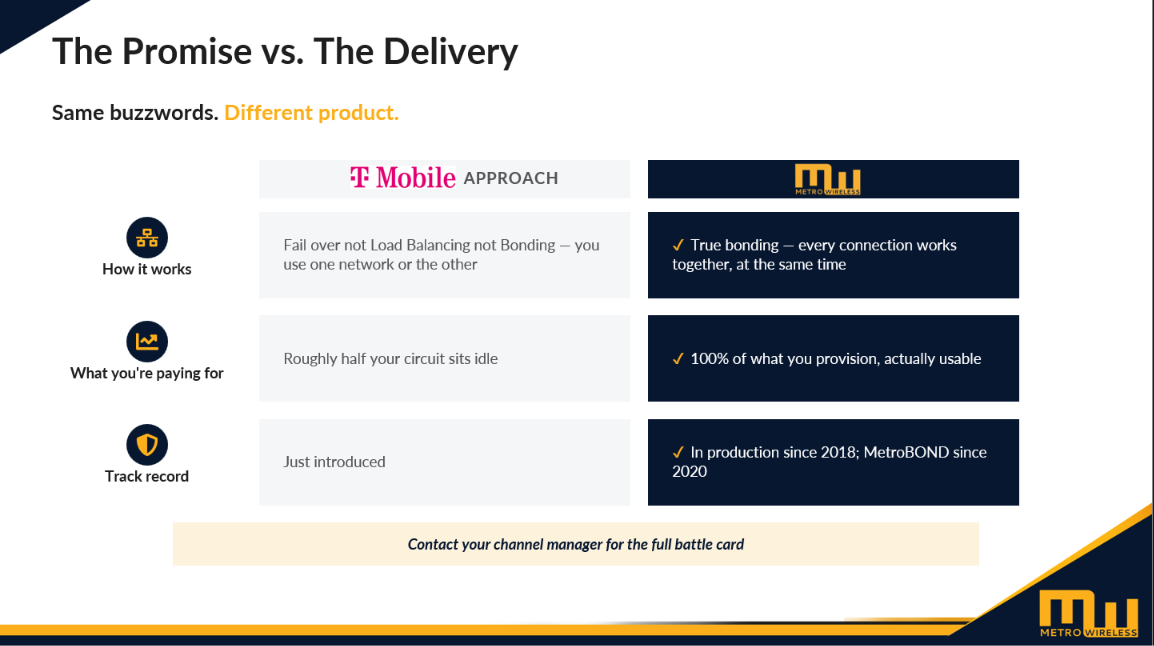
So Promise versus Delivery, this is where we're drawing a direct distinction between T-Mobile. These are just the facts. The T-Mobile approach is a failover approach. They're calling it T-Mobile super broadband, and they're touting it as bonded. You know, bonding is not a dictionary term. Bonding to me means you're using both at the same time. What T-Mobile's approach is load balancing. You're using Starlink or 5G. You're not using both at the same time. And so what's implied there is if you're using the T-Mobile side, the 5G side, your Starlink circuit is sitting there idle. Now you're still paying for it. You're just not using it. If you're using the Starlink side, you're not using the 5Gside, you're paying for it, but you're not using it. So one half of your available bandwidth is delivered and one half is sitting there doing nothing. It's just a load balancing approach. Load balancing is cute, but I mean, load balancing is not new. This is just two networks that load balance. Like, whoop-de-doo. This has been around forever. And they've just brought it out. And I can't know this for a fact, but I can reasonably predict that ordering a Starlink dish and an install through T-Mobile might have some friction. Let's just leave it at that. So let's go wrestle with your AI chat bot to get your circuit installed and see what happens. I just can't see that going smoothly. In contrast, MetroBOND is from us. We handhold it all the way through and you're using both circuits at the same time. So T-Mobile and Starlink. Starlink and Verizon, Starlink and AT&T, whoever has the best circuit in the area. Starlink is a fairly uniform network profile, right? We know what we're going to get from Starlink across the country. Basically. 5G is tower dependent. You want to get to the network that has the best service. So if T-Mobile doesn't mention this, but I will. If the nearest T-Mobile tower is 10 miles away, thenT-Mobile is not going to work I don't care how much it costs, it's just not going to work. It's too far away. But there might be a Verizon tower, an AT&T tower nearby, and so we would go to that. So this is where you start crafting an actual solution that will work. For your customer and deliver it, and they'll be happy, versus a theoretical approach that falls apart when you kind of go into delivery mode. So yeah, MetroBOND, we deliver both at the same time, aggregated bandwidth, no exceptions, download and upload. Okay, next slide, please.
Tom Benson 00:20:41
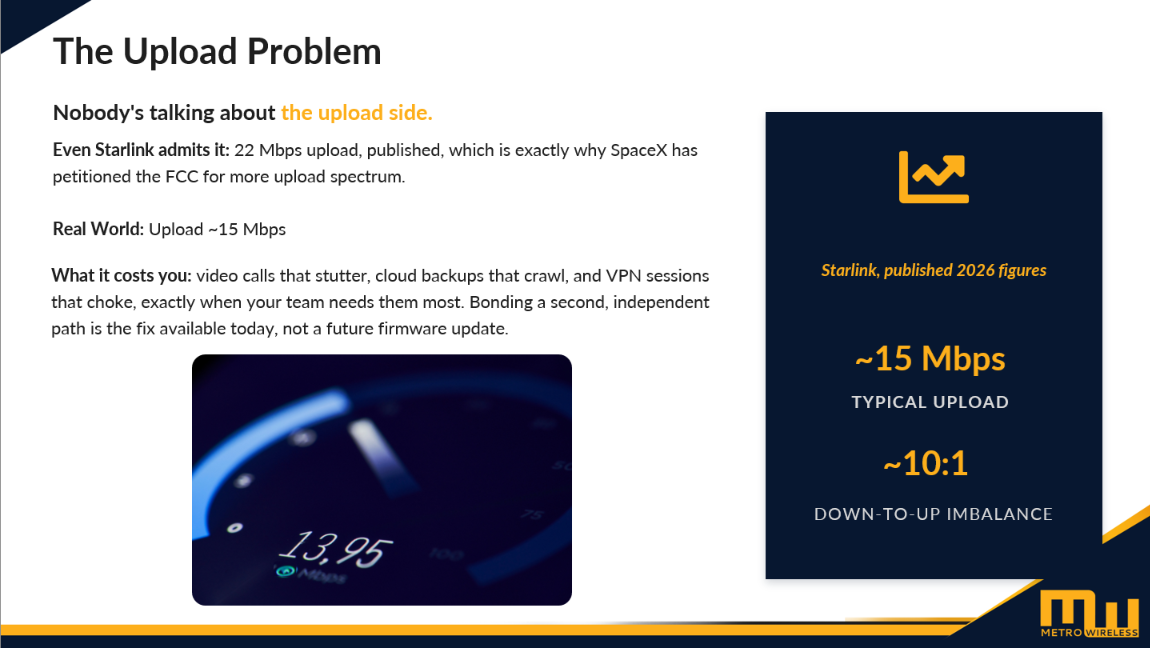
Let's focus onupload a little bit. Starlink proper is not fast on the upload. We're seeing a lot of requests for Starlink come in. And they kind of go like this. The execs say we got to have Starlink. Okay, let's talk about Starlink. Now, we love Starlink. It's a miracle if you're in the desert oryou're in the middle of the plains of Wyoming and nobody lives near you and you're driving a truck. Starlink is amazing. It delivers 150 meg down and 15meg up in the middle of. God left his shoes as a guy I used to know used to say. Or, if all the power is lost in an area for an extended period of time, and the cell towers die. For instance, the Texas ice storms or the South east hurricanes a couple years ago. In both cases, the cell networks disappeared. Pretty quickly, either because they got flooded with too many calls, and then they ran out of power. And Starlink kept working. So in those instances, Starlink's amazing. However. 150 down and 15 up is about the average speed on Starlink right now. And I would not categorize that as amazing. I would categorize that as nice. But 150/15, And particularly 15 15 is just nothing to write home about. Every Teams call, every Zoom call, there's a lot of upload traffic these days, and you're trying to shove it over a 15 meg upload circuit. So. That's just not that fast. Generally speaking, the way Metro Wireless approaches the solution is we have 4 networks to craft a solution out of Starlink, AT&T, T-Mobile, Verizon. Objectively, what's going to deliver the best performance at that address based on tower proximity, how much speed there is and how much diversity the customer wants. And then we craft a solution. We don't care what network we use. While we're impressed with Starlink, we don't place it above the 5G networks are an amazing tool that work well. And as I say many times, 100% of American business uses the cell networks every day. It is the most beloved technology in America. The 5G networks work. If you've had an experience in the past where it didn't work, it's because the provider you went with was doing this as a hobby. Referring to Paul's earlier solution, when they quit, that's when we dig in. Wireless works. You might have to put an antenna on the roof because you have a steel building. I get it, but with Starlink, you have to put an antenna on the roof too. So it that's sort of equal. So the 5Gnetworks work. They're rock solid amazing technology. And we have a case study coming up where it kind of expand into that a little bit more. So back to the upload problem. 15 meg upload is not that great. What if we fail over to this and it's our only circuit is 15 upload going to be enough for the business? Clearly it's not for an enterprise business. So how do we make it go faster? We got to bond it. So next slide, please.
Tom Benson 00:23:43
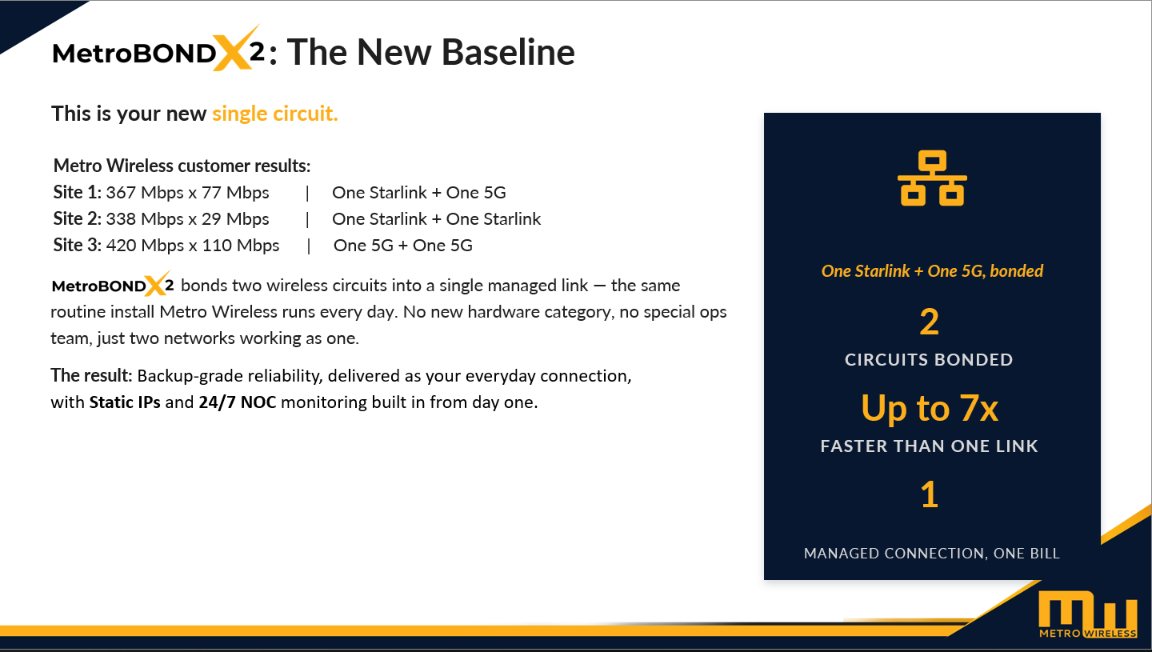
So Metro, so the baseline for this is at a minimum, let's bond two circuits. And these are just some examples that we've delivered. You know, one, two, three. One Starlink, one 5G site one, we got 367 down, 77 up. Okay? That's fast. Compare that to a 4G circuit, like I used to sell at Broad sky, where we've got 30 down,10 up, and we'd be giving each other high fives. That was cute, but that's irrelevant now. That's like failing over to DSL. The new standard is, you know, this, and then 338/29, that's Starlink plus Starlink. Now notice the drop off in upload speed. When you bond two Starlinks together, you only get to 30 meg upload. Likely there was no 5G circuit available here. And then finally, sort of a the one two 5Gs together, 420 down, 110 up. And that's unlimited data, by the way. So to make a point, if you put one of these circuits in, this is not an idle circuit that sits there doing nothing where you're paying for something you don't get to use like your insurance policy, you can use this every day. So MetroBOND two wireless circuits together. That's X2, the nomenclature here is the X is the multiplication symbol, two means two circuits. There's also three, four, five, six, really kind of the sky's the limit. Gus, can we do a 20? Is there a 20 port bonder out there? I know we can do 10.
Gus Staudt 00:25:14
It might be possible. We just need. If we have the right switches.
Tom Benson 00:25:15
It might be possible. You keep climbing the ladder.
Gus Staudt 00:25:19
If we have enough roof space, maybe we can.
Tom Benson 00:25:24
I have seen pictures where this was born, oddly enough, was on the cruise ships. Peplink start… the cruise ships needed more bandwidth for their Wi-Fi. They put Starlink's up, but they were multiple things, and they had to run VLANs. It was a pain in the ass. They found Peplink. Peplink said, why don't we just bond all20 together and give you one handoff and use that for your Wi-Fi? And that's what they did. And that's where Starlink and Peplink kind of got introduced. Since then, they've become very tightly integrated. And I read somewhere that if a Starlink terminates to another device, if. There are more starlink to Peplink than any other handoff device in the world. Now, it's a narrower category, because some people just have direct Starlink, but if youhand it off to a management device, then Peplink has number one market share there. So, for what it's worth. So that's yeah.
Paul Asquini 00:26:15
Hey, Tom, letme add here if I could, because it's really important that the group here knowsthat. The Bond X2 is we've been doing it for so many years. Every single month.Gus's team is delivering a MetroBOND X2. I'm without naming names. I have acustomer that this year alone has bought 10 different versions of our MetroBONDX. Right? So Tom's going to get into another slide that talks about more thanthat, but our MetroBOND X2 is what everybody else's 5G is today. So keep thatin mind. That's how normal this is for us and how easy it is for us just an X2.And of course, dollars go up. Compensation goes up.
Tom Benson 00:27:06
Win-win. It's aterm I've used in the past. You're walking down a well-lit path here. This isnot bleeding edge. It is leading edge, but the bleeding edge was two years ago.That's when we were making all our mistakes. We're done making mistakes. Thisis a production circuit for us. This is what we do. And it's just a prettystraightforward matter of find the nearest 5G tower, see how far away it is,find out what the roof space is, get it and quote it, get it installed, and putit in, and now you have significant high availability band within your roof toprotect your cloud, to protect your AI, to protect your compute power that's inthe cloud. To protect the business, really. Okay, next slide, please.
Tom Benson 00:27:51
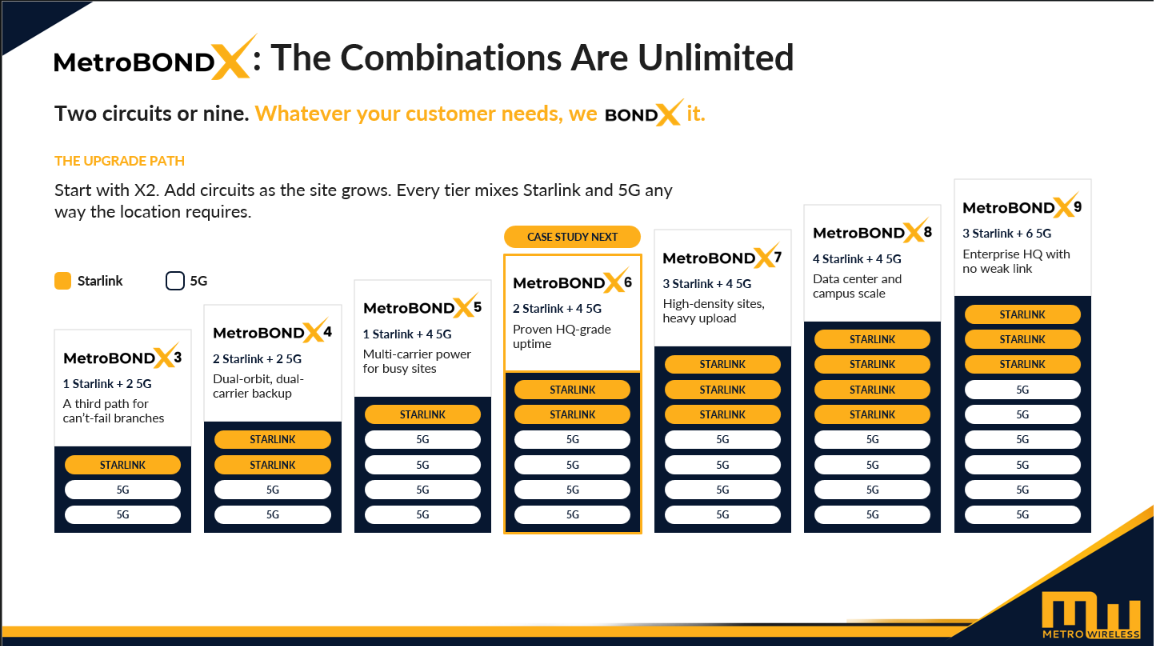
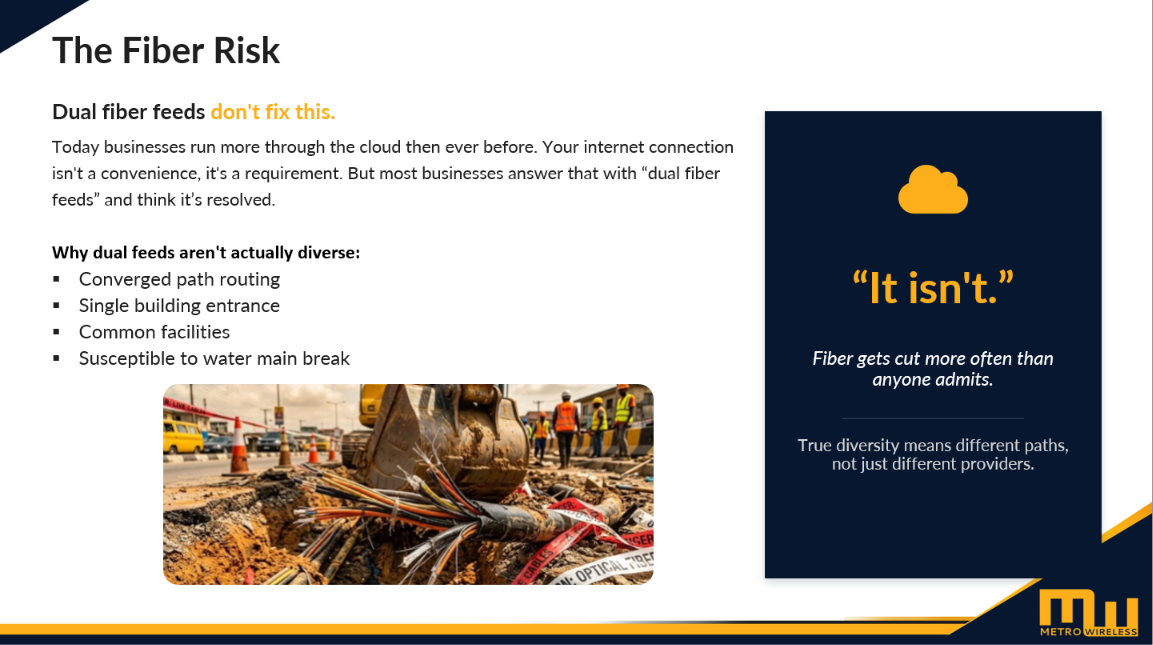
So the combinations are unlimited. This gets almost stupid complicated. Because you have four different networks to work for him. So I, the rate grid gets insane, but X2 is one Starlink, one 5G, or two Starlinks, or two 5Gs. Not so bad. Then you go to X3, and now you can see how it starts to get out of hand. It could be1 Starlink and two 5Gs, or it could be 3 5Gs, it could be 3 Starlinks. I won't keep going down this path, but. X2, X3, X4, X6, 7, 8, and 9. Now, as a practical matter, we're going to talk about a case study on X6. So we want to get into that, and this one happens to be 2 Starlinks and 4 5Gs. But I guess the point we want to make on this slide is if you want to go faster, go faster. We're not here to say no, we're just here to say this is how much it's going to cost. And yeah, we can get it delivered. As a use case, I've said this many, many times, but I'm going to say it again. If you look at the cloud compute motion that the entire nation, and the entire channel has moved down in the last 5 years. We've thrown everything in the cloud. It's amazing for many reasons. The workloads are in the cloud that all the advantages of the cloud are amazing, and frankly, there's been a fair amount of money generated moving things to the cloud. Here's the downside. You've generated a risk. Everything's in the cloud. It still is dependent on your fiber network, and fiber networks get cut. Yeah. And that if you want to say that my redundant fiber network can't get cut, I will point you to the Newark Airport story from three days ago where they had a double fiber connection and they both got cut. If that's your customer, your customer now has 50% of their business or more in the cloud. That's a major impact. And we put some numbers down we're going to talk about later. But just conceptually. This circuit is what seals in your cloud gains. The circuit is what ensures your house went from a $500,000 house, it rose in value to 5 million. You got to upgrade your insurance policy because if it burns down, now you're out four and a half million dollars. There's a million analogies here, but I think my point is made. Okay. Next slide, please.
Tom Benson 00:30:09
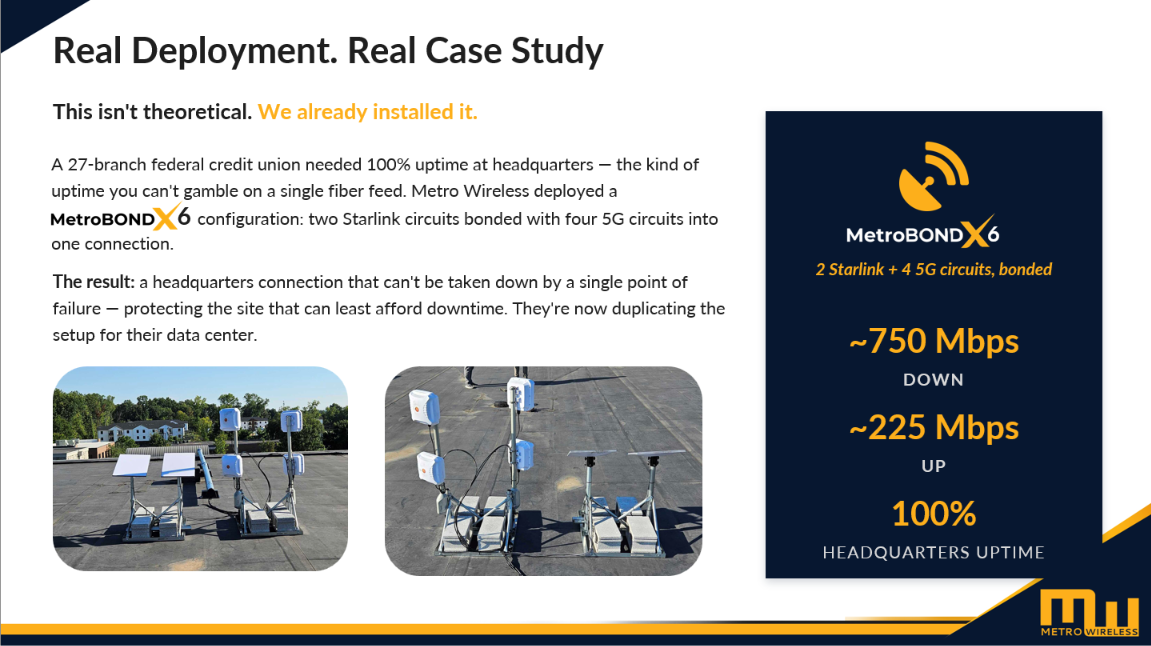
So, this is areal deployment case study. This is a federal credit union with 27 locations in Louisville, and they're moving to an SD-WAN environment. And they wanted to make sure they had redundancy on their HQ and on their data center. This was circuit one of two. This was installed MetroBOND X6. And the way that they ended up was this. They have two Starlinks and they have four 5G circuits. Here's a picture of the deployment at the bottom. This is what it looks like on their roof. Each one of those antennas you see is pointing at a tower. Those are called smart pole antennas, and they actually will rotate to the next tower if the tower goes down. And then the two Starlinks next to it. Yeah, I'm not going to get into, I'm not going to nerd out on the antennas. They're supercool, but let's just leave that for another time. It's the highest gain antenna you can get in the industry, deliver the fastest signal possible. This particular customer ended up with two Starlinks, two T-Mobile, and two AT&T. So they have triple carrier diversity on their roof. If Starlink disappears, they still have AT&T and T-Mobile. If T-Mobile disappears, they still have Starlink and AT&T, et cetera, et cetera. This particular customer, T-Mobile is the fastest 5G network in the area. And if we would have dumped AT&T and went with four T-Mobile circuits, we would go faster. We would have probably added another 100 meg. On the down and maybe 50 on another50 on the up. They chose not to because they wanted the diversity more than they wanted their performance. These are the intelligent conversations we have with end users when we're designing. What's more important to you, diversity or speed. Given these options. And then they make a choice. I don't know what the right answer is, but that was their answer. So we deployed this in a day. Yeah. And then we went through it, and I'm gonna let kind of well, Gus, maybe just speak to this now. This wasn't just a fast internet circuit. The next thing we had to do was make it work in their environment, and we had to map it to their BGP. And there was an IPsec VPN tunnel, which is gobbledygook to me, but means something to you. Without going too far. This was a sophisticated networking environment, and we had to make sure our circuit played nice with their SD-WAN handoff. And just, just, you know, give it a 60-second overview of how we had to integrate this.
Gus Staudt 00:32:34
Okay, so basically we had to hand off to a big Peplink device, like a 580X or in this case, it was a 580X. So just so you guys know, it's a big router that can handle up to two gigabits of speed. So we have enough space. To fit all those devices. And of course, and a funny thing here is we actually used all the PoE ports from the 580X, so we didn't have to run all the SMA cables to the antennas. We power everything with RJ45 PoE devices, and also for the Starlink as well, so that, like, the actual pipe, it didn't have to be so that big for all the SMA antennas. Sorry, cables. So it was very good, and the… on the logical side. We had basically an IPsec inside an IPsec, because we, for them, we had to deliver a static public IP, static, so the customer can have, like, his own IP, always, always the same. And using that one, like any other fiber connection or like any other fixed wireless connection, we were able to deliver smoothest connection between site A and site B, and inside this tunnel, he created another tunnel, another layer of security. For his devices, so he can connect one side to the other side. So basically, it's overhead, so he might not end up in the end reaching the full giga, but because of the overhead, but we can for sure deliver very high speeds with this MetroBOND X6.
Tom Benson 00:34:13
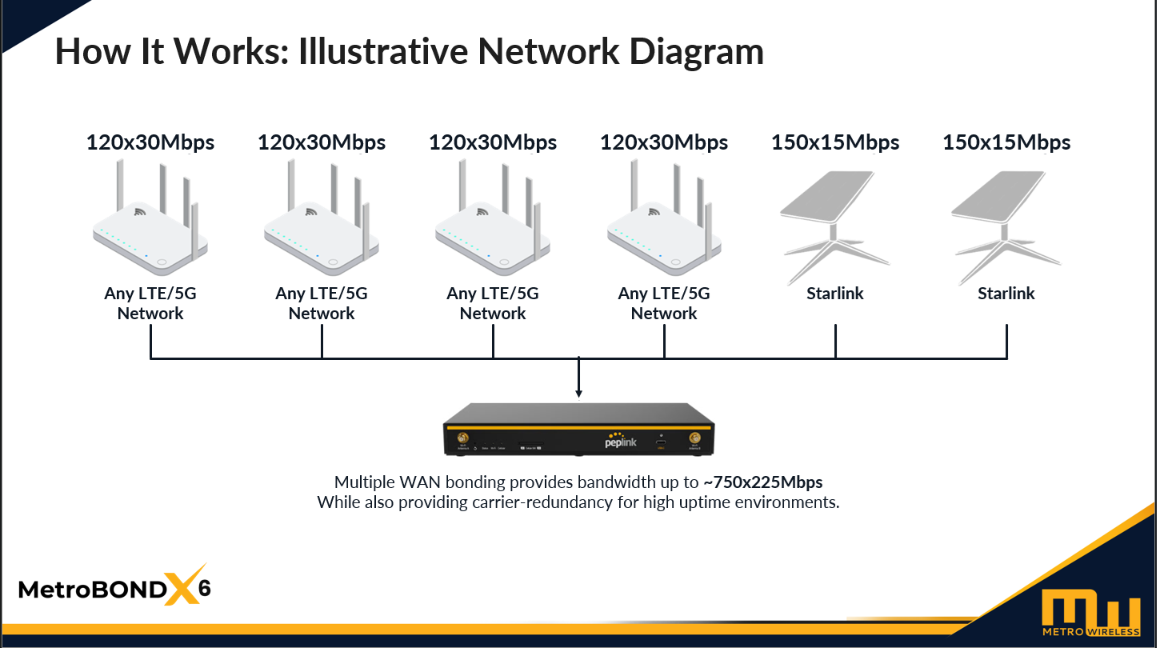
Okay. So sort of, you know, for some people who like to get granular, I got a guy who can get granular with you, so that's awesome. If I kind of summarize this, I kind of want to make three points to this. One, this is a United States federally regulated banking institution. This is the most regulated industry in the world. And this met all of their security requirements, and this will pass when it comes up, this will pass their security audit. So I'm confident that if they're confident in the security and the interoperability of the circuit, that we can match the security requirements of any client that you have. Second, even with we lose something in the bonding, but we delivered 750/225 on this. That's very fast. This is fast enough to run the business if they lose their fiber, and that was the intent. They're also going to put this on top of their data center. And so, you know, this was business land and expand. This is business leading to business, and then we'll we'll find out about the other 27locations. And then my third point is, this isn't just dropping off a circuit and saying, here you go. This is a sophisticated customer with high demands for security. And we were able to match this circuit to make sure we were delivering traffic in processing it properly. I want people to have confidence that you engage with your enterprise-grade clients, that we will speak their language. And we can make them happy. So, that's the case study we wanted to get across. This is up to six. I'm looking for the first person to sell at 10.In fact, I'm willing to bet I can get management to throw in a pretty good sized spiff for the first 10. So if anybody wants to go fast, let's get it. Let's get it. Next slide.
Paul Asquini 00:35:56
Yeah. Hey, Tom, you mentioned that you mentioned that these smart poles that have the 5G and they're kind of facing an opposite directions. I thought you could talk a little bit about when you said they rotate, how does that happen? How do we do that, or maybe not how, in terms of whatever, but, like, who does that, and why would you rotate?
Tom Benson 00:36:15
Yeah, these are, so these actually are motorized poles. And Paul invited me to get nerdy, so let's get nerdy. These are motorized poles, and currently they're pointing wherever they're pointing. And they're pointing at a tower. The reason you do this is because a fixed. This is called a fixed antenna versus an omni antenna. So the antenna sees signal from this direction, and it doesn't see signal from behind it, whereas an omni absorbs from all directions. The reason to use a fix is because they gather more signal, they're stronger. You measure this in dBi. dBi is a measurement of how much signal gain you're getting in a directional antenna will get 16 dBi gain, whereas an Omni's down around 9. So they're about double. So you get more signal gain off of fixed. The downside of, so that's good. Here's the downside. If that tower dies, you're still pointing at it. You can't see the tower behind you. That's why people would go with Omnis and say, well, let's get an Omni in here so we can absorb in every direction. The other theory on these antennas is, how about we point it at a tower, but when we install it. First of all, it does a rotation and picks up every tower in the area. And it knows that if it loses this tower, if this tower were to go down, which is rare, but it can happen. It will motorize and rotate over to the next tower over. And that takes 10 seconds, 20 seconds. It shouldn't make a difference. We're trying to get the best of both worlds here is the point of these smart antennas. And then you Gus touched on it earlier. The other reason this is cool is because we're not running antenna cable 100 feet down to the router. The routers are actually up on the roof. And so you're getting… so you're not losing your… the signal you gain on the roof, you're not losing it by running it through the wire. Again, super nerdy. But we're 100% of the gain that we get from the antenna is translated into performance, and we drop it to the router on the roof, and then it goes to an Ethernet cable, and so we're not losing 20% of our signal running it through the antenna. One person on this call cares about that, but it's probably me, but I just find that interesting. So summary statement, there's a lot of details. Again, I'm going to go back to, I love Paul's comment. This is not a hobby for us. This is what we do. So in this tiny little niche of wireless, when you come to things where like, I need a wireless solution that actually works here. You want to call us. We dig, and we dig, and we dig until you get the solution you need. And a lot of my friends in this industry quit. It's not their main business. It's too hard, and they quit. That's just bottom line. Okay, next slide, please.
Tom Benson 00:38:56
This is just a logical diagram of how it looks for you visual learners out there. This two-Starlink for 5G down to one router, aggregates the bandwidth together, hands off to an ethernet I think we're well covered on this. Next slide. So.
Tom Benson 00:39:15
We kind of mentioned this already, and I think this is my last slide. A dual fiber feed is not diverse. There's only so many ways you can get fiber to a building, and that's using the public right of way. There's only so many trenches, and there's only so many entrances to a facility. And I guess I'll bottom line this. If you have fiber from Verizon and you have fiber from Lumen, get them to put in writing that it's never in the same trench. And I'll wait. And I'll be dead before you get that in writing. It will never, ever happen. I'll put it inwriting. We're not in the same trench. So if you need a high availability circuit and you want to eliminate all risk of fiber cut. Dual path is not… does not do it, but wireless does. And then if you want to go fast enough to serve the business, you got to bond it. That's sort of the thrust of this whole webinar. Okay, next slide please.
Paul Asquini 00:40:18
I'll take
Tom Benson 00:40:19
All right, so cost of downtime. This is where Paul is going to talk about what's the ouch factor. I get the nerdy side, he gets the dollar side.
Paul Asquini 00:40:26
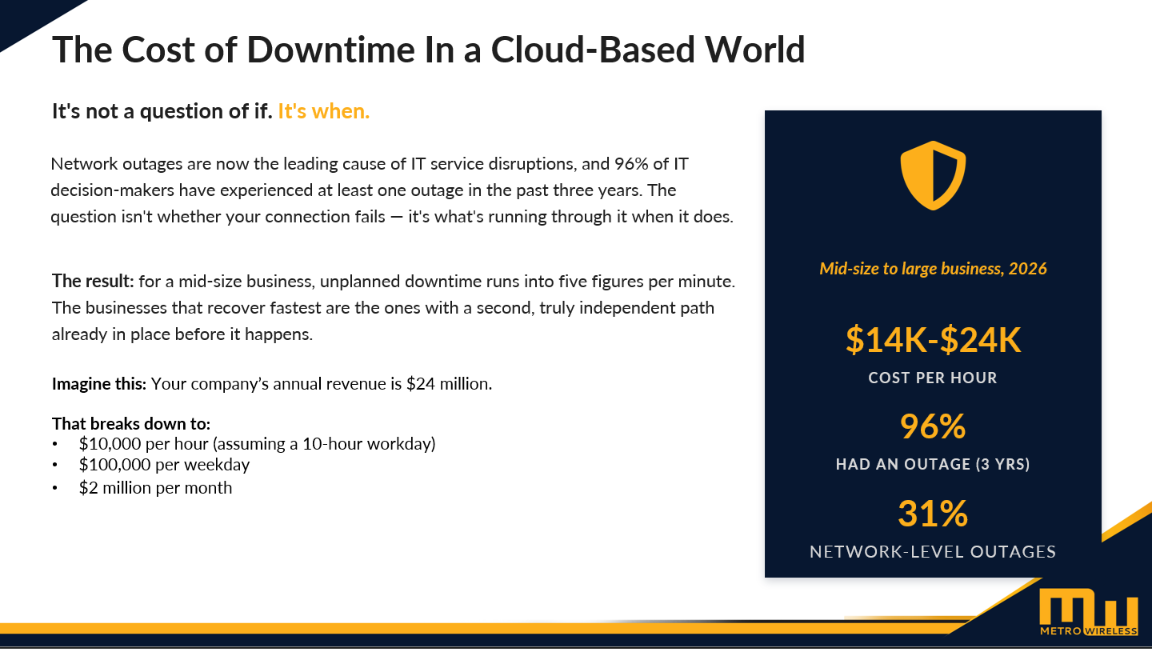
Oh, look at that. Well, look, man, we're all on here. Most of us have sold SD-WAN. Why? Because customers are asking for at least two circuits, right, for outages, more and more and more and more of their data is going to the cloud. And as Tom said earlier, I mean, that's a risk factor, and everybody feels like they recovered by having dual connections, and we talked a little bit about. I live in New Jersey, so I fly out of Newark, and was keenly aware and hearing of the. FAA issues these last couple days. I sat there and said to myself, I wonder how much. The 300 plus flights that got canceled just out of Newark alone. How much does that cost everyone involved, whether it's the airlines. It I have no idea. It's got to be a staggering number, right? And it could have been avoided. Really could have been avoided for not a lot of money. So let's talk about… so we know it's going to happen right? And I don't even think we need to impress upon that. We just know it's going to happen, and that's why you're selling SD-WAN to your clients, because they also know it, too, and they just need some more guidance from you. So let's look at a business that's doing it 24 million in annual revenues, right? So not a huge, big, big, you know conglomerate, you know, billion dollar, whatever, but just a $24 billion company. What is that…what does that come out to? About $2 million in revenue a month, and a 20-day…20 business day month, you're looking at $100,000 per day, right? In a 10-hourday, like, by the way, we did these numbers to make it easy math. If you want a12-hour day, do your math. You want an 8-hour day, you could do your math. If you could do this, but get it. It's thousands of dollars per hour, right? Whether it's 8,000, $12,000.
Tom Benson 00:42:12
I was told there'd be no math.
Paul Asquini 00:42:16
That's a line. Yeah, I'm not trying to do math. That's why I'm trying to do this Dewey decimal system or something with the tens. But yeah, no quizzes here. So just think about that. It's thousands of dollars an hour. It doesn't cost thousands of dollars a month to have. True redundancy. So I'll just leave it at that. This is a slide you'll get, and if you want to use it, feel free to use it, but important stuff. Okay, let's move on to the next. Yep.
Tom Benson 00:42:46
Yeah, thelittle point I've made on this, just when we have a nice worksheet there isit's $10,000 an hour using this example for 10,000 a year, I can eliminate thisproblem.
You know, a dual bond met MetroBOND X2 doesn't cost 10,000 a year. It's about 10 grand a year, about 800 a month, give or take. So for 10 grand a year, we can eliminate this problem. This $10,000 an hour problem. That's kind of a nice little shortcut.
Paul Asquini 00:43:10
There you go. That was math. You did math, Tom. Okay.
Tom Benson 00:43:13
I did do math,yeah.
Paul Asquini 00:43:15
All right, nextslide, sir.
Paul Asquini 00:43:18
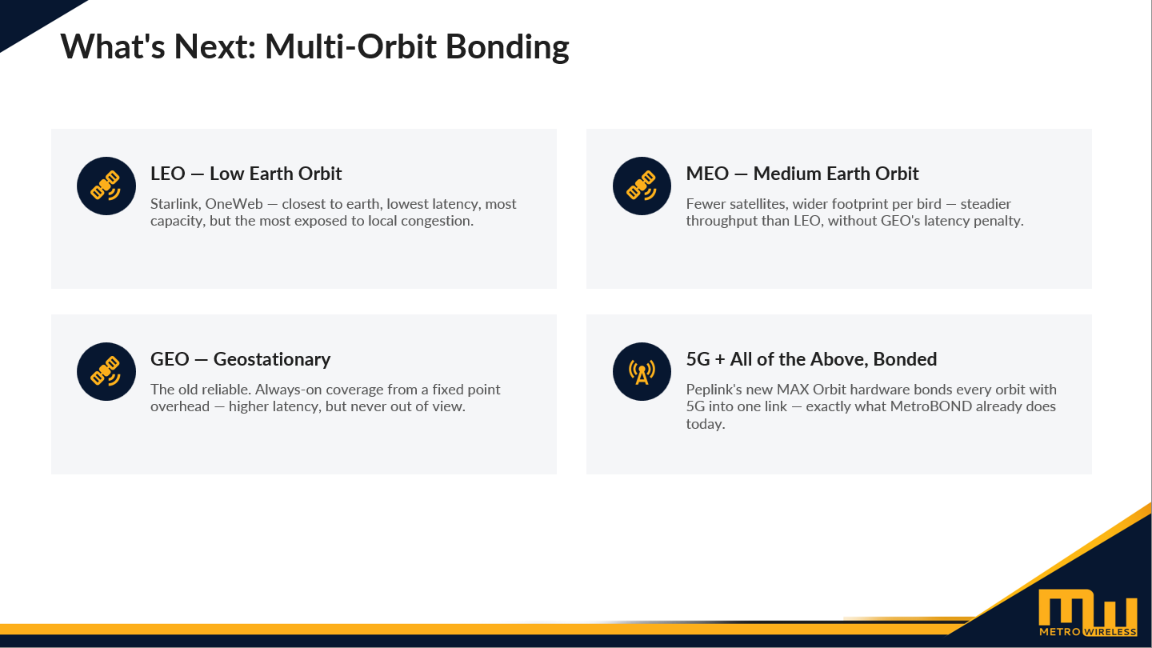
Oh, what's next? Oh my gosh. So as you're hearing, right, we are super tight with our friends over at Starlink, right? We have already been in multiple discussions with our friends over at Amazon and. Amazon is ready for prime time North America. You can bet that we'll be on the front end of that. Interesting discussions going on there that we clearly can't share. Blue Origin, whoever else is going to be playing in here. And you can see the various different types of. Earth orbits here. Gus, is this a place where you wanted to jump in? The multi-orbit piece?
Gus Staudt 00:43:57
Yep, I was gonna say, basically, it doesn't matter where in the sky it is, we're going to get them. We're going to partner with Amazon, Blue Origin, Starlink. And we're going to connect to them so we can deliver the best possible internet for every one. And wild ones. So it has to be huge that I don't like it, but we can do it. If it has been Amazon in a few months or maybe years, I don't know how they are going to, how long they're going to take to do it as fast as Starlink did. But we're gonna get there, and we're gonna partner up, and we're going to be. If not the first, the second ones, so we can be there and deliver those services to our partners. That's basically it. Bonding with Peplink as long as you can and as fast as we can.
Paul Asquini 00:44:54
Right on.
Tom Benson 00:44:55
This isn't on here, but just underneath the hood. It's not just new networks, it's new capabilities. Starlink is talking about… They came out with a dish called the HP Dish. It's out now. They're talking about 1 gig download speeds. There's a little bit of Elon sizzle here. Elon promised self-driving cars in 2021. But self-driving cars are basically here now. So are they ahead of the curve? Yes. But I don't think it's I don't think they're just making this up. Satellite's gonna keep getting faster. So, you're gonna keep putting things in the cloud, demand for bandwidth is insatiable, and Starlink is getting faster, and then Amazon's gonna have to match that. So the speeds we're at today you know, again, I made this point 10 years ago, I delivered 30/10 on 4G and was ecstatic. Now it's a joke. 10 years from now, I'll look at my 760/220 [as heard; slide 12 shows ~750/225] that I was jumping up and down about and go, well, that's cute. But the networks keep getting faster, and we will always figure out a way to deliver. Deliver that actual real high speed to the end user. We'll have the solution for that. So everything's getting quicker.
Paul Asquini 00:46:02
Perfect. Righton, right on. Okay, next. I think we're getting to the.
Tom Benson 00:46:05
I think we're there.
Paul Asquini 00:46:06
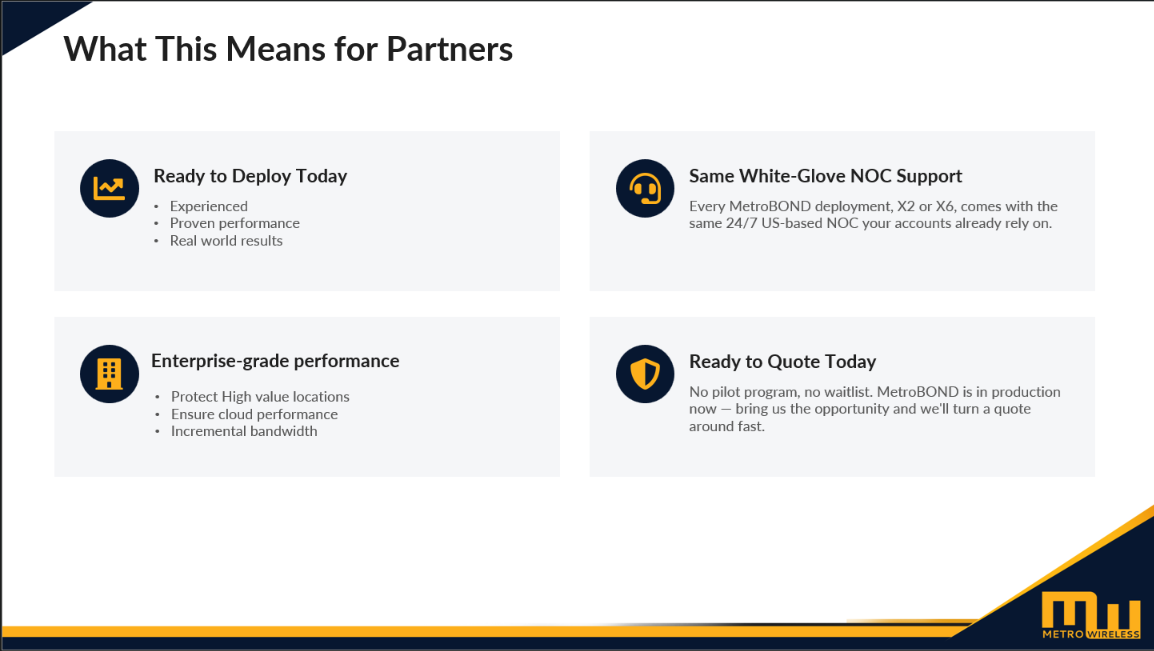
To the end here, folks, yeah, we are here. So, hey, listen, just, I mean, go back one, please. Well, hey, listen I mentioned earlier we stock the product. You have a client need now. We're just about the only ones that can satisfy that shipping same day, next day. Oh, gosh, you guys need static IP addresses slash 29 slash28. We've just eliminated almost everybody out there, right? Because they don't have their own block of ARIN IP addresses. We are. No doubt the heavyweight champion of the world when it comes to bonding technology. We've been doing it longer than anybody, we're just not as big as some of the others, which is what gets Tom and I super excited when we hear the guys like T-Mobile saying Bonding, because now more and more and more of you are listening, because they're bigger than us. That's great. So we'll ride their coattails of their marketing and then we'll crush them because they're not bonding. They're not even load balancing. It's one or the other, right? And if you need multiple wireless circuits to act as one single bigger, faster internet connection, there's nobody else that can do it. Four different TSDs have told me they don't have any supplier that's been able to deliver, and I mentioned earlier, just one customer, just one of my customers 10 already this year, Gus's team has delivered a variety of our MetroBOND X solution. So hey, moving forward, how do you work with us, right? If you go to sales@metrowireless.com, that'll hit Tom, myself, the rest of our account management team and support team so that if for some reason one of us is. On the road, you're not going to be left behind, and we're going to be able to take care of you. So, we got a little bit of time here for some, questions. Gus and Tom, you guys ready?
Tom Benson 00:47:59
We're ready.
Gus Staudt 00:48:00
You bet.
Paul Asquini 00:48:01
Okay, allright. Let's go in our little chat here. So. All right. Good.
Tom Benson 00:48:11
Here's how we usually do this. One of us will read the question, one of us will answer, and we'll read it so everyone has the benefit of hearing it. Lahar asked, is there a month-to-month option, no contract? Yes. Yes. It costs more. And so the only thing I want to add on to that is my friends at Fortify threw everything out as month to month starting about five years ago, and somehow people start associating wireless with month to month. One, they're getting away from that. Their churn rate got high. And two. A 3-year term costs less. So if they're going to have it for three years, then let's get them the best price. But if they need it for a short-term deployment, yes, we can do that. And that includes the bonding. We've put them out there for events. So, yes, with caveats. I just want to make sure we deliver the best value. But yes, month to month is available.
Paul Asquini 00:48:57
Hey, Tom, let me add to that specifically. So as Tom has mentioned multiple times in wireless world, number one industry that we all sell into is the energy space. Number two. Which is a big drop-off, but we do a tremendous amount with construction, in the construction industry. So what we do is we'll match. Our service term, our contract term with their project term. So let's say they have a seven month highway project that they're working on. They're doing a bridge or something like that, we'll… we'll offer a 7-month, you all get paid as if, you know, just as long as they're paying for the solution, they don't have to sign a 12-monthterm on that. So we'll match their term, their project term, and our agreement or contract term.
Tom Benson 00:49:43
Okay. The only thing I'd add to that for construction companies, we'll also throw out the idea set that this service is not tied to an address. So why don't we just leave it on the trailer? And when you get to the next job site, you have day one internet. Yep. So that's an idea. A lot of construction companies. The reason construction companies love wireless is because they have the same set of problems every time. They try to order a coax circuit to an address that they're building. The address doesn't exist. So the cable company doesn't believe that it's there and then they want a three-year term, but they're only going to be there for nine months, and then they finally work it out and then they install it and then somebody digs it up. Because it's a construction site. So wireless solves all those problems.
Paul Asquini 00:50:25
All right.
Tom Benson 00:50:26
Steve asked, if you have MetroBOND X2 with 5G and Starlink. This is a great question. Is there a way to automatically scale back Starlink usage when you get close to 500 gig to avoid overages? Yes. And.
Paul Asquini 00:50:38
Gus, let's hear what Gus has to say about that, right?
Tom Benson 00:50:39
Let's hear what Gus has to say. The underlying issue here is that Starlink has metered data plans, and we didn't get into this, but I'll get into just a little bit. If you're on Starlink and you use three terabytes of data at 280 per month, 280per terabyte, that's Starlink direct. Costs, that's 760 bucks a month, wherea sa MetroBOND circuit with a 5G unlimited. The math works out there where it actually costs less than Starlink Direct at three terabytes or more. Plus we deliver double download, double upload, and we can give you a static IP. The magic to that. Actually, I love math.
Paul Asquini 00:51:15
Did you just do math, Tom? Did you just do math? I thought you just, you said.
Tom Benson 00:51:17
Gus, the magic on this is favoring a or shading a circuit or favoring a circuit. What's the term you use?
Gus Staudt 00:51:25
Priority.
Tom Benson 00:51:26
We can set a percentage of how much business runs through the flight versus the Starlink. Go ahead, priority.
Gus Staudt 00:51:28
Yeah, basically I can prioritize the 5G over the Starlink and also you will get you can get access to the portal, to the Starlink portal. So if you want to like, okay, I'm looking at 80%, you will receive some messages saying like you 80% of usage on the Starlink. And plus, when it starts throttling, it's basically the 5G, the automatic 5G, and the Peplink device will automatically use the 5G and stop using Starlink, because it's only delivering 1 meg. Up and down, so it's throttling, so it's not going to use the Starlink, and you're not going to be affected, because it will see its worst than the 5G.
Tom Benson 00:52:12
And Gus, can we.
Gus Staudt 00:52:13
So that's the Peplink magic.
Tom Benson 00:52:14
Can we get super granular and nerdy and say, I want 80% of my traffic to go on 5G and 20%of my traffic to go on starlink on from day one because I don't want to consume, I want to ration out my Starlink data.
Paul Asquini 00:52:29
Okay.
Gus Staudt 00:52:30
Yes, we can do. Yep, it is doable.
Tom Benson 00:52:32
And then, if the Starlink does hit its limit, even with that shading and the Starlink drops to one mega, does that affect the 5G performance?
Gus Staudt 00:52:39
Nope, not at all.
Tom Benson 00:52:41
Okay.
Paul Asquini 00:52:43
All right. Hey, Tom, we got this one's a question for you, sir, right? Greg's asking. What is the MRC and NRC cost for that MetroBOND X6 solution for the Federal Credit Union. And do you offer proof of concept?
Tom Benson 00:53:05
We actually did proof of concept for these guys. That circuit went in at $2,795. And I think the NRCs on that were about eight grand. I think we could get a little more aggressive on that. That was the first time we put those We'd put four pointing antennas out there. We've used singly ones, but we're putting four out there. And it was simpler than we thought. So we've streamlined it. Do we offer proof of concept? Here's what we offered to the FCU. We said we will get to 600/200with, and we had a latency of less than either 100 or 120. And if we don't, you can take it back out again. If you do, you have to keep, then you'll keep it. So we just, you know, we had a minimum standard on there. And then we went on further to say the NRC charges, the install charges, the shipping charges. That we can't refund, because those are hard costs, but we will take every but and we'll charge you for one month of service with unlimited tech support, and, you know, just some logical rules around a POC to make sure it goes well, particularly something with six circuits. But at the end of 30 days, if it doesn't work out, you can you can send it all back to us. The NRC charges are out the door, but there's no further contract. So, yes, we will do a POC. I will say that yes, we will do a POC if the end user is invested in making sure it works. If it's we're not going to lift a finger, prove this works to me. No, then we're not going to do that.
Paul Asquini 00:54:37
Yeah, yeah. And keep in mind, everybody, you know, a MetroBOND X6 isn't just a cost, it's what's the solution, right? What are we designing? Every one of them is going to be different. What's the term? What's the data plans? What do they need and what are we building for them? So this gives you an example, Greg, of where we're at. Yeah, I'd say the proof of concept, bring it to us. Our answer isn't no, initially, it's let's talk about it. And if it makes some sense, we'll doit. Right, Gus?
Gus Staudt 00:55:11
Definitely.
Paul Asquini 00:55:12
You got it. All right.
Tom Benson 00:55:13
Fadi asked the question, and I'm glad he asked this because we just, we want to be absolutely laser focused on this. The question is, do you offer static IP? Will the IP change if one of the Starlinks goes down? No, and I realize that we're there are, we're kind of a unicorn here. Most people, if you press them on this, will say, oh yeah, it can change. So Starlink Direct does not offer static IP. They offer persistent IP, and your IP can change if your ground station change. It can and does change. Period. Second, most people reselling, even authorized partners reselling Starlink in the community, Epic as an example, but based on my last, and I used to work for Epic and some of my best friends are there, but this is true unless someone specifically tells me it's not. It was true two months ago. Epic cannot deliver a static IP, and most carriers, this as an example. Most authorized resellers cannot offer static IP. They don't have the technology. Because we're a fixed wireless provider in Detroit, we have our own ASN, and we are network constructed such that we can offer true static IP, and not just one. We can offer 5 or 13, and we have them in production that we can show you in product. We've done it. It's not just on paper. We've delivered it. So we'll continue to make that message out there, because we're one of the few that says it. So it just it kind of keeps slipping. So that was that question. Oh, Paul, this one's for you. Is there a mobile version. Is there something that they can bring around with them? Think group live streaming, basketball games, different gyms around the country. Brian, I'm actually selling to a com…I have a company who actually… that's their business, but this is our MetroGO family of products, and it's near and dear to Paul's heart.
Paul Asquini 00:57:02
Oh, I love it. We custom build these, Ryan. Everybody, they're rugged, they're weatherproof. I mentioned at the very early onset of this when I started talking about Starlink, that we can sell Starlink globally. And one of these cases is actually in Perth. Australia, and they go from airfield to airfield and throw this thing in the back of their truck when they're done with it. So, absolutely, we can do that and do it.
Tom Benson 00:57:33
Okay.
Paul Asquini 00:57:34
Hey, you missed a question here, Tom. Do we offer Starlink pool plans? Tom or Gus, why don't you guys jump on that one?
Tom Benson 00:57:42
Pool plans. Yeah, I've mentioned Broad sky a couple times. That's where I cut my teeth in this. And. Broad sky sort of invented pooling plans, or… anyway, I was there when pooling plans were invented, and I've done a million pooling plan analysis for people based on… it was $15 a gig for overage, and so is it better to buy it in a pool for $11, and just all that business, right? Starlink does offer pool plans. The math has changed and it becomes a spreadsheet analysis. The problem with a Starlink pool plan is that you pay more for every gig. In order to generate that excess amount of gigs that you can layer into. And it needs to be proven out on an Excel spreadsheet that that actually saves you money. Versus. You have a single data plan at every site, and then you have auto top-ups. So if you exceed and you get throttled, you just add data. So that you don't get throttled. There is no right answer here, but I am rigorous on this I hear, I hear people talking about when we have pooling, it's cheaper. Prove it. Prove it because you're paying more for every gig to generate a pool, so prove to me that that incremental added cost of paying more for every gig saves you money. Prove. Prove it, it's not just a blanket statement, and I hear it a lot. We have pooling, it saves you money. Prove it. Against top-up. And if it's right, yeah, we'll pull it too. I have to prove it internally before I'll doit. It's rare that it's proven to be cheaper. I'm going to say it like that.
Paul Asquini 00:59:24
Okay, all right. Listen, here we are. We're at the top of the hour. Lahar, you had another question about who do you work with? Send us an email to sales@metrowireless.com. We'll get it in the right hands. It might be one of us that's on this call right now for you. But listen, everybody, thank you. Thankyou, thank you so much for attending. Thank you for your awesome questions. Thank you for your business and opportunities and trust in Metro Wireless. Engineered Wireless solutions, one of a kind. Gus, thank you, brother. Thanks, Tom.
Tom Benson 00:59:55
Thanks, everyone.
Gus Staudt 00:59:56
Thanks, guys.
Paul Asquini 00:59:57
Be well. All right, take care.


