December 30, 2025
.jpg)
You know the feeling. You are wrapping up a critical business call on the sidewalk and looking at full bars of 5G on your phone. The connection is crystal clear. But the moment you step through the revolving doors of your office building, the audio chops up and the video buffers. You find yourself hovering near a window or rushing back toward the lobby just to keep the signal alive. Finally, the call drops, leaving you staring at a "No Service" notification.
It is a frustrating paradox of modern infrastructure. We have faster mobile networks than ever before, yet the buildings we work in are better than ever at blocking them.
Modern construction materials like Low-E glass, steel, and high-density concrete are incredible for energy efficiency but catastrophic for radio frequency (RF) signals. For facility managers and IT directors, this creates a massive operational gap. You have tenants and employees demanding high-speed 5G access at their desks, but the macro network outside simply cannot penetrate the building shell.
The solution is not to hope the carriers turn up the power on nearby towers. The solution is to bring the network inside. This is where a distributed antenna system (DAS) becomes the backbone of your enterprise connectivity strategy.
Before moving forward, use this DAS discovery checklist to ensure your deployment is properly planned from the start.
At its core, a distributed antenna system is a network of spatially separated antenna nodes connected to a common source. These antennas act as repeaters to provide wireless service within a specific geographic area or structure.
Think of it like a sprinkler system for wireless signals. Instead of a single powerful fire hose trying to spray water from the street into every room of a skyscraper, you have smaller and distinct nozzles in every hallway and conference room. These nozzles deliver exactly the coverage needed right where people stand.
Distributed antenna systems are the industry standard for environments where high user demand and physical barriers make traditional tower coverage insufficient. This includes sprawling corporate campuses, dense high-rise buildings, stadiums, hospitals, and transit hubs. By installing these systems, businesses ensure that in building wireless coverage remains consistent regardless of how many people are on the network or how thick the concrete walls are.
For the modern enterprise, a DAS is no longer a luxury add-on. It is a utility as vital as electricity, plumbing, or fiber internet.
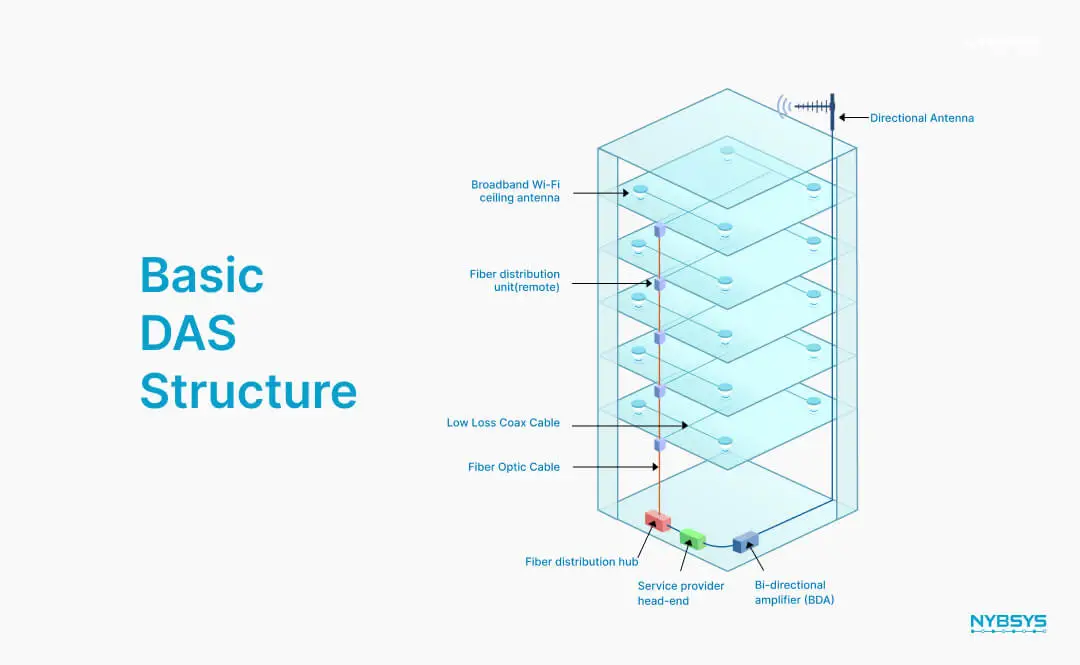
Understanding the mechanics of a cellular DAS is critical for network engineers and IT decision-makers. While the engineering behind RF propagation is complex, the architecture of a DAS follows a logical flow from the signal source to the end-user device.
Every DAS needs a source signal to distribute. Without a clean input, the system has nothing to broadcast. This typically comes from one of three sources:
This is the central nervous system of the operation. The head-end unit receives the signals from the source. It houses the critical electronics that condition, filter, and amplify the frequencies. In a complex deployment, the head-end organizes traffic to ensure different carrier frequencies do not interfere with one another. This equipment typically resides in the main telecommunications room alongside your dedicated internet access hardware and SD WAN solutions.
Once the signal is processed, it needs to travel through the building. The distribution system acts as the highway for this data.
Finally, the signal reaches the remote units and antennas strategically placed throughout the facility. These are the small and often discreet discs you see mounted on ceilings. They broadcast the amplified signal to user devices and capture the return signal from phones to send back down the chain to the carrier network.
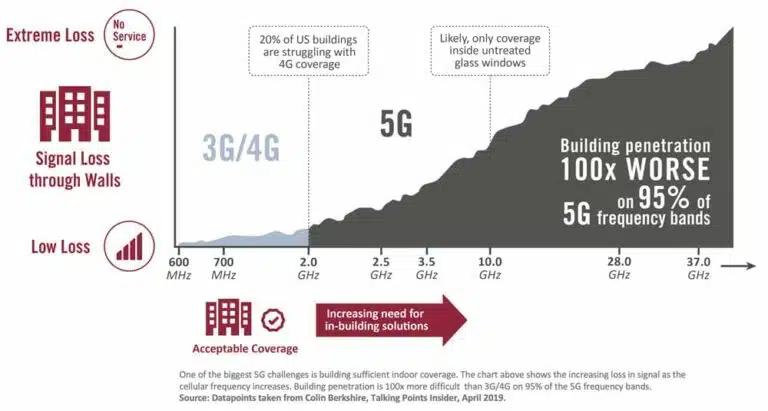
The global transition to 5G has fundamentally changed the requirements for wireless infrastructure. While 5G promises lightning-fast gigabit speeds and near-zero latency, the physics of these new frequencies introduces a significant challenge.
5G networks operate at much higher frequencies than 4G LTE. Physics dictates that higher frequency waves have shorter wavelengths. While they can carry massive amounts of data, they struggle to penetrate solid objects. A concrete wall that might only slightly dampen a 4G signal can stop a high-band 5G signal dead in its tracks.
A distributed antenna system bridges this gap. By placing the antennas inside the perimeter of the building, you bypass the penetration problem entirely. You are no longer fighting the building shell. You are broadcasting from within it.
5G DAS is not just about coverage. It is about capacity. In an office setting where hundreds of devices are competing for bandwidth, a DAS offloads traffic from the macro network. This is critical for enterprise connectivity. If your business plans to leverage private 5G networks for automation or advanced robotics, a DAS is practically a requirement. It provides the low-latency and high-reliability environment these applications demand.
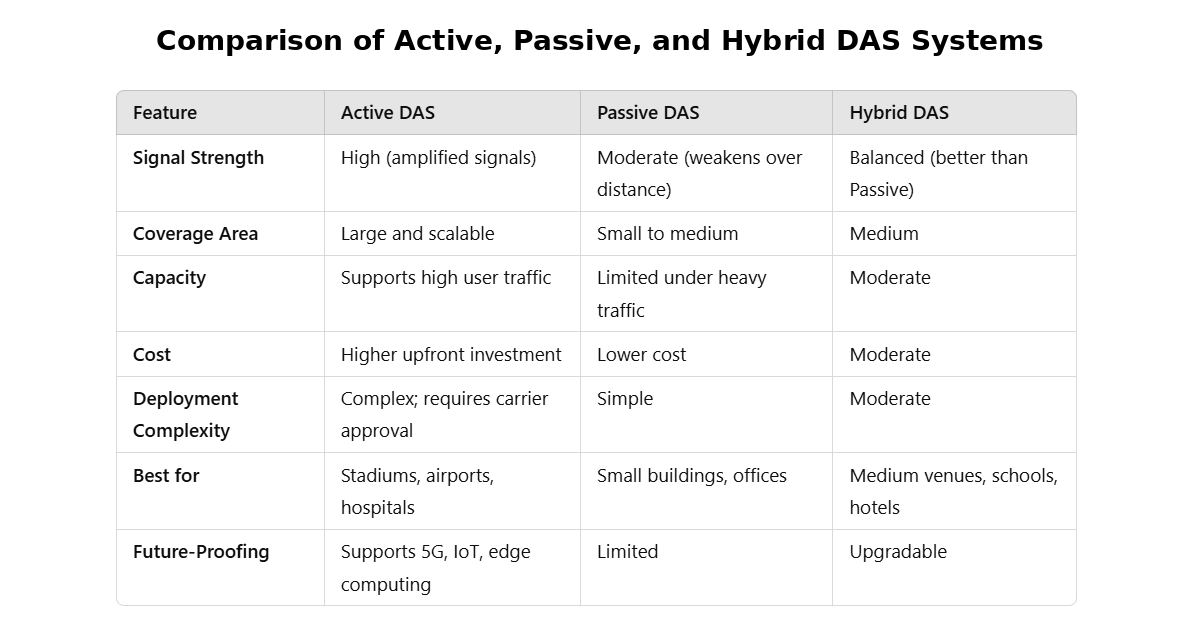
Not all buildings require the same level of firepower. DAS solutions generally fall into three categories. Understanding the distinctions can help you align the technology with your budget.
A passive system is the simplest form of wireless signal boosting. It typically uses a donor antenna on the roof and a coaxial cable to distribute the signal. It is considered passive because the components between the source and the antenna do not require electricity.
An active cellular distributed antenna system is a full-scale enterprise solution. It converts the radio frequency (RF) signal into a digital optical signal at the head-end. This optical signal is sent over fiber optic cables to remote units, which convert it back to RF and boost it.
As the name suggests, this combines elements of both. It typically uses fiber optic cable to get the signal to a specific floor and then uses coaxial cable to distribute it to individual antennas.
If you are managing a mission-critical facility, an Active DAS is likely the necessary choice to ensure unbreakable 5G connectivity. For a standard suburban office park, a Hybrid solution might deliver the enhanced cellular coverage you need without breaking the budget.
Investing in indoor connectivity solutions delivers returns that go beyond just more bars on a cell phone.
Users move from the parking lot to the elevator to their desk without a packet. This continuity is vital for modern mobile workflows where employees are constantly on video calls.
A carrier-neutral DAS supports multiple network providers simultaneously.14 This is crucial for BYOD environments. You cannot predict whether a client or new hire uses AT&T, Verizon, or T-Mobile. A neutral host system ensures that everyone connects regardless of their provider. Offloading Wi-Fi Congestion
When cellular coverage is poor, every mobile device automatically jumps onto the Wi-Fi network. This clogs the bandwidth intended for mission-critical laptops. Good cellular coverage moves mobile traffic off your internal Wi-Fi, which frees up bandwidth for your managed internet services and business internet operations.
Connectivity is the new currency in real estate. Buildings with certified cellular coverage command higher rents and have higher lease retention rates. Tenants view commercial internet provider choice and strong cellular signal as non-negotiables.
While any building with poor reception benefits from wireless signal boosting, certain industries find DAS technology mission-critical.
Deploying an enterprise DAS installation is a complex engineering feat. It is not as simple as plugging in a router.
Common Challenges
You cannot legally rebroadcast a carrier signal without their express permission. Getting all three major US carriers to sign off can be a regulatory hurdle. Additionally, improperly designed systems can create noise that actually degrades network performance for everyone in the area.
Best Practices
Start with a professional site survey. You cannot fix what you cannot measure. A professional RF survey maps out exactly where the weak points are and identifies sources of interference.20 You must also plan for public safety by ensuring your design meets NFPA 72 and IFC regulations. Finally, treat the DAS as part of your holistic network strategy. It should sit alongside your fiber internet, wireless failover, and backup internet solutions.
The world of telecom solutions moves fast. We are seeing the rise of Private 5G and CBRS, which allows enterprises to build their own private cellular networks for secure applications while using the same DAS infrastructure to support public carrier signals.
The beauty of a modern distributed antenna system is its versatility. You do not need to build two separate physical networks to achieve this. A single, well-designed wireless infrastructure can broadcast these private, secure signals for your operations teams while simultaneously acting as a neutral host system for the public carriers (AT&T, Verizon, T-Mobile) that your visitors and employees use.
As Metro Wireless continues to roll out 5G business internet and diverse commercial internet provider solutions, the line between wired and wireless performance will blur. Your building DAS will be the vehicle that delivers this next-generation performance to the end user.
1. How is a DAS different from a standard signal booster?
A signal booster simply amplifies an already weak signal. A commercial DAS system creates a clean digital signal and distributes it through fiber for reliable, building-wide coverage. For enterprise connectivity, DAS is the only scalable option.
2. Why do I need a DAS if my building has strong Wi-Fi?
Wi-Fi handles local data traffic; a cellular distributed antenna system brings the carrier network indoors. Wi-Fi calling can fail during roaming and often can’t support SMS 2FA. A DAS ensures independent, consistent voice and text while keeping your business internet free of congestion.
3. Will a single DAS support all carriers?
Yes,when designed as a carrier-neutral DAS. It carries AT&T, Verizon, and T-Mobile signals over one platform to support BYOD environments. Metro Wireless specializes in neutral host deployments that give every user full coverage.
4. Can a DAS support private networks alongside public cellular?
Absolutely. With CBRS, a DAS can broadcast a private LTE/5G network for internal operations while also carrying public carrier signals. This creates a secure, dedicated lane for business traffic that never competes with guests or visitors.
5. How does Metro Wireless integrate DAS with existing internet?
We align your DAS with your fiber internet, SD-WAN solutions, and dedicated internet access to form a unified network. Metro Wireless manages both wired and wireless infrastructure so cellular offload and internal data traffic work seamlessly together.
Unbreakable connectivity is no longer optional. Whether you are managing a hospital or a high-rise office, the expectation is the same. The phone must work.
A Distributed Antenna System is the only scalable and reliable way to bring the power of the outdoor network indoors. It solves the physics problem of 5G penetration, supports the density of modern device usage, and future-proofs your property.
At Metro Wireless, we understand that true connectivity is a mix of wired and wireless excellence. We combine industry-leading reliability, scalability, and innovation to help you build a network that never quits.
Do not let your building be a dead zone. Contact Metro Wireless today to discuss your site survey and take the first step toward flawless coverage.

Tyler Hoffman
CEO


