You know the feeling. You are standing outside a modern office tower with full bars of 5G on your phone. You step through the revolving doors, walk past the security desk, and call the elevator. Suddenly, that strong signal vanishes. Your music stream buffers, your call drops, and your important email sits in your outbox unsent.
It is a frustrating experience for a visitor, but for a business tenant, it is a critical failure.
We live in a world where we expect connectivity to be like electricity. It should just be there. Yet, as carriers roll out faster and more advanced 5G networks outdoors, the indoor experience in large buildings often lags behind. Dead zones, slow data speeds, and dropped calls are still a nightmare for facility managers and building owners.
The solution is not just hoping for a stronger signal from the cell tower down the street. The fix lies in bringing the network inside. A 5G distributed antenna system (DAS) is the infrastructure bridge that connects your building to the future of wireless communication.
In this guide, we will break down exactly why modern buildings kill cellular signals and how a properly designed DAS architecture solves these connectivity challenges for good.
A thorough DAS discovery checklist can help identify coverage gaps, infrastructure needs, and deployment priorities early on.
It seems counterintuitive. 5G is marketed as the fastest, most robust wireless technology in history. So why does it struggle so much to get inside a building?
The answer lies in physics. 5G networks, especially those utilizing high-band frequencies for ultra-fast speeds, operate on shorter wavelengths than older 4G LTE networks. While these short waves can carry massive amounts of data, they are terrible at penetrating physical obstacles.
To make matters worse, the very materials that make modern buildings energy-efficient and visually stunning are the enemies of RF (radio frequency) signals.
When you combine these factors, a large building effectively becomes a Faraday cage. It blocks the outdoor signal from entering. This results in significant operational headaches. Productivity drops when employees cannot use mobile apps. Tenant satisfaction plummets. In critical environments like hospitals, a lack of connectivity can even impact safety.
Relying solely on outdoor macro towers is no longer a viable strategy for enterprise connectivity. You need a dedicated cellular DAS system to bypass these barriers.
.jpg)
A 5G distributed antenna system is a network of spatially separated antenna nodes connected to a common source that provides wireless service within a specific structure.
Think of it like a central heating and cooling system for wireless data. You do not try to heat a 50-story building with a bonfire outside the front door. You use a system of ducts and vents to distribute conditioned air to every room. DAS does the exact same thing for cellular signals.
It captures the signal from a source and distributes it evenly throughout the building using a network of cables and antennas.
This is different from a simple signal booster you might buy for a home office. Distributed antenna systems are engineered, carrier-grade solutions. A modern 5G DAS is designed to handle:
There are different types of architectures available, including active, passive, and hybrid DAS. However, for large commercial buildings, active systems are the standard because they ensure the signal remains strong even over long distances.
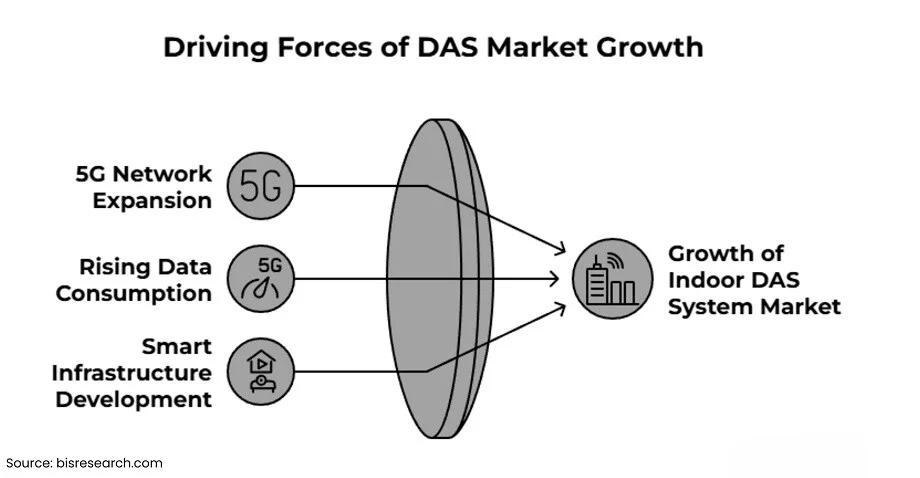
Understanding the mechanics of a DAS system helps explain why it is the superior choice for wireless infrastructure. The process involves four key stages that work together to deliver a seamless user experience.
The system needs a high-quality signal to distribute. For large venues, we rarely rely on an antenna on the roof to catch a signal from outside. Instead, we use a direct feed. This often comes from a Base Transceiver Station (BTS) or Small Cells installed on-site by the wireless carriers. This ensures the building has its own dedicated capacity that does not compete with the public network outside.
This is the central nervous system of the DAS cellular system. Located in the building’s main server room or MDF (Main Distribution Frame), the head-end unit receives the signal from the source. It filters, conditions, and converts the analog radio frequencies into digital optical signals.
Once digitized, the signal travels through fiber optic cables to different areas of the building. Fiber is essential here. Unlike copper or coaxial cable, fiber allows the signal to travel long distances across sprawling campuses or up high-rise elevator shafts without losing quality. This is the same principle that makes fiber internet so reliable.
The fiber connects to remote units located in IT closets on each floor. These units convert the optical signal back into radio waves and send them to discreet antennas installed on the ceilings. These antennas broadcast the 5G distributed antenna system signal to user devices. This ensures full bars whether you are in the basement cafeteria or the penthouse conference room.
Investing in in-building wireless coverage provides immediate and tangible ROI. It transforms your facility from a digital dead zone into a connected ecosystem.
Eliminates Dead Zones Completely
The most obvious benefit is coverage. A well-designed DAS pushes signals into hard-to-reach areas like stairwells, elevators, and interior rooms. This ensures seamless connectivity as people move through the space.
Boosts Data Speed and Capacity
A DAS distributed antenna system does not just provide a signal. It provides a fast signal. By bringing the antennas closer to the users, the system reduces interference and increases data throughput. This is vital for bandwidth-heavy tasks like downloading large files or streaming 4K video.
Multi-Carrier Support
Most commercial environments require a carrier neutral DAS. This means the system supports AT&T, Verizon, and T-Mobile simultaneously. You do not want a building where only Verizon users get service while T-Mobile users are stuck searching for a signal. A neutral host system ensures everyone stays connected.
Improves Network Reliability
Reliability is a core value at Metro Wireless. With a dedicated indoor system, you are less susceptible to congestion on the outdoor macro network. Your internal connectivity remains stable even during peak usage times in the surrounding city. This stability creates an excellent layer of redundancy for businesses that also rely on backup internet solutions.
Supports IoT and Smart Building Systems
Modern buildings run on data. From smart HVAC sensors to security cameras and automated lighting, IoT devices require constant connection. A robust DAS provides the backbone for these indoor connectivity solutions. It works alongside your managed internet services to create a fully integrated smart building.
The versatility of distributed antenna systems makes them essential across various industries.
Healthcare Facilities
Hospitals are notorious for having poor cellular reception due to radiology shielding and complex layouts. However, doctors and nurses rely on mobile devices for communications and accessing electronic health records. A DAS cellular system ensures that critical alerts go through instantly and that families in waiting rooms can stay connected.
Airports and Shopping Malls
These are high-density environments where thousands of people try to use data simultaneously. Without a dedicated system, the local towers would be overwhelmed. A DAS manages this massive traffic load. It allows travelers to download boarding passes and shoppers to access digital coupons without frustration.
Corporate Offices
In the business world, a dropped call can mean a lost deal. Corporate tenants demand business internet reliability on their mobile devices. DAS allows for crystal clear Voice over LTE (VoLTE) and reliable 5G data. This is often part of a broader connectivity strategy that includes SD WAN solutions and private networks.
Universities and Stadiums
On game days or during final exams, the density of users in these locations skyrockets. A distributed system ensures that the network does not crash under the pressure of thousands of simultaneous uploads and streams.
Selecting the right DAS system requires a careful analysis of your building’s specific needs. There is no one-size-fits-all solution in telecom.
Active vs Passive vs Hybrid
Factors to Consider
You must evaluate the size of the facility, the estimated density of users, and which carriers need to be supported. Metro Wireless recommends starting with a professional site survey. This assessment identifies the weak points in your current coverage and determines the optimal antenna placement.
5G Readiness
Not all legacy systems can handle 5G frequencies. If you are upgrading or installing a new system, ensure the hardware is 5G-ready. This protects your investment and ensures compatibility with future wireless internet standards.
Discussions about commercial DAS systems inevitably turn to cost. The price varies significantly based on square footage, the number of antennas required, and the type of signal source used.
However, viewing this strictly as an expense is a mistake. It is an investment in the property’s value. Buildings with superior connectivity certifications command higher lease rates and have lower tenant vacancy rates.
Furthermore, there is an operational ROI. Reliable connectivity improves staff efficiency and enables the deployment of money-saving smart building technologies. When you consider the cost of downtime or the inability to utilize modern dedicated internet access applications, the return on investment for a DAS becomes clear.
The landscape of telecom solutions is evolving. 5G distributed antenna system technology is moving toward even tighter integration with emerging tech.
We are seeing a rise in Private LTE and 5G networks running over DAS infrastructure. This gives enterprises complete control over their data security and network priority. Additionally, the integration of CBRS (Citizens Broadband Radio Service) is opening new lanes for private wireless communication within commercial buildings.
Future systems will also leverage AI-driven management tools to optimize signal flow in real-time. As we look toward 6G and beyond, the fiber backbones installed for today’s DAS will serve as the foundation for the next generation of connectivity. This creates opportunities for seamless wireless failover and redundancy.
1. What’s the difference between a DAS and a signal booster?
A signal booster simply amplifies weak cellular signal for small areas. A 5G DAS is a full infrastructure system using fiber to deliver high-capacity, congestion-free coverage for large buildings and heavy user loads.
2. Does a Metro Wireless DAS support all carriers?
Yes. We deploy carrier-neutral DAS systems that let one antenna network broadcast Verizon, AT&T, and T-Mobile simultaneously—ensuring reliable service for all users.
3. Why do I need a DAS if I already have fast Wi-Fi?
Wi-Fi can’t reliably handle cellular voice, SMS, or authentication texts, and it adds strain to your network. A DAS offloads mobile traffic, providing a secure, dedicated lane for indoor cellular coverage.
4. Can a DAS support public safety communications?
Yes. Many cities require public safety DAS on 700/800 MHz bands for first-responder radios. We design systems that work alongside cellular DAS to keep buildings compliant and safe.
5. How does a DAS integrate with other Metro Wireless services?
A DAS complements your enterprise connectivity—including dedicated internet, SD-WAN, and wireless failover—to deliver seamless, redundant, always-on communication across your facility.
Weak indoor signals are more than just a nuisance. They are a barrier to business operations and a drag on property value. A 5G distributed antenna system solves this problem by bringing the network to the user, bypassing the physical obstacles of the building structure.
Whether you manage a hospital, a corporate tower, or a large public venue, reliable indoor coverage is now a requirement. It ensures safety, boosts productivity, and provides the seamless experience users expect.
At Metro Wireless, we specialize in delivering high-performance coverage improvement systems tailored to your unique infrastructure. From fixed wireless to fiber and DAS, we build the networks that power modern business.
Contact Metro Wireless today to discuss your connectivity needs and schedule a consultation for a custom DAS design.

Tyler Hoffman
CEO


.jpg)


