We have all walked into a modern, architecturally stunning building and watched our connection disappear. You step into the lobby of a high-rise, a hospital wing, or a stadium concourse, and the signal bars on your phone drop to zero. The stream buffers. The call fails. The email sits in your outbox.
In a world where business operates in real time, this is more than an inconvenience. It is a critical operational failure.
The irony is that the better a building is built, the worse the cellular reception tends to be. LEED-certified glass, heavy concrete reinforcement, and steel structures are fantastic for energy efficiency and stability, but they are formidable barriers to Radio Frequency (RF) signals. They effectively block the macro network from penetrating the facility.
The solution to this invisible problem is not to rely on stronger towers outside. The solution is to bring the network inside. This is the domain of DAS technology.
Distributed Antenna Systems (DAS) represent the gold standard for in-building wireless coverage. For network engineers, IT directors, and building owners, understanding this technology is the key to unlocking true enterprise connectivity. At Metro Wireless, we specialize in deploying the infrastructure that turns dead zones into hubs of productivity.
This DAS discovery checklist breaks down the key steps to plan a successful distributed antenna system deployment.
DAS technology acts as a dedicated transportation system for wireless signals.
To understand it, you must first understand the limitation of the traditional macro cell tower. A tower located miles away blasts a signal toward your building. By the time that signal fights its way through the atmosphere, trees, neighboring structures, and finally your building’s exterior walls, it is weak and degraded.
DAS wireless technology changes this dynamic entirely. Instead of pulling a signal from the outside in, it distributes a pristine signal source from within.
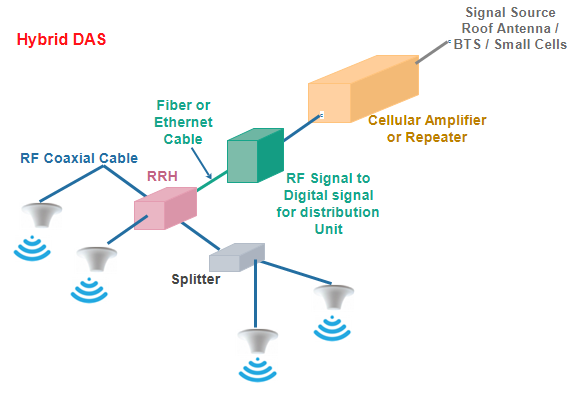
A DAS is a network of spatially separated antenna nodes connected to a common source via a transport medium, typically fiber optics. Think of it like a sprinkler system for cellular data. A single fire hose at the front door cannot water every plant in a sprawling office complex. However, a system of pipes and sprinkler heads distributed throughout the ceiling ensures that every square foot receives the coverage it needs.
This system creates a seamless blanket of enhanced cellular coverage. It ensures that users in the basement, the elevator, and the corner executive suite all experience the same high-quality connection. Unlike simple signal boosters which merely amplify existing noise, a commercial DAS creates a clean, high-capacity network environment.

A robust commercial DAS system is a sophisticated piece of engineering. It is not a single device but a collection of specialized components working in unison to deliver wireless signal boosting and data throughput.
The Head-End is the brain of the DAS. Located in the building’s Main Distribution Frame (MDF) or server room, this unit is responsible for the intake and conditioning of signals. In a carrier neutral DAS, the Head-End receives signal feeds from multiple mobile network operators like AT&T, Verizon, and T-Mobile. These signals might come from an off-air antenna on the roof or, in larger deployments, directly from a carrier’s base station equipment installed onsite. The Head-End combines these frequencies and converts the RF energy into optical signals for transport.
Once the signal is converted to light, it travels over fiber optic cables. This is the backbone of the system. Fiber is essential because it allows the signal to travel long distances—up dozens of floors or across sprawling campuses—without degrading. This mirrors the reliability we see in fiber internet deployments for dedicated internet access. The quality of this fiber backbone dictates the overall performance ceiling of the system.
The fiber cables terminate at Remote Units, which are typically located in Intermediate Distribution Frames (IDFs) or IT closets on individual floors. The Remote Unit’s job is to convert the optical signal back into an RF signal. It then amplifies this signal to the specific power levels required for that zone.
The antennas are the only visible component of the system, although they are often designed to be low-profile and unobtrusive. Connected to the Remote Units via coaxial cable, these antennas broadcast the DAS cellular technology signals to user devices. Strategic placement is critical here. Engineers use heat mapping software to determine exactly where to place antennas to eliminate shadows and interference.
The active electronics within the system must be capable of handling complex modulation schemes. Modern DAS solutions utilize advanced radio technology that supports Multiple Input Multiple Output (MIMO) configurations. This allows for faster data speeds and ensures the system is compatible with current 4G LTE and emerging 5G DAS standards.
Implementing DAS technology services is a major infrastructure project. It requires careful planning, engineering, and execution. It is far more complex than setting up a Wi-Fi network.
1. Site Survey and RF Benchmarking
The process begins with data. Engineers perform a comprehensive site survey to measure the existing RF environment. They identify where the macro signal is failing and locate potential sources of interference. This establishes a baseline for coverage improvement systems.
2. System Design and Engineering
Using the survey data, engineers design the system architecture. This involves calculating link budgets to ensure the signal remains strong from the Head-End to the farthest antenna. They select the appropriate hardware and determine the routing for fiber and coaxial cabling. This phase is crucial for ensuring the system can scale.
3. Carrier Coordination
Because DAS transmits on licensed frequencies, it requires coordination with mobile network operators. A provider must ensure that the neutral host systems are configured correctly so they do not cause interference with the outdoor macro network.
4. Installation and Integration
Technicians install the cabling, mount the antennas, and rack the Head-End equipment. This often happens alongside other telecom work, such as installing backup internet solutions or SD WAN solutions hardware.
5. Commissioning and Optimization
Once built, the system is powered on. Engineers walk the site again with testing equipment to verify coverage. They adjust gain settings and fine-tune the system to ensure optimal performance.
Most people associate DAS with simply "getting a signal." However, the benefits go far beyond basic connectivity. DAS technology fundamentally improves the speed and reliability of the network.
Capacity Management
In high-density environments like stadiums, airports, or convention centers, the problem is rarely a lack of signal. The problem is congestion. Too many devices are trying to talk to the same distant cell tower. A DAS alleviates this by creating smaller, manageable sectors within the building. It increases the total capacity of the network which allows thousands of users to stream, upload, and call simultaneously without slowdowns.
Lower Latency
Distance equals latency. By bringing the antenna closer to the user, DAS reduces the time it takes for data packets to travel back and forth. This is vital for real-time applications used in business internet environments, such as video conferencing or cloud-based collaboration tools.
Battery Life Conservation
When a mobile phone has to scream to reach a tower three miles away, it drains its battery rapidly. When it connects to a DAS antenna twenty feet away, it can transmit at a much lower power level. This extends battery life for all users and reduces the overall RF noise floor in the environment.
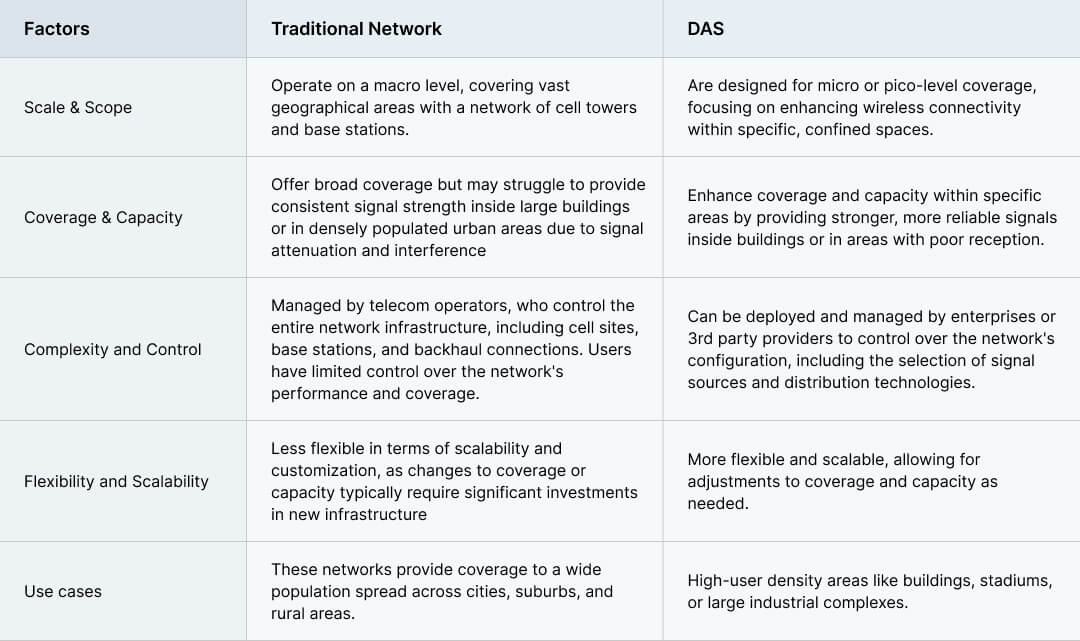
A common question from facility managers is whether they can simply rely on Wi-Fi or standard cell towers. While wireless internet is a staple of modern business, it is not a substitute for cellular infrastructure.
Reliability and Handoffs
Wi-Fi operates on unlicensed spectrum, meaning it is prone to interference from microwaves, Bluetooth devices, and neighboring networks. Cellular signals on a DAS operate on licensed, regulated spectrum. Furthermore, DAS allows for seamless mobility. A user can walk from the parking garage to the top floor without the call dropping. Wi-Fi often struggles with these handoffs between access points.
Security and Public Safety
Cellular networks are inherently more secure than open Wi-Fi networks. Additionally, public safety DAS is a specific category of installation often required by fire codes. These systems ensure that first responders can communicate via two-way radios inside stairwells, basements, and pump rooms during an emergency. Standard Wi-Fi cannot meet these rigorous life-safety standards.
Performance consistency
External cell towers are subject to weather and atmospheric conditions. A DAS provides a controlled, consistent environment. For enterprises that rely on wireless failover for their commercial internet provider connections, relying on a fluctuating outdoor signal is a risk. A DAS ensures that your failover routers always have a pristine connection.
Investing in enterprise DAS installation yields immediate and long-term ROI for organizations.
The deployment of a DAS solution is a significant capital expenditure.It involves industrial-grade hardware and specialized labor. However, the cost must be weighed against the cost of poor connectivity.
If a sales team cannot make calls, revenue is lost. If a hospital cannot track telemetry data because of a dead zone, patient care is compromised. If a manufacturing floor loses connection to its IoT sensors, production halts.
Metro Wireless helps clients view DAS as a foundational utility. Just as you invest in managed internet services or fixed wireless backups to ensure uptime, DAS is an investment in mobile uptime. It eliminates the need for ad-hoc workarounds and provides a stable platform for future wireless technologies.
The wireless landscape is shifting rapidly. The rollout of 5G brings higher frequency bands, such as millimeter-wave, which carry massive amounts of data but have very poor penetration capabilities. They can barely pass through a window, let alone a concrete core.
This makes DAS technology more critical than ever. It will be the primary vehicle for bringing 5G speeds indoors.
We are also seeing the convergence of DAS with private LTE networks. Enterprises are beginning to build their own secure cellular networks for automation and robotics. DAS serves as the physical layer for these advanced applications. As telecom solutions evolve, the line between the wired network and the wireless network will blur, with DAS serving as the critical bridge.
1. How does DAS differ from standard Wi-Fi?
Wi-Fi connects devices to your internal network on unlicensed bands, which can face interference. DAS technology extends licensed cellular networks indoors, ensuring reliable calls, texts, and authentication. Most enterprises use both: managed internet for internal data and DAS for dependable mobile coverage.
2. How is a commercial DAS different from a signal booster?
A booster simply amplifies whatever outdoor signal exists—including noise. A commercial DAS system creates a clean, high-quality indoor signal source, often carrier-fed, offering far greater capacity and speed for large offices and venues.
3. Is a DAS system compatible with 5G?
Yes. 5G signals struggle to pass through walls, so a 5G DAS delivers the signal inside via fiber, ensuring users get the fast speeds and low latency expected from next-gen networks.
4. Can one DAS support AT&T, Verizon, and T-Mobile together?
Yes. A carrier-neutral DAS broadcasts multiple carriers simultaneously, giving tenants and visitors strong coverage regardless of provider.
5. Is DAS required for safety compliance?
Often. Many jurisdictions require Public Safety DAS/ERRCS to ensure first responders’ radios work in stairwells, elevators, and basements during emergencies.
We no longer live in a world where "good enough" connectivity is acceptable. Dead zones are liabilities. Dropped calls are lost opportunities. DAS technology offers the engineering solution to these problems, transforming static buildings into dynamic, connected environments.
From ensuring public safety compliance to enabling the blazing speeds of 5G, Distributed Antenna Systems are the secret to a smarter, faster network.
At Metro Wireless, we understand the complexities of RF design and wireless infrastructure. We provide the expertise needed to navigate the transition to a fully connected enterprise. Whether you need dedicated internet access, robust backup internet solutions, or a comprehensive DAS deployment, we are your partner in connectivity.
Contact Metro Wireless today to discuss your project and learn how our DAS technology services can future-proof your building.

Tyler Hoffman
CEO


%20(1).jpg)


