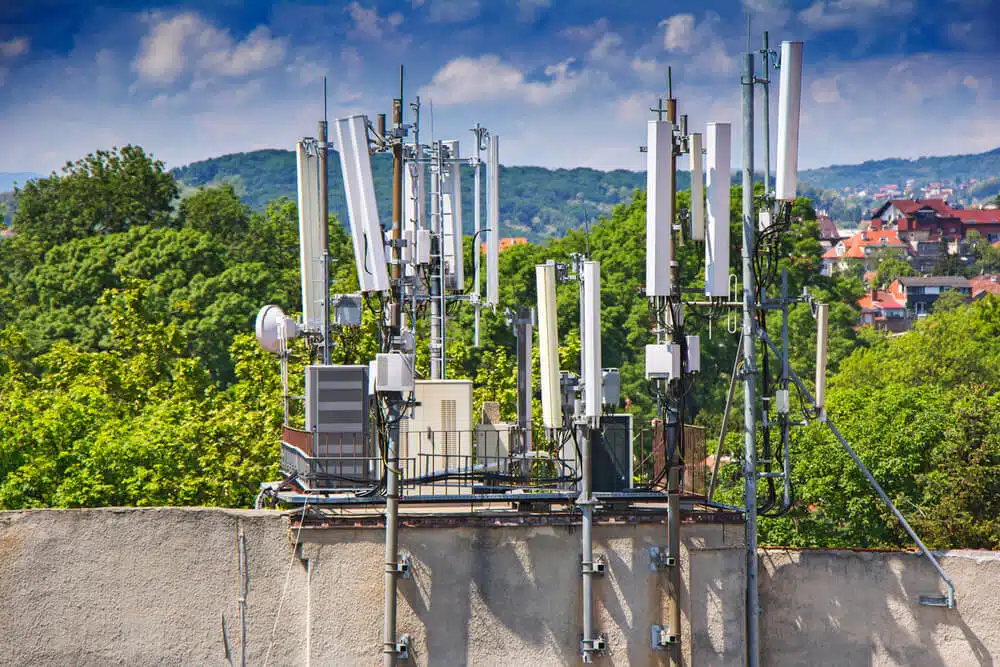
You have likely walked into a modern, beautifully designed office building and watched the signal bars on your phone drop to zero. It is a frustrating experience for a visitor. For a business operating inside that facility, it is a critical operational failure.
In an era where remote teams, IoT devices, and cloud applications demand constant connectivity, relying solely on outdoor cell towers is no longer enough. The walls that protect your business are often the same obstacles blocking your communication.
This is where a cellular DAS system becomes a game changer.
For enterprise IT managers and facility owners, solving indoor connectivity issues is not just about convenience. It is about maintaining productivity and ensuring safety. As a leading commercial internet provider, Metro Wireless specializes in delivering the robust wireless infrastructure needed to keep your business online regardless of the physical challenges your building presents.

It seems counterintuitive that as mobile technology improves, indoor reception often gets worse. The culprit is rarely the carrier network itself but rather the building infrastructure.
Modern construction prioritizes energy efficiency and durability. Materials like low-emissivity (Low-E) glass, steel, and high-density concrete are fantastic for insulation and structural integrity. However, they are terrible for wireless signal boosting. These materials effectively act as a shield as they reflect or absorb radio frequency (RF) signals before they can reach the people inside.
The consequences of this "Faraday cage" effect are immediate and costly.
Employees drop important client calls. Data speeds crawl to a halt which makes mobile apps unusable. In emergency situations, the inability to dial out can become a significant safety liability. For a business relying on dedicated internet access and mobile coordination, these dead zones translate directly into downtime, poor customer service scores, and tangible revenue loss.
A cellular DAS system, or Distributed Antenna System, is the definitive solution to the problem of signal penetration.
In simple terms, a das system is a network of spatially separated antenna nodes connected to a common source. Instead of forcing a signal to blast through thick concrete walls from a tower miles away, a DAS brings the signal source inside the building and distributes it evenly.
Think of it like a sprinkler system for wireless data. Just as a sprinkler system distributes water to every corner of a lawn, a das distributed antenna system ensures that strong cellular signals reach every office, conference room, basement, and stairwell.
These systems are versatile. They can be designed to support:
Whether you are looking to support 4G LTE or prepare for the future with a 5G distributed antenna system, DAS provides the infrastructure backbone required for modern enterprise environments.
Understanding the mechanics of a cellular das system helps in realizing why it is superior to simple signal boosters. The architecture is designed for capacity, consistency, and low latency.
Here is the typical signal flow in an enterprise environment:
The result is a blanket of uniform coverage. A user walking from the parking garage to the top floor penthouse will experience no interruption in service. This seamless handoff is vital for maintaining business internet continuity on mobile devices.
Investing in distributed antenna systems offers returns that go far beyond just "more bars" on a phone screen. It impacts the core efficiency of your facility.
We see distributed antenna systems making massive differences across various verticals.
Hospitals and Healthcare
In medical facilities, communication can literally be a matter of life and death. Doctors and nurses rely on mobile devices for real-time alerts and patient data.A cellular das antenna network ensures that connectivity remains stable for critical staff and anxious families even in radiology wings lined with lead shielding.
Corporate Offices and Skyscrapers
Modern hybrid workforces rely on flexibility. Staff members often move from desks to huddle rooms. A cellular das system supports VoIP calls and cloud access throughout high-rise structures where upper floors might otherwise suffer from tower interference.
Universities and Campuses
Sprawling campuses with older masonry buildings are notorious for poor reception. DAS ensures that students and security personnel stay connected which is a key component of public safety protocols.
Airports, Malls, and Hotels
These are high-density environments. When thousands of people try to use data simultaneously, macro towers get overwhelmed. Commercial DAS systems provide the necessary capacity to handle thousands of concurrent users without network congestion.
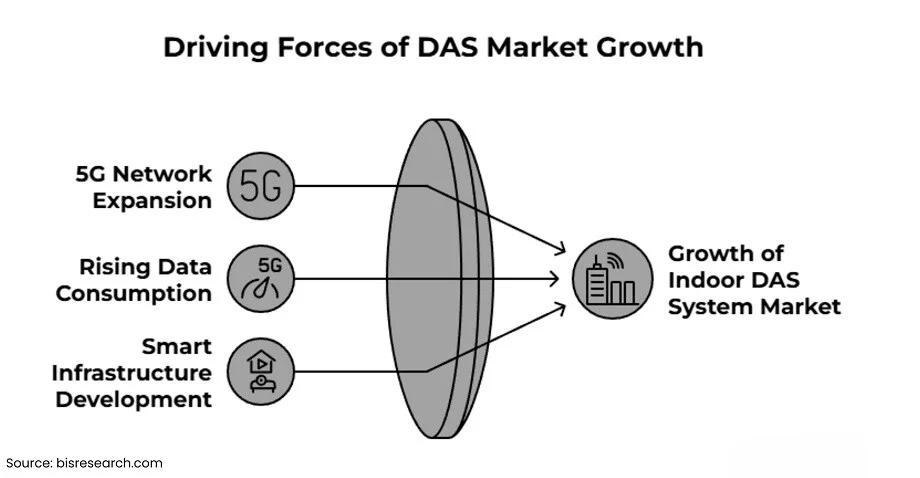
The conversation around wireless infrastructure today inevitably leads to 5G.
5G offers incredible speeds and low latency which are perfect for enterprise connectivity and industrial automation. However, the physics of 5G means it has shorter wavelengths that are easily blocked by physical barriers.
This makes a 5G distributed antenna system not just a luxury but a requirement for future-proofing.
Enterprises lay the groundwork for next-generation technologies by upgrading to or installing a 5G-ready DAS. This includes massive IoT deployments, smart building controls, and augmented reality applications for maintenance or training. A robust DAS complements your fixed wireless and SD WAN solutions to create a cohesive ecosystem where mobile and fixed networks work in harmony.
Deploying a das system is a significant infrastructure project. It requires careful planning to ensure it delivers the expected results.
If you are considering this investment, here is a checklist of factors to guide your strategy:
Partnering with an experienced provider like Metro Wireless ensures these technical hurdles are managed efficiently. This saves you time and prevents costly design errors.
When evaluating the cost, look at the Return on Investment (ROI) through the lens of operational efficiency.
What is the cost of a dropped negotiation call? How much productivity is lost when an employee waits for a file to download on a slow connection?
A cellular das system is a capital expense that reduces operational friction. Data shows that in-building coverage solutions can lead to drastic reductions in network-related complaints. Furthermore, it serves as a competitive differentiator for building owners. Tenants are increasingly demanding WiredScore certifications and proof of connectivity before signing leases.
Viewed this way, a das distributed antenna system pays for itself by protecting revenue streams and increasing the asset value of the real estate.
1. How is a Cellular DAS different from a signal booster?
A signal booster amplifies weak outdoor signals for small areas. A cellular DAS system is a full fiber-based network built for large facilities, supporting thousands of users with consistent, congestion-free coverage across hospitals, campuses, and high-rises.
2. Can a DAS replace our Wi-Fi?
No. Wi-Fi handles internal data, but it can’t reliably support cellular calls, SMS, or guest devices. A DAS system provides dependable mobile connectivity and acts as a backup when Wi-Fi is overloaded or unavailable.
3. Does a DAS work with all major carriers?
Yes. Modern distributed antenna systems are carrier-neutral, broadcasting Verizon, AT&T, and T-Mobile signals at the same time so all users get strong, unified coverage.
4. Is a DAS compatible with 5G?
Yes. 5G’s high-frequency signals struggle indoors, making a 5G DAS essential. Metro Wireless designs systems that are future-proof and meet the speed and low-latency needs of 5G applications.
5. How do I know if my building needs a DAS?
Indoor dropped calls, weak texts, or slow data are clear signs. Low-E glass, concrete, and steel often block signals. Dead zones in conference rooms, elevators, or basements mean you likely need a cellular DAS antenna site survey.
Strong indoor connectivity is no longer optional for modern enterprises. It is the backbone of daily operations, safety, and tenant satisfaction.
Reliance on outdoor towers is a strategy of the past. To guarantee performance, scalability, and 5G readiness, a cellular das system is the most efficient path forward. It bridges the gap between your building and the digital world to ensure that your wireless internet experience is seamless from the parking lot to the boardroom.
At Metro Wireless, we understand the complexities of enterprise connectivity. From backup internet solutions to advanced DAS deployments and wireless failover, we deliver the expertise you need to stay connected.
Contact Metro Wireless today to discuss your Cellular DAS options.

Tyler Hoffman
CEO