We have all walked into a building and watched the bars on our phone vanish. One minute you are on a critical conference call. The next minute you are standing near a window just hoping to catch a single bar of service. For a modern enterprise, that silence is expensive.
Unlike the science fiction scenarios you might find in The Signal television show, the reality of disappearing connectivity is a very practical, solvable engineering problem. It is not a mystery. It is usually just physics. Concrete, steel, and low-E glass are excellent at blocking radio waves. This turns your state-of-the-art office or facility into a digital fortress.
That is where a DAS signal solution comes into play. If you manage a large venue, a hospital, or a corporate headquarters, relying on outside cell towers is not enough. You need to bring the signal inside.
Here is how a DAS system works to eliminate dead zones and why it is the gold standard for enterprise connectivity.
A thorough DAS discovery checklist can help identify coverage gaps, infrastructure needs, and deployment priorities early on.
A DAS distributed antenna system is exactly what it sounds like. Instead of relying on a single, powerful antenna source (like a cell tower miles away) to blast a signal through your thick walls, a DAS distributes that signal across a network of smaller antennas placed strategically throughout your building.
Think of it like a sprinkler system for wireless data. A traditional tower is like a fire hose outside on the street trying to water the plants in your lobby through the front door. It is inefficient and messy. A DAS system runs pipes throughout the building to sprinkle signal exactly where it is needed.
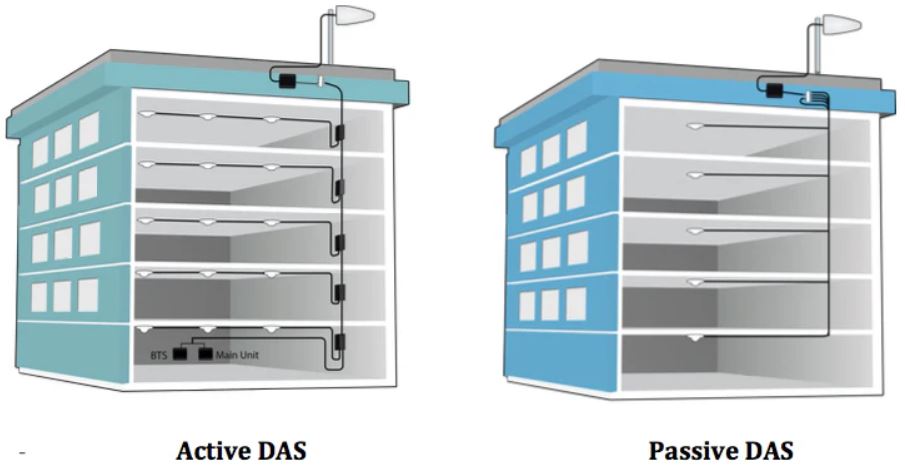
This technology does more than just amplify noise. A true DAS system takes a source signal from a carrier (or multiple carriers) and distributes it digitally or via analog radio frequency (RF) over fiber optic cables to remote units. These units then broadcast a clean, strong signal to the end user devices.This ensures that whether you are in the basement parking garage or the penthouse boardroom, your in building wireless coverage remains consistent.
To understand why this solution works so well, you need to look under the hood. A commercial DAS system is an ecosystem of hardware working in unison.
This is the control center of the system. It connects directly to the signal source, whether that’s an off-air signal captured by a rooftop donor antenna or a dedicated connection from a carrier’s base transceiver station (BTS). The head-end processes, filters, and conditions the signal to ensure it’s clean and ready for distribution throughout the building.
Once the signal is prepared, it travels across fiber optic cabling, which preserves signal quality over long distances. Fiber’s low-loss characteristics are essential for hospitals, stadiums, or large campuses where copper cables would degrade the signal quickly and limit performance.
Placed in IT closets, mechanical rooms, or distributed zones, these units convert the optical signal back into RF. They act as localized “mini base stations,” ensuring that every wing or floor of the building gets the proper strength and capacity.
Finally, the signal reaches the antennas mounted on ceilings or walls. These are the visible access points that broadcast cellular coverage to employees, guests, devices, and IoT equipment. Their placement and density determine how seamless the experience feels as users move through the building.
Poor connectivity usually boils down to two things: distance from the tower and obstruction. A DAS signal solution bypasses obstacles by routing the signal around them. By placing antennas inside the building, you are no longer asking a radio wave to punch through three feet of concrete. You are generating the signal on the correct side of the wall.
This approach fixes coverage gaps in several critical environments:
By using digital transport technology, Metro Wireless ensures that the signal arriving at the antenna is just as clean as the signal that entered the Master Unit. This provides high-performance wireless infrastructure regardless of the building size.
There is a major difference between a "signal booster" you might buy online and a professionally engineered DAS system. Traditional boosters generally just take an existing weak signal and scream it louder. If the input signal is noisy or poor quality, a booster just makes that noise louder.
A DAS distributed antenna system is a scalable, enterprise-grade solution that offers distinct advantages:
For a business looking for telecom solutions that will last a decade, DAS is the investment that makes sense.
Deploying a system this robust requires expertise. At Metro Wireless, we approach enterprise DAS installation as a precise science.
This process often involves coordination with wireless carriers to ensure compliance with FCC regulations. This is a task Metro Wireless handles as part of our managed internet services.
The immediate benefit is obvious. Your phone works. But the business impact goes deeper.
Even though the technology is complex, the impact is easy to see. Different environments have unique connectivity challenges, and DAS quietly solves them behind the scenes.
Airports
Large terminals, steel structures, and constant movement make outdoor signals unreliable. A DAS ensures travelers can access boarding passes, updates, and ride-share apps, while also supporting the critical communications used by ground crews and airport staff.
Sports Arenas & Stadiums
Here, capacity is everything. When tens of thousands of fans try to stream, post, or text at the same moment, networks buckle. A high-density DAS provides the extra bandwidth needed so fans can stay connected even during peak moments.
Hospitals & Healthcare
Hospitals are harsh RF environments with lead-lined rooms and sensitive equipment. A DAS ensures doctors receive pages and VoIP calls, telemetry data stays reliable, and patients have consistent coverage without searching for a signal.
Corporate Offices
Energy-efficient Low-E glass blocks cellular signals. A DAS restores strong indoor coverage, enabling BYOD policies, preventing dropped calls in elevators, and ensuring cellular failover works if primary internet service goes down.
Installing a distributed antenna system involves upfront costs for hardware, fiber cabling, and engineering labor. However, the Return on Investment (ROI) is realized through operational efficiency.
Consider the cost of downtime. If a medical team cannot access records on a tablet or a sales team drops a call during a closing negotiation, the revenue loss accumulates quickly. Additionally, offloading mobile traffic to a DAS can relieve congestion on your internal Wi-Fi network. This improves the performance of your commercial internet provider services. Investing in DAS solutions is investing in the utility that powers modern business.
The landscape of wireless infrastructure is evolving. The rollout of 5G DAS is changing the game. This requires systems that can handle higher frequencies and massive data throughput.
We are also seeing the rise of CBRS (Citizens Broadband Radio Service) and private LTE networks. These allow businesses to run their own private cellular networks using neutral host systems. This provides secure, ultra-fast communication for robotics, automation, and sensitive data. As we move toward smarter buildings, the line between fixed wireless, Wi-Fi, and DAS is blurring into a single, unified connectivity strategy.
A signal booster only amplifies an existing, often noisy signal and supports limited coverage. A DAS distributes a clean, high-capacity signal through fiber to multiple antennas, supports many users and carriers, and is ideal for large buildings like stadiums or hospitals.
Yes. Modern DAS solutions support 4G LTE and emerging 5G bands. Installing fiber-backed DAS now ensures long-term readiness for high-speed, low-latency 5G and private LTE networks.
Yes. A carrier-neutral DAS lets Verizon, AT&T, T-Mobile and others run on the same infrastructure, ensuring strong coverage for all users without separate systems.
Small buildings may take weeks; large campuses may take months. The process includes site surveys, design, fiber installation, and carrier coordination, all managed by Metro Wireless with minimal disruption.
Yes. DAS improves cellular reliability, boosts tenant satisfaction, increases property value, and reduces Wi-Fi strain by offloading mobile traffic—delivering strong ROI for commercial properties.
You do not have to accept poor signals as a fact of life in your building. Whether you are fixing coverage for public safety compliance or ensuring your executive team stays connected, a DAS signal solution is the answer.
It transforms your facility from a dead zone into a hub of productivity.
At Metro Wireless, we specialize in delivering high-performance commercial DAS systems tailored to your specific footprint. From fiber internet to 5G business internet backup, we build the networks that keep business moving.
Ready to solve your connectivity issues for good? Contact Metro Wireless today for a consultation on your custom DAS solution.

Tyler Hoffman
CEO


.jpg)


