January 7, 2026

You know the feeling. You walk into a pristine, modern office building or a sprawling new hospital wing. The architecture is stunning. The glass facade is impressive. You pull out your phone to send a quick email or finish a call, and suddenly, everything stops.
The signal bars drop to zero. The call fails. The data wheel spins endlessly.
For a visitor, this is a momentary annoyance. For a facility manager, IT director, or building owner, this is a significant liability. Cellular connectivity is no longer just a convenience; it is a utility. Tenants and employees expect to be connected from the parking garage to the penthouse. When they are not, productivity stalls, satisfaction drops, and safety risks increase.
The irony is that the better a building is built, the worse the indoor signal usually is. Modern construction materials are fantastic for sustainability and structural integrity, but they are absolute killers for radio frequency (RF) signals. They effectively turn your building into a fortress that blocks the macro cellular network from entering.
A thorough DAS discovery checklist can help identify coverage gaps, infrastructure needs, and deployment priorities early on.
Common building materials that kill indoor cellular signal include:
This is where a DAS antenna system becomes the critical solution.
At Metro Wireless, we know that true enterprise connectivity goes beyond just a fast business internet connection at a desk. It requires a holistic approach to wireless coverage. In this comprehensive guide, we will explore the truth about indoor connectivity solutions, explain exactly what is DAS distributed antenna system technology, and help you decide if it is the right investment for your infrastructure.
To solve the problem of poor reception, we first need to define the solution accurately. A DAS distributed antenna system is a network of spatially separated antenna nodes connected to a common source via a transport medium.
That definition might sound technical, but the concept is straightforward. Think of a DAS as a dedicated highway for cellular signals inside your building.
A standard cell tower outside your building blasts a signal toward your location. However, once that signal hits the exterior walls, it degrades significantly. By the time it reaches the interior corridors, it is often too weak to support a voice call, let alone high-speed data.
A Distributed Antenna System bypasses this barrier entirely. It captures the signal from a source (either an antenna on the roof or a direct feed from the carrier) and distributes it internally through a system of cables and indoor antennas.
These DAS solutions are designed to provide enhanced cellular coverage within a specific geographic area or structure. Instead of relying on a distant tower miles away, your device connects to a DAS antenna located just a few feet away on the ceiling. This ensures that your in building wireless coverage is strong, consistent, and capable of supporting high data throughput.
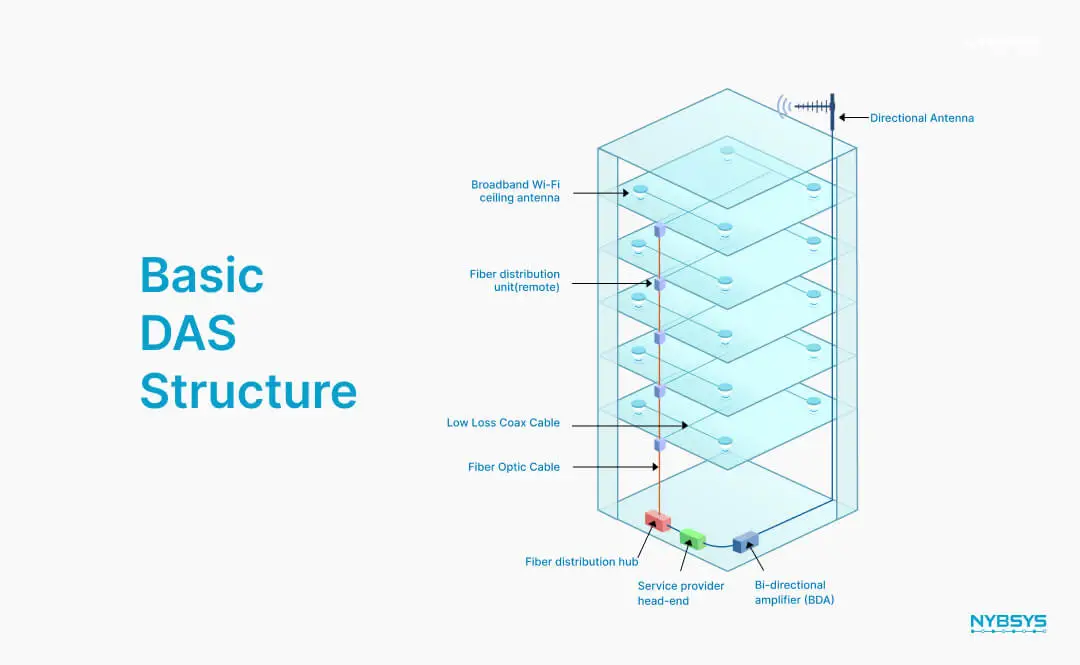
Understanding the architecture of a DAS helps in realizing why it is a superior solution to simple consumer-grade products. A robust DAS network architecture is an engineered system composed of four primary components:
Why do major enterprises invest in commercial DAS systems? The return on investment is clear when you break down the operational improvements.
.png)
Despite the maturity of the technology, there is still confusion in the market about what a DAS actually does. Let us clear up the common myths surrounding mobile signal amplification.
Myth: "DAS Boosts Wi-Fi"
This is the most common mix-up we hear. DAS and Wi-Fi are two different technologies that serve different purposes.Wi-Fi connects devices to your local area network (LAN) for data.A DAS antenna connects devices to the macro cellular network for voice and data. You typically need both for a complete enterprise connectivity strategy.
Myth: "A Simple Booster Can Fix Everything"
We often see facility managers try to solve a 20-story problem with a cheap signal booster from an online retailer. These boosters are designed for small homes or vehicles. They lack the power, filtering, and capacity required for enterprise wireless coverage. Using a consumer booster in a commercial environment can actually cause interference and get your business in trouble with the FCC.
Myth: "DAS is Only for 5G"
DAS is technology-agnostic. While 5G-ready DAS is the current standard, these systems provide the bedrock for 4G LTE, which is still the primary voice network for most carriers. A properly installed DAS improves current voice quality while paving the way for future data speeds.
When looking for coverage improvement systems, it is important to choose the right tool for the job. Here is how DAS stacks up against the alternatives.
DAS vs. Small Cells
Small cells are individual radio access points that emit cellular signals. They are similar to Wi-Fi access points but for cellular networks. Small cells are excellent for adding capacity to specific "hotspots" like a cafeteria or a busy lobby. However, managing a network of hundreds of individual small cells across a large campus can be complex. DAS distributed antenna system architecture creates a single, unified system that is often easier to manage and more efficient for broad, uniform coverage.
DAS vs. Signal Boosters
Signal boosters (repeaters) take an outside signal and amplify it.They are generally passive and relatively inexpensive. They work well for small retail shops or small offices. However, for commercial internet provider standards and enterprise reliability, boosters fall short. They cannot handle high user density and often fail to support multiple carriers effectively without installing multiple separate units. If you need carrier-grade indoor connectivity, DAS is the professional route.
How do you know if it is time to call Metro Wireless for a consultation? If your building fits any of the following criteria, you likely need a DAS antenna system:
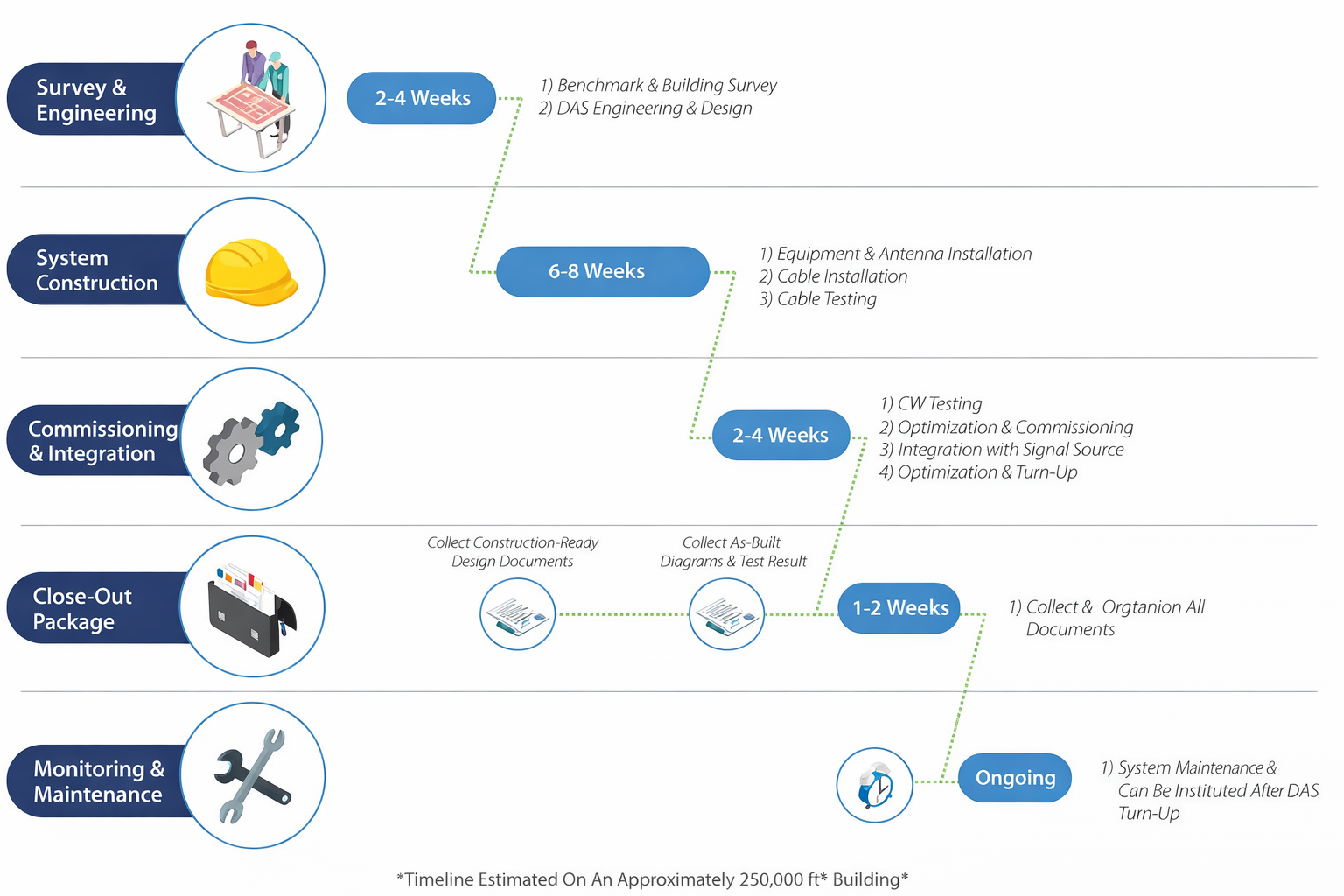
Transparency is key to a successful project. Deploying a DAS is a significant infrastructure project, not a plug-and-play fix.
Carrier Approval and Integration
You cannot just turn on a DAS. Because it broadcasts on licensed frequencies, you must get retransmission agreements from the carriers (AT&T, Verizon, etc.). This can be a bureaucratic process. Experienced providers handle this coordination to ensure your system is compliant and authorized.
Cost and Infrastructure
Active DAS requires cabling, power, and space for the head-end equipment.It is an investment in your property’s value and utility. You need to plan for cable pathways through risers and ceilings, similar to how you would plan for fiber internet cabling.
Future Proofing
Future-proofing is when you need to ensure your system is designed for current needs but ready for future expansion. Installing outdated cabling now will only lead to expensive upgrades later. Working with a forward-thinking partner ensures your wireless signal boosting infrastructure is ready for the next generation of mobile technology.
The wireless landscape is shifting rapidly. The rollout of 5G is the biggest driver for modern DAS adoption.
Higher frequency 5G bands (like mmWave) carry massive amounts of data but have very poor propagation.They can barely penetrate a window, let alone a concrete wall. This makes in-building cellular solutions mandatory for any business that wants to utilize true 5G indoors.
We are also seeing the rise of neutral host DAS utilizing CBRS (Citizens Broadband Radio Service) and private LTE/5G networks.These allow enterprises to own their own wireless networks for secure, high-speed connectivity tailored to automation and robotics.As wireless infrastructure evolves, DAS will remain the backbone of the smart building ecosystem.
A distributed antenna system is more than just a signal booster. It is a critical utility for modern enterprise buildings. It resolves the conflict between modern energy-efficient construction and the need for constant digital connection.
Whether you are looking to improve tenant satisfaction, ensure public safety compliance, or support a fleet of cellular-connected IoT devices, DAS provides the wireless coverage improvement you need.
At Metro Wireless, we specialize in cutting-edge telecom solutions. From fixed wireless and managed internet services to complex indoor DAS deployments, we ensure your business stays connected when it matters most. Do not let your building's walls stand in the way of your business's success.
What is a DAS distributed antenna system?
A DAS is a network of antennas that distributes cellular signals inside large buildings to improve coverage and capacity where outdoor signals cannot reach.
What does a DAS antenna do?
It receives cellular signals from a source and redistributes them to different areas of a building to eliminate dead zones and ensure consistent connectivity.20
Does DAS improve both voice and data connectivity?
Yes. A properly installed DAS improves voice call quality, reduces dropped calls, and significantly increases mobile data speeds for users inside the building.21
Is DAS the same as a signal booster?
No. Signal boosters are typically for small spaces and amplify existing weak signals.22 DAS is a scalable, enterprise-level solution that creates a comprehensive coverage network.23
How much does a DAS system cost?
Costs vary widely based on building size, cabling, antenna count, and carrier requirements.24 It is a custom infrastructure project rather than an off-the-shelf product.
Is DAS required for 5G?
For many buildings, yes. 5G signals, especially high-band frequencies, struggle to penetrate walls. DAS or small cells are often required to fully support indoor 5G coverage.
In the dynamic world of enterprise operations, reliable indoor connectivity is indispensable. A well-engineered DAS system serves as the vital backbone to address the barriers posed by advanced building materials and the demands of emerging 5G technologies.
Metro Wireless excels in providing state-of-the-art wireless systems and comprehensive networking services. If your building is facing issues with inconsistent indoor mobile coverage,
Reach out to Metro Wireless now to discover how a tailored Distributed Antenna System can transform your connectivity hurdles into seamless solutions.

Tyler Hoffman
CEO


