In the contemporary commercial landscape, the expectation for seamless wireless connectivity has transcended "amenity" status to become a fundamental operational utility, arguably as critical as electricity or HVAC. For enterprise leaders, facility managers, and IT directors, the challenge of in-building cellular coverage has evolved from a simple convenience issue to a complex matrix of productivity, safety, and regulatory compliance requirements. That is why DAS Solutions are the way to go for all these issues.
A particularly difficult segment of the real estate market—often termed the "Middleprise"—encompasses commercial buildings ranging from 25,000 to 500,000 square feet. These structures, which include corporate headquarters, hotels, warehouses, and healthcare facilities, find themselves in a technological "no-man's land." They are too large and structurally complex for simple consumer-grade signal boosters (Passive DAS) to be effective, yet they typically lack the multimillion-dollar budgets and carrier relationships required to deploy the massive legacy Active DAS networks found in airports and stadiums.
This report provides an exhaustive technical and strategic analysis of the solution that has emerged to bridge this gap: Active Hybrid DAS. By deconstructing the physics of Radio Frequency (RF) propagation, the limitations of legacy architectures, and the innovations of digital signal processing, we will demonstrate why Active Hybrid DAS represents the superior return on investment (ROI) for the modern enterprise.
The Market Shift: The Rise of the Middleprise and the Retreat of Carriers
To understand the necessity of Active Hybrid DAS, one must first understand the economic shifts in the telecommunications landscape. Historically, the largest wireless carriers—AT&T, Verizon, and T-Mobile—would fund and deploy Distributed Antenna Systems in high-traffic venues. If a building had enough foot traffic, the carrier would pay for the infrastructure to ensure their subscribers had service.
However, the economics of this model have fundamentally changed. As data consumption has exploded and the cost of network densification has risen, carriers have largely retreated from funding in-building solutions for all but the most massive venues (Tier 1 stadiums and airports). This has shifted the financial burden of connectivity squarely onto the building owner or the enterprise tenant.
This shift has created a significant void for the Middleprise. A 200,000-square-foot office building or a distribution center typically does not generate enough carrier revenue to justify a carrier-funded DAS, yet the business operations within these buildings are often critically dependent on mobile connectivity for logistics, communications, and safety.
The "Bring Your Own Device" (BYOD) Complication
Further complicating the landscape is the ubiquity of BYOD policies. An enterprise cannot standardize on a single carrier because its employees, visitors, and contractors bring a mix of devices subscribed to different networks.
A solution that only boosts AT&T, for example, is insufficient if the CEO uses Verizon and the logistics team uses T-Mobile. Therefore, the modern enterprise requirement is a carrier-agnostic, multi-carrier solution that delivers uniform performance regardless of the user's service provider. Learn more about how private cellular networks can support this.
The Physics of Failure: Why Modern Buildings Kill Cellular Signals
The connectivity crisis in commercial real estate is arguably a victim of its own architectural success. The very materials and techniques used to make modern buildings energy-efficient and sustainable are the same materials that destroy Radio Frequency (RF) propagation.
Material Attenuation
RF signals, particularly the higher frequencies used in 4G LTE and 5G, behave like light; they can be blocked, reflected, or absorbed.
Low-E Glass: Low-emissivity glass is coated with microscopic layers of metal to reflect thermal radiation. This metal coating acts as a shield against RF energy, often attenuating (reducing) signals by 30 dB to 40 dB. To put this in perspective, a 3 dB loss represents a halving of signal power. A 30 dB loss means 99.9% of the signal power is blocked before it even enters the building.
Concrete and Steel Construction: Dense core walls, elevator shafts, and steel superstructures create "shadow zones" where macro signals cannot penetrate. This phenomenon is known as the "Faraday Cage" effect, where a conductive enclosure blocks electromagnetic fields.
The Noise Floor and Interference
It is not just about signal strength; it is about signal quality.
Signal-to-Noise Ratio (SNR): A device needs a signal that is significantly stronger than the background RF noise to operate effectively. In urban environments, the noise floor is high. Simply "boosting" a signal (amplifying it) often amplifies the noise as well, resulting in a loud but unintelligible signal—analogous to shouting in a crowded room.
Pilot Pollution: In high-rise buildings, devices on upper floors often have line-of-sight to multiple distant cell towers. The phone receives strong "pilot" signals from too many sources simultaneously, confusing the device and causing it to rapidly switch (handover) between towers. This excessive processing leads to dropped calls, poor data throughput, and rapid battery drain.
A Distributed Antenna System (DAS) solves these physics problems not by fighting the building, but by bypassing it. By capturing the signal source and distributing it via a dedicated internal network, a DAS ensures that the dominant signal comes from inside the building, overwhelming the noise and interference from the outside. See our case studies for real examples.
Architectural Taxonomy: Passive vs. Active vs. Hybrid
Navigating the DAS marketplace requires understanding the three distinct architectures available. Each has a specific use case, cost profile, and performance ceiling.
1. Passive DAS (Analog Signal Boosters)
Passive DAS, often referred to as "cellular repeaters" or "signal boosters," represents the entry-level tier of in-building coverage.
Architecture: A donor antenna on the roof captures the macro signal. It travels via coaxial cable to an amplifier (BDA), and then via more coaxial cable to indoor serving antennas.
Mechanism: Pure analog amplification. The system takes the waveform it hears and makes it louder.
Limitations:
Attenuation over Distance: RF energy degrades rapidly over coaxial cable. Long cable runs result in significant signal loss, limiting the coverage area per amplifier.
Noise Amplification: Because it is analog, it amplifies interference along with the signal, which can degrade data speeds.
Carrier Constraints: While multi-carrier, they cannot easily balance disparate signal strengths. If AT&T is strong outside and Verizon is weak, the amplifier may reduce its power to protect the AT&T network, effectively starving the Verizon signal.
Best Fit: Small offices, retail shops, and homes under 15,000 sq. ft..
2. Legacy Active DAS (Fiber-to-the-Edge)
Legacy Active DAS is the "gold standard" used in stadiums and airports.
Architecture: The signal source is typically a direct feed from the carrier (a Base Transceiver Station or BTS) rather than an off-air antenna. The signal is converted from RF to optical light at a "Head-End" unit, transported over fiber optic cables to Remote Units, and then reconverted to RF.
Mechanism: Optical transport.
Advantages: Fiber allows signals to travel miles without loss. High capacity is possible because it connects directly to the carrier's core network.
Limitations:
Extreme Cost: Requires expensive fiber infrastructure, specialized HVAC, and substantial power at every remote node. Costs can exceed $2-$4 per square foot.
Deployment Time: Requires negotiated retransmission agreements with every carrier, often taking 12-18 months to commission.
Best Fit: Airports, stadiums, convention centers (1M+ sq. ft.).
3. The "Active Hybrid" Evolution
This category creates a middle ground, but it is important to distinguish between "Legacy Hybrid" and "Modern Active Hybrid."
Legacy Hybrid: Used fiber for the vertical riser and coaxial cable for the horizontal runs. It solved the distance problem of passive DAS but retained the signal loss issues of coax on the floor.
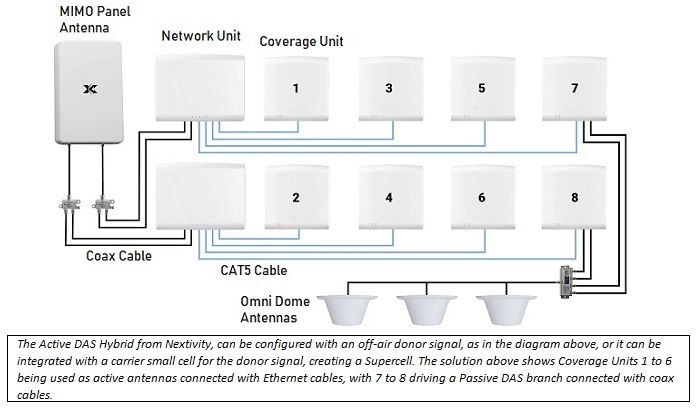
Modern Active Hybrid (The Focus of this Report): Systems like the Nextivity Cel-Fi QUATRA. These systems digitize the RF signal and transport it over standard Ethernet (Cat5e/6) cabling using Power over Ethernet (PoE). This architecture is the game-changer for the Middleprise.Compare it to private LTE vs 5G.
Architectural Taxonomy: Passive vs. Active vs. Hybrid
The Technological Breakthrough: Active Hybrid DAS
Active Hybrid DAS fundamentally alters the economics and performance of enterprise connectivity by leveraging IT infrastructure rather than proprietary RF infrastructure.
The Digital Backbone
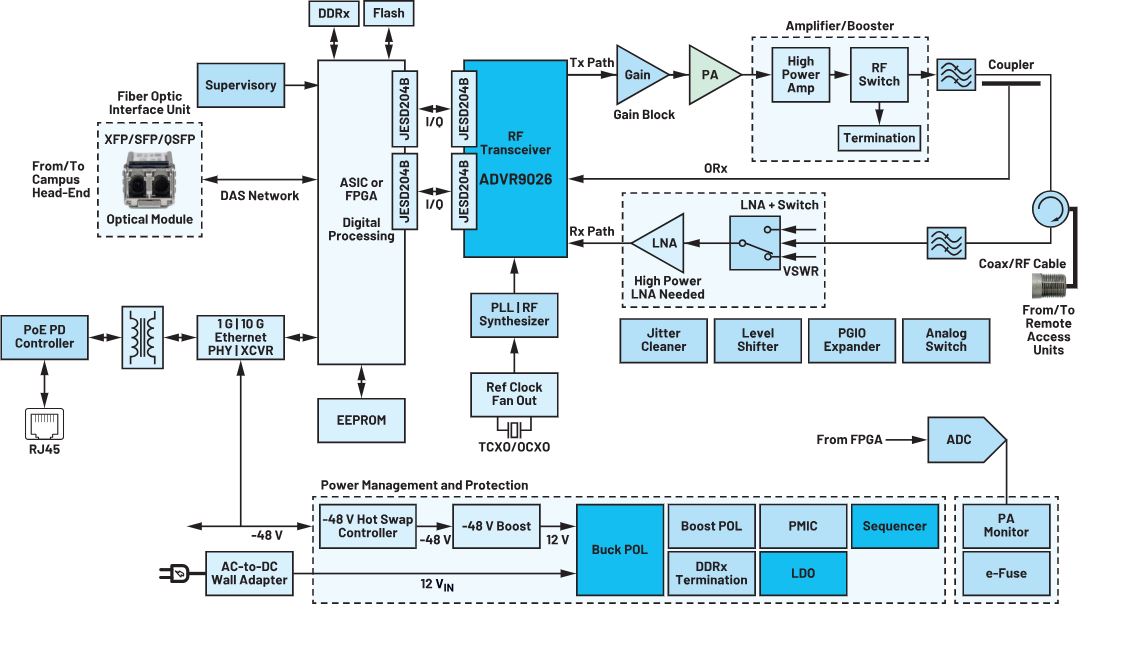
Unlike passive systems that push analog waves through copper (coax), Active Hybrid systems digitize the signal at the Network Unit (NU).
The Intelliboost Processor: At the heart of systems like the Cel-Fi QUATRA is a sophisticated baseband processor. This chip analyzes the incoming cellular signal, separates the carrier traffic from the background noise, and digitizes the clean signal into data packets.
Lossless Transport: Once digitized, the signal can be transmitted over Ethernet cable without any degradation. Whether the cable is 10 feet or 300 feet long, the signal arriving at the remote unit is identical to the signal that left the head-end. This eliminates the "slope" calculations and complex engineering required for coaxial systems.
Intelligent Edge and Self-Optimization
The Remote Units (Coverage Units) in an Active Hybrid system are not "dumb" antennas; they are active edge devices.
Echo Cancellation: One of the biggest risks in DAS is oscillation (feedback loops), where the indoor antenna talks back to the outdoor antenna. Active Hybrid systems use real-time echo cancellation algorithms to detect and neutralize feedback, allowing them to operate at much higher gains (up to 100 dB) than passive systems (capped at 70 dB by FCC rules).
Automatic Gain Control (AGC): The system continuously monitors the macro network. If a cell tower breathes (adjusts its power), the DAS adjusts automatically to maintain the optimal coverage footprint without interfering with the carrier network.
Carrier-Grade Reliability for the Enterprise
Because these systems are digital and intelligent, they are classified differently by the FCC and carriers. They are "unconditionally network safe," meaning they do not generate noise that harms the carrier's tower. This allows for a streamlined approval process ("Carrier Pre-Approval"), bypassing the months of negotiation required for legacy Active DAS.
Feature
Passive DAS
Legacy Active DAS
Active Hybrid DAS
Primary Cabling
Coaxial (RG6/LMR400)
Fiber Optic
Cat5e / Cat6 Ethernet
Max System Gain
~70 dB
Variable
~100 dB (1000x stronger)
Signal Transport
Analog (Lossy)
Optical (Lossless)
Digital (Lossless)
Installation
Low Voltage
Specialized Fiber
Standard IT / Low Voltage
Carrier Approval
Not Required (Registration only)
Mandatory (Complex)
Pre-Approved (Streamlined)
Cost Profile
$
$$$$
$$
The Technological Breakthrough: Active Hybrid DAS
Technical Deep Dive: Digital Electricity and Ethernet Backhaul
For larger Middleprise deployments, particularly those stretching across expansive campuses or high-rise towers, Active Hybrid DAS introduces innovations in power and data delivery that solve the "distance limit" of standard Ethernet.
The Challenge of Power
Standard Power over Ethernet (PoE) is limited by the resistance of the cable, typically capping reliable power delivery at 100 meters (328 feet). In a 500,000 sq. ft. warehouse, this is insufficient.
The Solution: Digital Electricity
Active Hybrid DAS platforms often integrate with Digital Electricity™ (DE), a technology pioneered by VoltServer.
Packetized Energy: DE breaks electricity into minute packets. It sends a packet of energy, checks for safety (short circuit, person touching the wire), and then sends another. This happens thousands of times per second.
Safety and Range: Because the energy is packetized, it is "touch-safe." It can be run on standard low-voltage wiring without conduit, yet it can carry high wattage (up to 2kW) over extremely long distances (up to 2km), far exceeding the limits of PoE.
Application: This allows Metro Wireless to place Coverage Units deep inside a facility, thousands of feet from the head-end, powering them remotely without needing to hire licensed electricians to install AC outlets at every antenna location. This dramatically lowers the total cost of installation.
Structured Cabling Advantages
By utilizing Cat5e or Cat6 cabling, Active Hybrid DAS aligns with the existing skill sets of enterprise IT teams.
Synergy: The same cable trays and pathways used for Wi-Fi access points and security cameras can be used for the DAS.
Future Proofing: If the system needs to be moved or upgraded, the cabling infrastructure is standard and reusable, unlike the heavy, rigid coaxial cable used in passive systems. Discover how to deploy private 5G for similar benefits.
The 5G Imperative: Preparing for mmWave and C-Band
The transition to 5G is not merely a speed upgrade; it is a fundamental change in frequency physics that renders many legacy DAS systems obsolete.
The 5G Spectrum Trinity
5G operates in three bands, each with unique propagation characteristics:
Low-Band (Sub-1 GHz): Great coverage, 4G-like speeds. Penetrates walls well.
Mid-Band (C-Band, 3.5 GHz): The "Goldilocks" band offering high speed and decent coverage. However, it penetrates buildings poorly compared to low-band.
High-Band (mmWave, 24 GHz+): Ultra-fast speeds but effectively blocked by any obstruction, including standard glass and drywall.
Active Hybrid Readiness
Legacy passive systems often struggle with C-Band frequencies due to the high attenuation of coaxial cable at 3.5 GHz.
Software-Defined Radios: Active Hybrid units like the Cel-Fi QUATRA 4000 are built with 5G in mind. Through software updates (like the recent update enabling 5G NR), these systems can reconfigure their internal radios to support new 5G bands as carriers roll them out.
Architecture for C-Band: The digital transport of Active Hybrid DAS is frequency-independent. As long as the radio head can receive the C-Band signal, the Ethernet cable can transport the data packet representing that signal without the severe losses that coaxial cable would suffer at those frequencies.Compare private cellular vs Wi-Fi for related insights.
The Future of mmWave
While mmWave is currently limited to stadiums and outdoor urban canyons due to its poor propagation, Active Hybrid systems are evolving to support it via dedicated mmWave nodes that can be plugged into the existing Ethernet backbone, allowing for surgical capacity upgrades in high-density areas like cafeterias or auditoriums.
Public Safety DAS: ERRCS, NFPA Compliance, and Liability
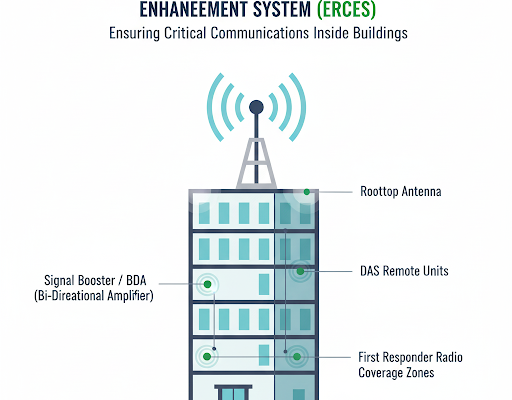
While commercial DAS focuses on productivity, Public Safety DAS is a matter of life, death, and legal liability. It is critical for building owners to understand that these are two separate systems with distinct code requirements.
Emergency Responder Radio Communication Systems (ERRCS)
When first responders enter a building during a fire or emergency, their radios must work. If the building materials block their radio signals (usually on 700/800 MHz or VHF/UHF bands), they cannot communicate with each other or the command post. This failure can lead to tragedy.
Regulatory Codes: NFPA and IFC
Most jurisdictions enforce codes based on the National Fire Protection Association (NFPA) and the International Fire Code (IFC).
NFPA 72 / NFPA 1221 / NFPA 1225: These standards dictate the performance of the system.
IFC Section 510: Often adopted by local fire marshals, requiring specific coverage levels.
Critical Requirements for Public Safety DAS
A commercial DAS generally cannot serve as a Public Safety DAS because it lacks the required hardening:
Coverage Mandates: Codes typically require 99% coverage in critical areas (stairwells, elevators, pump rooms, command centers) and 90-95% in general areas.
Survivability: The system must be housed in NEMA-4 (water/dust proof) enclosures to survive sprinkler activation.
Battery Backup: The system must have dedicated battery backup capable of running the system for 12 to 24 hours during a full power outage.
Monitoring: The system must be connected to the building's fire alarm panel, triggering specific alerts for DAS malfunction, antenna failure, or low battery.
Signal Source: Unlike commercial DAS which might use a roof antenna, Public Safety DAS must often be tuned to specific frequencies assigned by the local Authority Having Jurisdiction (AHJ).
Metro Wireless Expertise: We specialize in the "Grid Testing" required to certify these systems. Our engineers walk the building in a grid pattern, measuring signal strength in every zone to generate the pass/fail report required by the Fire Marshal for the Certificate of Occupancy. Explore private LTE networks for campus applications.
Critical Requirements for Public Safety DAS
Metro Wireless Methodology: The 4-Phase Design Lifecycle
Deploying an Active Hybrid DAS is not a "plug and play" operation; it is a systems engineering project. Metro Wireless employs a rigorous 4-phase methodology to ensure performance guarantees.
RF Analysis: Technicians use spectrum analyzers to measure the macro signal environment. We determine which carriers are weak, the noise floor, and the dominant server (tower).
Structural Review: We analyze blueprints to identify cable pathways, IDFs (Intermediate Distribution Frames), and structural barriers (firewalls, elevator cores).
Outcome: A feasibility report recommending the exact architecture (Active Hybrid vs. Passive) and a budgetary estimate.
Phase 2: Predictive Design (iBwave)
We utilize iBwave, the industry-standard software for in-building wireless design.
3D Modeling: We build a digital twin of your facility, defining wall materials (concrete vs. drywall) and floor layouts.
Propagation Simulation: We simulate the placement of Coverage Units and antennas. The software calculates exactly how the signal will propagate, predicting signal strength (RSRP) and quality (SINR) in every room.
Heat Maps: You receive visual heat maps showing the "Before" and predicted "After" coverage, providing a data-driven guarantee of performance.
Phase 3: Strategic Installation
Our certified installation teams deploy the infrastructure with minimal disruption to your operations. For a step-by-step breakdown, check out how we install a DAS project.
Cabling: We run the Cat5e/6 or Fiber backbone, adhering to all plenum and fire-stopping codes.
Hardware: Network Units are rack-mounted in the server room (MDF); Coverage Units are mounted in the ceiling, often blending with Wi-Fi APs or light fixtures.
Antennas: We utilize "omni" antennas for open areas and "panel" antennas for focused coverage in corridors or problem zones.
Phase 4: Commissioning and Cloud Monitoring
Once the hardware is live, the system is "commissioned."
Optimization: We fine-tune the gain and echo-cancellation settings for each carrier.
Grid Testing: We perform a post-install walk test to validate that the real-world coverage matches the iBwave model.
NOC Integration: The system is connected to the Metro Wireless Network Operations Center (NOC). Via the Nextivity WAVEportal monitoring, we check the system 24/7. We can see if a unit goes offline or if a carrier changes their frequency, often resolving issues remotely before you notice a service interruption.
Financial Analysis: CapEx, OpEx, and ROI
For the CFO, the decision to invest in Active Hybrid DAS is driven by ROI.
Cost Per Square Foot Analysis
Passive DAS: Low CapEx ($0.50 - $0.80/sq ft), but often fails to deliver reliable data speeds in large buildings, leading to sunk costs.
Legacy Active DAS: Extremely high CapEx ($2.00 - $4.00+/sq ft), high OpEx (power/cooling), and long deployment times.
Active Hybrid DAS: Moderate CapEx ($1.00 - $1.50/sq ft). The use of standard Ethernet cabling and PoE significantly reduces labor and electrical costs, placing it in the "sweet spot" for the Middleprise.
Operational Expenditure (OpEx) Savings
Active Hybrid systems consume significantly less power than legacy active systems. Furthermore, the ability to monitor and troubleshoot remotely via the cloud reduces truck rolls and maintenance contracts.
ROI Factors
Productivity: Eliminating dead zones recovers man-hours. If 100 employees lose 10 minutes a week to dropped calls or slow loading, the productivity loss is massive over a year.
Tenant Retention: In commercial real estate, connectivity is a top 3 factor for lease renewal. A building with certified "5-bar" coverage commands higher rents and lower vacancy.
Safety and Liability: Ensuring E911 calls can be made from anywhere in the building is a critical risk mitigation strategy. Read about the business case for private wireless.
Strategic Recommendations
The era of relying on outside cell towers to penetrate modern energy-efficient buildings is over. For the Middleprise, the choice of connectivity infrastructure is a strategic decision that impacts operational efficiency, tenant satisfaction, and safety.
Active Hybrid DAS has emerged as the definitive solution. By digitizing the signal, utilizing standard IT infrastructure, and offering carrier-grade intelligence at an enterprise price point, it resolves the technical and economic contradictions that have plagued this market sector for years.Understand fixed wireless internet as a complementary option.
Strategic Recommendations for Enterprise Leaders:
Audit Your RF Environment: Don't guess. Use a professional site survey to document your current coverage gaps.
Prioritize 5G Readiness: Ensure any system you deploy today is capable of supporting C-Band and future 5G frequencies via software upgrades.
Separate Church and State: distinct systems are required for Commercial Cellular (productivity) and Public Safety (compliance). Do not conflate the two budgets or designs.
Partner for Lifecycle Management: Connectivity is not a one-time install. Select a partner like Metro Wireless that offers end-to-end design, installation, and 24/7 monitoring. Learn about network as a service.
Frequently Asked Questions (FAQ)
What is the difference between a signal booster and Active Hybrid DAS?
A "signal booster" (Passive DAS) typically uses analog technology that amplifies both the signal and the background noise. It struggles with long cable runs in large buildings. Active Hybrid DAS uses digital processors to clean the signal before amplifying it and uses Ethernet cabling to transport the signal without loss, making it suitable for much larger enterprise environments (up to 500k sq. ft.).
How much does Active Hybrid DAS cost?
While every building is unique, Active Hybrid DAS typically ranges from $1.00 to $1.50 per square foot for a turnkey solution (hardware + installation). This is significantly more affordable than legacy Active DAS (fiber-based), which can cost upwards of $3.00 per square foot, and offers a far better ROI than passive systems that may fail to penetrate the core of your building.
Does Active Hybrid DAS support 5G?
Yes. Systems like the Cel-Fi QUATRA are designed with 5G architecture. They support current 5G Dynamic Spectrum Sharing (DSS) technologies and are capable of being upgraded via software to support new bands as carriers release them. This makes your investment future-proof compared to analog systems that are locked to specific frequencies.
Can I use the same DAS for Public Safety and Commercial Cellular?
Generally, no. Public Safety DAS (ERRCS) has distinct and rigorous code requirements (NFPA 72/1221), including red NEMA-4 enclosures, dedicated battery backup for 12-24 hours, and specific alarm panel integrations. While the technologies are similar, the regulatory compliance standards require separate infrastructure to ensure liability protection and occupancy certification.
How long does installation take?
Because Active Hybrid DAS utilizes standard IT infrastructure (Cat5e/6 cabling) rather than specialized heavy-gauge coaxial or fiber welding, deployment is rapid. A typical 100,000 sq. ft. facility can often be fully installed and commissioned in 2 to 3 weeks, whereas legacy Active DAS systems can take months of construction and carrier negotiation.
Take Control of Your Connectivity
Is your building ready for the future of work? Don't let dead zones dictate your productivity.
Metro Wireless is the leader in Active Hybrid DAS integration. Our team of engineers is ready to analyze your floor plans, evaluate your signal environment, and design a custom solution that fits your budget and performance goals.Explore our fixed wireless solutions today.
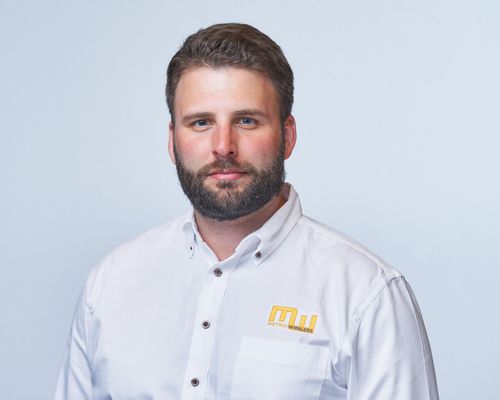
Tyler Hoffman serves as the owner and CEO of Metro Wireless, a Detroit-MI based company that delivers better commercial connectivity via wireless solutions to a national client base. He lives in Detroit and holds an MBA from Kellogg @ Northwestern University, and a BBA from Ross @ University of Michigan. His guilty pleasures include craft beer and horror films.
.jpg)